Technical Specifications
| Brand | Audi |
| Model | A4 |
| Generation | A4 Avant (B9 8W) |
| Type (Engine) | g-tron 2.0 TFSI (170 Hp) S tronic |
| Start of production | 2017 |
| End of production | 2018 |
| Powertrain Architecture | Internal Combustion engine |
| Body type | Station wagon (estate) |
| Seats | 5 |
| Doors | 5 |
| Fuel consumption (economy) – urban | 7.1-7.5 l/100 km (33.1 – 31.4 US mpg, 39.8 – 37.7 UK mpg, 14.1 – 13.3 km/l) |
| Fuel consumption (economy) – urban (CNG) | 5.1-5.3 kg/100 km |
| Fuel consumption (economy) – extra urban | 4.6-5.2 l/100 km (51.1 – 45.2 US mpg, 61.4 – 54.3 UK mpg, 21.7 – 19.2 km/l) |
| Fuel consumption (economy) – extra urban (CNG) | 3.1-3.5 kg/100 km |
| Fuel consumption (economy) – combined | 5.5-6 l/100 km (42.8 – 39.2 US mpg, 51.4 – 47.1 UK mpg, 18.2 – 16.7 km/l) |
| Fuel consumption (economy) – combined (CNG) | 3.8-4.2 kg/100 km |
| CO2 emissions | 126-137 g/km |
| CO2 emissions (CNG) | 102-111 g/km |
| Fuel Type | Petrol / CNG |
| Acceleration 0 – 100 km/h | 8.4 sec |
| Acceleration 0 – 62 mph | 8.4 sec |
| Acceleration 0 – 60 mph | 8 sec (Calculated) |
| Maximum speed | 221 km/h (137.32 mph) |
| Emission standard | Euro 6 |
| Weight-to-power ratio | 9.4 kg/Hp, 106.6 Hp/tonne |
| Weight-to-torque ratio | 5.9 kg/Nm, 169.3 Nm/tonne |
| Power | 170 Hp @ 4450-6000 rpm |
| Power per litre | 85.7 Hp/l |
| Torque | 270 Nm @ 1650-4400 rpm (199.14 lb.-ft. @ 1650-4400 rpm) |
| Engine layout | Front, Longitudinal |
| Engine Model/Code | EA888 / CVLA |
| Engine displacement | 1984 cm3 (121.07 cu. in.) |
| Number of cylinders | 4 |
| Engine configuration | Inline |
| Cylinder Bore | 82.5 mm (3.25 in.) |
| Piston Stroke | 92.8 mm (3.65 in.) |
| Number of valves per cylinder | 4 |
| Fuel injection system | Direct injection and Multi-port manifold injection |
| Engine aspiration | Turbocharger, Intercooler |
| Valvetrain | DOHC |
| Engine oil capacity | 5.2 l (5.49 US qt | 4.58 UK qt) |
| Kerb Weight | 1595 kg (3516.37 lbs.) |
| Max. weight | 2135 kg (4706.87 lbs.) |
| Max load | 540 kg (1190.5 lbs.) |
| Trunk (boot) space – minimum | 415 l (14.66 cu. ft.) |
| Trunk (boot) space – maximum | 1415 l (49.97 cu. ft.) |
| Fuel tank capacity | 25 l (6.6 US gal | 5.5 UK gal) |
| CNG cylinder capacity | 19 kg |
| Max. roof load | 90 kg (198.42 lbs.) |
| Permitted trailer load with brakes (8%) | 1700 kg (3747.86 lbs.) |
| Permitted trailer load with brakes (12%) | 1500 kg (3306.93 lbs.) |
| Permitted trailer load without brakes | 750 kg (1653.47 lbs.) |
| Permitted towbar download | 80 kg (176.37 lbs.) |
| Length | 4725 mm (186.02 in.) |
| Width | 1842 mm (72.52 in.) |
| Width including mirrors | 2022 mm (79.61 in.) |
| Height | 1442 mm (56.77 in.) |
| Wheelbase | 2818 mm (110.94 in.) |
| Front track | 1572 mm (61.89 in.) |
| Rear (Back) track | 1553 mm (61.14 in.) |
| Front overhang | 880 mm (34.65 in.) |
| Rear overhang | 1027 mm (40.43 in.) |
| Minimum turning circle | 11.6 m (38.06 ft.) |
| Drivetrain Architecture | ICE drives front wheels |
| Drive wheel | Front wheel drive |
| Number of gears and type of gearbox | 7 gears, automatic transmission S tronic |
| Front suspension | Independent multi-link suspension, Transverse stabilizer |
| Rear suspension | Independent multi-link spring suspension with stabilizer |
| Front brakes | Ventilated discs |
| Rear brakes | Disc |
| Assisting systems | ABS (Anti-lock braking system) |
| Steering type | Steering rack and pinion |
| Power steering | Electric Steering |
| Tires size | 205/60 R16; 225/50 R17 |
| Wheel rims size | 7J x 16; 7.5J x 17 |
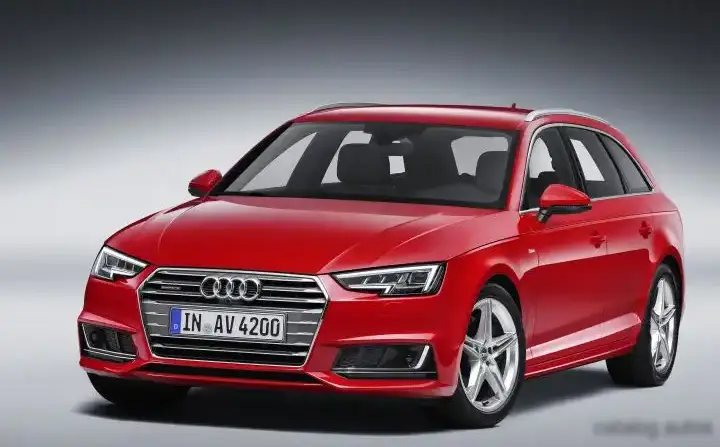
The Audi A4 Avant (B9 8W) g-tron 2.0 TFSI S tronic, launched in 2017 and discontinued in 2018, was a station wagon variant of Audi’s popular A4 model, specifically engineered to run on both gasoline and Compressed Natural Gas (CNG). Built on the Volkswagen Group’s MLB Evo platform (1HX0/A3), it aimed to provide a more sustainable alternative to traditional gasoline-powered vehicles, particularly in European countries with well-developed CNG infrastructure. This model represented Audi’s commitment to exploring alternative fuels and reducing its fleet’s overall carbon footprint. The g-tron variant was positioned as a mid-range option, offering a blend of efficiency, practicality, and a degree of performance not typically associated with alternative fuel vehicles.
Powertrain & Engine Architecture
At the heart of the A4 Avant g-tron lies the EA888 2.0-liter turbocharged four-cylinder gasoline engine, specifically the CVLA engine code. This engine is a direct-injection unit, utilizing both direct injection and multi-port manifold injection for optimized combustion efficiency. The engine produces 170 horsepower at 4450-6000 rpm and 270 Nm (199.14 lb.-ft.) of torque between 1650 and 4400 rpm. The key difference from standard A4 2.0 TFSI models is the addition of a CNG conversion system. This system allows the vehicle to run primarily on CNG, switching to gasoline automatically when the CNG tank is depleted. The engine management system seamlessly handles the transition between fuels. The S tronic 7-speed dual-clutch transmission provides quick and smooth gear changes, contributing to both performance and fuel efficiency. This transmission features a relatively short final drive ratio, optimized for both CNG and gasoline operation.
Driving Characteristics
The driving experience in the A4 Avant g-tron 2.0 TFSI S tronic is surprisingly engaging. While 170 hp isn’t a massive amount of power, the readily available torque from the turbocharged engine and the quick-shifting S tronic transmission provide brisk acceleration. The 0-60 mph sprint takes around 8 seconds, and the car feels responsive in everyday driving situations. When running on CNG, there’s a slight reduction in power compared to gasoline mode, but it’s generally not noticeable during normal driving. The S tronic transmission’s gear ratios are well-suited to the engine’s characteristics, providing ample power for overtaking and highway cruising. Compared to the more powerful A4 variants (like the 2.0 TFSI quattro with 252 hp), the g-tron prioritizes efficiency over outright performance. It also feels more refined than the lower-powered 1.4 TFSI models.
Equipment & Trim Levels
The A4 Avant g-tron typically came with a generous level of standard equipment, reflecting its position as a mid-range offering. Standard features included Audi’s MMI infotainment system with a 7-inch display, automatic climate control, power windows and mirrors, and a leather-wrapped steering wheel. Safety features such as ABS, electronic stability control, and multiple airbags were also standard. Optional extras included a larger MMI display, navigation system, upgraded sound system, panoramic sunroof, and various driver assistance systems like adaptive cruise control and lane departure warning. Interior upholstery was typically cloth or a combination of cloth and leatherette, with options for full leather available at an extra cost. Trim levels varied slightly depending on the market, but generally followed Audi’s standard ‘SE’, ‘Sport’, and ‘S line’ designations.
Chassis & Braking
The A4 Avant g-tron utilizes a fully independent suspension system, with a multi-link setup at both the front and rear. This provides a comfortable ride quality and good handling characteristics. The front suspension incorporates a transverse stabilizer bar to reduce body roll during cornering. The braking system consists of ventilated discs at the front and solid discs at the rear, providing ample stopping power. ABS (Anti-lock Braking System) is standard, enhancing safety in emergency braking situations. The g-tron variant’s weight (approximately 1595 kg / 3516.37 lbs) is comparable to other A4 Avant models, and the suspension is tuned to accommodate this weight effectively. Stabilizer bar thickness is typical for this class of vehicle.
Market Reception & Comparison
The Audi A4 Avant g-tron was generally well-received by critics, who praised its fuel efficiency, comfortable ride, and refined driving experience. However, its limited availability and the relatively underdeveloped CNG infrastructure in many regions hampered its widespread adoption. Compared to the standard A4 Avant 2.0 TFSI, the g-tron offered comparable performance but with significantly lower CO2 emissions when running on CNG. Fuel economy was also notably better when utilizing CNG. Compared to the diesel-powered A4 variants (like the 2.0 TDI), the g-tron offered a quieter and smoother driving experience, but typically didn’t match the TDI’s fuel economy on long journeys. Reliability has proven to be generally good, with the EA888 engine being a well-established and robust unit.
Legacy
The Audi A4 Avant g-tron represents an interesting chapter in Audi’s exploration of alternative fuel technologies. While production was limited, it demonstrated the feasibility of combining natural gas power with a premium vehicle platform. In the used car market, the g-tron variant typically commands a slightly lower price than comparable gasoline-powered A4 Avants, reflecting the niche appeal and the need for access to CNG refueling stations. However, for buyers in regions with established CNG infrastructure, the g-tron offers a compelling combination of efficiency, practicality, and environmental responsibility. The powertrain has proven to be relatively reliable, and parts availability remains good, making it a viable option for those seeking a unique and sustainable vehicle.