Technical Specifications
| Brand | Audi |
| Model | A4 |
| Generation | A4 (B5, Typ 8D) |
| Type (Engine) | 1.8 20V (125 Hp) Automatic |
| Start of production | November, 1994 |
| End of production | 1999 |
| Powertrain Architecture | Internal Combustion engine |
| Body type | Sedan |
| Seats | 5 |
| Doors | 4 |
| Fuel consumption (urban) | 12.3 l/100 km (19.1 US mpg, 23 UK mpg, 8.1 km/l) |
| Fuel consumption (extra urban) | 7 l/100 km (33.6 US mpg, 40.4 UK mpg, 14.3 km/l) |
| Fuel consumption (combined) | 7.8 l/100 km (30.2 US mpg, 36.2 UK mpg, 12.8 km/l) |
| Fuel Type | Petrol (Gasoline) |
| Acceleration 0 – 100 km/h | 12.3 sec |
| Acceleration 0 – 62 mph | 12.3 sec |
| Acceleration 0 – 60 mph | 11.7 sec |
| Maximum speed | 200 km/h (124.27 mph) |
| Weight-to-power ratio | 9.9 kg/Hp, 100.8 Hp/tonne |
| Weight-to-torque ratio | 7.2 kg/Nm, 139.5 Nm/tonne |
| Power | 125 Hp @ 5800 rpm |
| Power per litre | 70.2 Hp/l |
| Torque | 173 Nm @ 3950 rpm (127.6 lb.-ft. @ 3950 rpm) |
| Engine layout | Front, Longitudinal |
| Engine Model/Code | ADR, ARG |
| Engine displacement | 1781 cm3 (108.68 cu. in.) |
| Number of cylinders | 4 |
| Engine configuration | Inline |
| Cylinder Bore | 81 mm (3.19 in.) |
| Piston Stroke | 86.4 mm (3.4 in.) |
| Compression ratio | 10.3:1 |
| Number of valves per cylinder | 5 |
| Fuel injection system | Multi-port manifold injection |
| Engine aspiration | Naturally aspirated engine |
| Valvetrain | DOHC |
| Engine oil capacity | 3.5 l (3.7 US qt | 3.08 UK qt) |
| Coolant | 6.5 l (6.87 US qt | 5.72 UK qt) |
| Kerb Weight | 1240 kg (2733.73 lbs.) |
| Max. weight | 1790 kg (3946.27 lbs.) |
| Max load | 550 kg (1212.54 lbs.) |
| Trunk (boot) space – minimum | 440 l (15.54 cu. ft.) |
| Fuel tank capacity | 62 l (16.38 US gal | 13.64 UK gal) |
| Length | 4479 mm (176.34 in.) |
| Width | 1733 mm (68.23 in.) |
| Height | 1415 mm (55.71 in.) |
| Wheelbase | 2617 mm (103.03 in.) |
| Front track | 1498 mm (58.98 in.) |
| Rear (Back) track | 1479 mm (58.23 in.) |
| Drag coefficient (Cd) | 0.31 |
| Minimum turning circle | 11.1 m (36.42 ft.) |
| Drivetrain Architecture | The Internal combustion engine (ICE) drives the front wheels of the vehicle. |
| Drive wheel | Front wheel drive |
| Number of gears and type of gearbox | 4 gears, automatic transmission |
| Front suspension | Wishbone |
| Rear suspension | Suspension with traction connecting levers |
| Front brakes | Disc |
| Rear brakes | Disc |
| Assisting systems | ABS (Anti-lock braking system) |
| Steering type | Steering rack and pinion |
| Power steering | Hydraulic Steering |
| Tires size | 195/65 R15 |
| Wheel rims size | 15 |
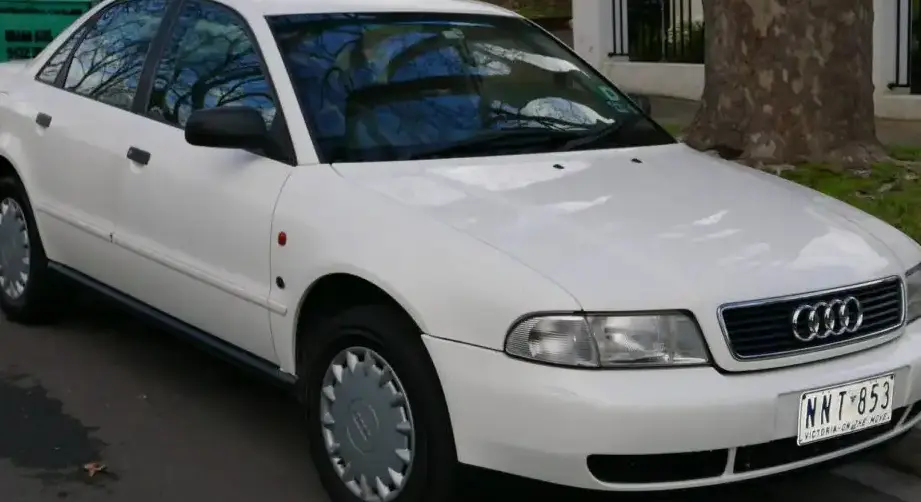
The Audi A4 (B5), produced from November 1994 to 1999, marked a pivotal moment for Audi, solidifying its position as a serious contender in the competitive compact executive car segment. The Typ 8D chassis, as it was known internally, represented a complete departure from the aging Audi 80. Among the diverse range of engine and transmission options, the 1.8-liter 20-valve inline-four cylinder engine coupled with a four-speed automatic transmission proved particularly popular in markets where driving ease and comfort were highly valued. This variant occupied a middle-ground position within the A4 lineup, offering a compelling balance between performance and affordability, positioned below the more potent 2.8-liter V6 and the fuel-conscious TDI diesel models.
Powertrain & Engine Architecture
At the core of this A4 variant lies the 1.8-liter (1781cc) inline-four cylinder engine, identified by engine codes ADR and ARG. This engine belongs to the Volkswagen Group’s EA827 engine family, renowned for its relatively lightweight design and overall refinement. It boasts a dual overhead camshaft (DOHC) configuration with five valves per cylinder, enhancing airflow and contributing to improved high-rpm power. Fuel delivery is managed by a Bosch Motronic multi-port fuel injection system, optimizing fuel atomization and combustion efficiency. The engine’s 20 valves, combined with a compression ratio of 10.3:1, yielded a respectable 125 horsepower at 5800 rpm and 127.6 lb-ft of torque at 3950 rpm. The four-speed automatic transmission, typically the 5HP19, was a conventional hydraulic automatic, prioritizing smooth gear changes over the efficiency and responsiveness found in more modern transmissions. It was selected to appeal to drivers who favored a relaxed and comfortable driving experience.
Driving Characteristics
The 1.8L automatic A4 delivered a comfortable and predictable driving experience. Acceleration from 0-60 mph took approximately 11.7 seconds, which was sufficient for everyday commuting but noticeably slower than the manual transmission versions or the more powerful 2.8 V6. The automatic transmission’s gear ratios were tuned for fuel economy and smooth cruising, rather than outright performance. While the engine provided adequate power for highway merging and overtaking, it required a firm press of the accelerator. The automatic transmission could occasionally feel hesitant during quick downshifts, and lacked the engine braking control offered by a manual gearbox. The front-wheel-drive configuration provided good traction in most conditions, but some torque steer could be detected during hard acceleration.
Equipment & Trim Levels
The 1.8-liter automatic A4 generally came equipped with a reasonable array of standard features. These included power windows, power door locks, air conditioning, and an AM/FM radio. Interior upholstery was typically cloth, with optional leather upgrades available at an additional cost. Dashboard trim was commonly woodgrain or a metallic finish. Optional extras included a sunroof, upgraded audio systems, alloy wheels, and heated front seats. The specific trim level often determined the level of standard equipment, with higher trims offering more luxurious appointments.
Chassis & Braking
The B5 A4 featured an independent front suspension with wishbones and a semi-independent rear suspension utilizing trailing arms. This setup provided a good compromise between ride comfort and handling. The 1.8L models typically used disc brakes on all four wheels, providing adequate stopping power. An Anti-lock Braking System (ABS) was standard, enhancing safety and control during emergency braking. Stabilizer bars were fitted to both the front and rear axles to minimize body roll during cornering. The suspension tuning was generally softer than that of the sportier V6 models, prioritizing ride comfort over aggressive handling.
Market Reception & Comparison
The 1.8-liter automatic A4 was generally well-received by automotive critics as a practical and comfortable daily driver. It offered a good balance of features and affordability, making it a popular choice for families and commuters. However, it was often criticized for its relatively slow acceleration and the somewhat sluggish response of the automatic transmission. Compared to the 2.8-liter V6, the 1.8L offered significantly less power and performance, but it was more fuel-efficient and less expensive to maintain. The TDI diesel models offered even better fuel economy, but at the expense of refinement and performance. The 1.8L automatic was often considered the “sweet spot” for buyers seeking a comfortable and reliable A4 without a substantial financial outlay.
Legacy
The 1.8-liter engine and four-speed automatic transmission combination proved to be reasonably reliable, provided regular maintenance was performed. Common issues include oil leaks, particularly from the valve cover gasket, and occasional transmission slippage. While durable, the automatic transmission isn’t known for exceptional longevity when subjected to aggressive driving or neglected maintenance. Today, these A4s are gaining popularity among enthusiasts and collectors, offering a blend of classic Audi styling and modern convenience. Well-maintained examples can still provide years of dependable service, and parts availability remains good. The B5 A4, particularly the 1.8L variants, established Audi as a significant player in the premium compact car market and laid the groundwork for the brand’s continued success.