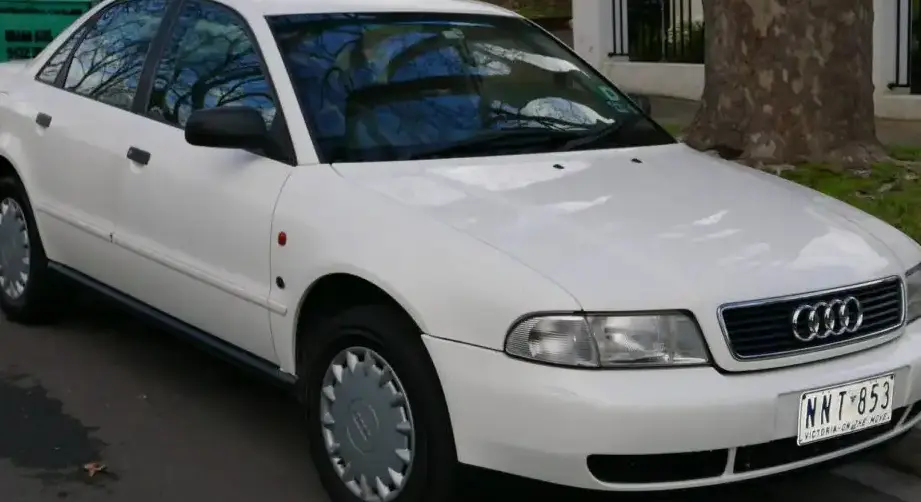
The Audi A4 (B5), produced from 1995 to 1999, represented a significant step forward for Audi, establishing a new benchmark in the compact executive car segment. The 1.8 20V Turbo variant, powered by the engine codes AEB, ANB, APU, ARK, and AWT, was a cornerstone of the B5 A4 lineup, offering a compelling blend of performance, refinement, and affordability. Positioned as a mid-range offering, it sat between the base 1.6-liter models and the more potent 2.6-liter V6 and TDI diesel options. This model was crucial in establishing the A4’s reputation in both European and North American markets, appealing to buyers seeking a premium driving experience without the higher price tag of the flagship models.
Technical Specifications
| Brand | Audi |
| Model | A4 |
| Generation | A4 (B5, Typ 8D) |
| Type (Engine) | 1.8 20V Turbo (150 Hp) |
| Start of production | February, 1995 |
| End of production | 1999 |
| Powertrain Architecture | Internal Combustion engine |
| Body type | Sedan |
| Seats | 5 |
| Doors | 4 |
| Fuel consumption (urban) | 11.1 l/100 km (21.2 US mpg, 25.4 UK mpg, 9 km/l) |
| Fuel consumption (extra urban) | 6.5 l/100 km (36.2 US mpg, 43.5 UK mpg, 15.4 km/l) |
| Fuel consumption (combined) | 7.7 l/100 km (30.5 US mpg, 36.7 UK mpg, 13 km/l) |
| Fuel Type | Petrol (Gasoline) |
| Acceleration 0 – 100 km/h | 8.3 sec |
| Acceleration 0 – 62 mph | 8.3 sec |
| Acceleration 0 – 60 mph | 7.9 sec |
| Maximum speed | 222 km/h (137.94 mph) |
| Weight-to-power ratio | 8.4 kg/Hp, 119.5 Hp/tonne |
| Weight-to-torque ratio | 6 kg/Nm, 167.3 Nm/tonne |
| Power | 150 Hp @ 5700 rpm |
| Power per litre | 84.2 Hp/l |
| Torque | 210 Nm @ 1750 rpm (154.89 lb.-ft. @ 1750 rpm) |
| Engine layout | Front, Longitudinal |
| Engine Model/Code | AEB, ANB, APU, ARK, AWT |
| Engine displacement | 1781 cm3 (108.68 cu. in.) |
| Number of cylinders | 4 |
| Engine configuration | Inline |
| Cylinder Bore | 81 mm (3.19 in.) |
| Piston Stroke | 86.4 mm (3.4 in.) |
| Compression ratio | 9.5:1 |
| Number of valves per cylinder | 5 |
| Fuel injection system | Multi-port manifold injection |
| Engine aspiration | Turbocharger |
| Valvetrain | DOHC |
| Engine oil capacity | 3.5 l (3.7 US qt | 3.08 UK qt) |
| Coolant | 6.5 l (6.87 US qt | 5.72 UK qt) |
| Kerb Weight | 1255 kg (2766.8 lbs.) |
| Max. weight | 1775 kg (3913.21 lbs.) |
| Max load | 520 kg (1146.4 lbs.) |
| Trunk (boot) space – minimum | 440 l (15.54 cu. ft.) |
| Fuel tank capacity | 62 l (16.38 US gal | 13.64 UK gal) |
| Length | 4479 mm (176.34 in.) |
| Width | 1733 mm (68.23 in.) |
| Height | 1415 mm (55.71 in.) |
| Wheelbase | 2617 mm (103.03 in.) |
| Front track | 1498 mm (58.98 in.) |
| Rear (Back) track | 1479 mm (58.23 in.) |
| Minimum turning circle | 11.1 m (36.42 ft.) |
| Drivetrain Architecture | The Internal combustion engine (ICE) drives the front wheels of the vehicle. |
| Drive wheel | Front wheel drive |
| Number of gears and type of gearbox | 5 gears, manual transmission |
| Front suspension | Wishbone |
| Rear suspension | Suspension with traction connecting levers |
| Front brakes | Disc |
| Rear brakes | Disc |
| Assisting systems | ABS (Anti-lock braking system) |
| Steering type | Steering rack and pinion |
| Power steering | Hydraulic Steering |
| Tires size | 195/65 R15 |
| Wheel rims size | 15 |
Powertrain & Engine Architecture
The heart of the A4 1.8 20V Turbo is the 1.8-liter, inline-four cylinder engine. This engine, belonging to Audi’s EA827 family, was a significant advancement in forced induction technology. The engine codes AEB, ANB, APU, ARK, and AWT denote slight variations in calibration and equipment, primarily related to emissions standards and regional markets. The engine featured a cast iron block with an aluminum cylinder head, incorporating five valves per cylinder (three intake, two exhaust) – a design intended to improve breathing and enhance power delivery. Fuel delivery was managed by a Bosch Motronic multi-port fuel injection system, precisely metering fuel into the intake ports. A K03 turbocharger, relatively small by modern standards, provided boost, contributing to the engine’s responsive character. The 5-speed manual transmission was the most common pairing, offering precise shifts and a direct connection to the engine. A 4-speed automatic transmission was also available, though it generally resulted in slightly reduced performance and fuel economy.
Driving Characteristics
The 1.8T A4 offered a surprisingly engaging driving experience. With 150 horsepower and 155 lb-ft of torque, acceleration from 0-60 mph took around 7.9 seconds, respectable for the era. The turbocharger provided a noticeable surge of power in the mid-range, making overtaking maneuvers effortless. The manual transmission version felt particularly lively, allowing drivers to fully exploit the engine’s potential. The automatic transmission, while offering convenience, felt somewhat sluggish in comparison, with noticeable delays in downshifts. The A4’s front-wheel-drive configuration provided good traction in most conditions, although torque steer could be felt under hard acceleration. The suspension, tuned for comfort, provided a compliant ride, absorbing bumps and imperfections in the road surface effectively.
Equipment & Trim Levels
The 1.8T A4 typically came standard with features such as power windows, power locks, air conditioning, and an AM/FM stereo. Higher trim levels added options like leather upholstery, sunroof, heated front seats, and a premium sound system. The interior design was typically understated and functional, reflecting Audi’s commitment to quality and ergonomics. Exterior features included alloy wheels, body-colored bumpers, and a subtle rear spoiler. Optional extras included a sport suspension package, which lowered the ride height and stiffened the dampers for a more dynamic driving experience.
Chassis & Braking
The B5 A4 utilized a MacPherson strut front suspension and a semi-independent torsion beam rear suspension. This setup provided a good balance between ride comfort and handling. Brakes were typically disc brakes all around, providing ample stopping power. ABS (Anti-lock Braking System) was standard equipment. Steering was rack-and-pinion, with hydraulic power assistance, offering precise and responsive control. The chassis was relatively lightweight, contributing to the A4’s nimble handling characteristics.
Market Reception & Comparison
The A4 1.8T was generally well-received by automotive critics. It was praised for its refined engine, comfortable ride, and high-quality interior. Compared to the base 1.6-liter models, the 1.8T offered a significant performance upgrade. Compared to the 2.6-liter V6, it provided a similar level of performance at a lower price point. The 1.8T also offered better fuel economy than the V6. Reliability was generally good, although some owners reported issues with the turbocharger and the cooling system. The 1.9 TDI diesel variant was favored by those prioritizing fuel economy, while the V6 appealed to buyers seeking maximum performance.
Legacy
The Audi A4 B5 1.8T remains a popular choice among enthusiasts and used car buyers. The engine, while aging, is known for its durability and potential for modification. The availability of aftermarket performance parts allows owners to significantly increase the engine’s power output. However, regular maintenance is crucial to ensure long-term reliability. Common issues include oil leaks, turbocharger failure, and cooling system problems. Despite these potential issues, the A4 B5 1.8T remains a well-regarded and enjoyable compact executive car, offering a blend of performance, refinement, and affordability that continues to appeal to drivers today.