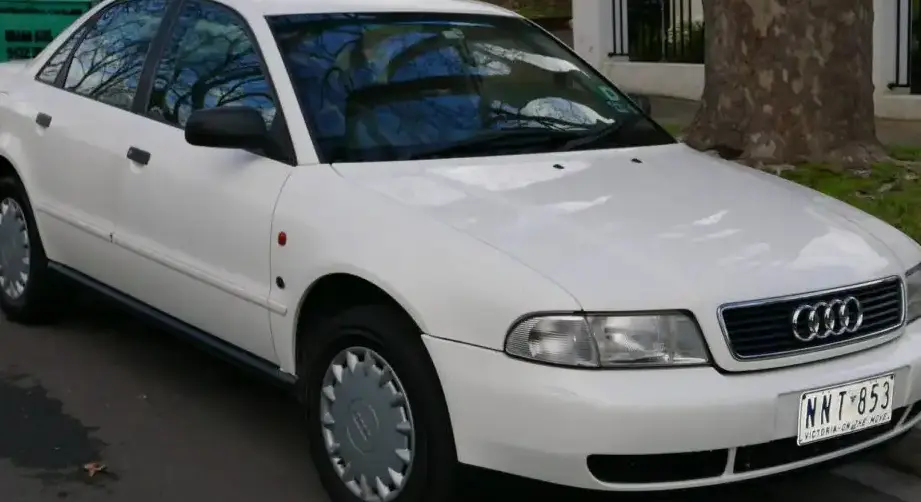
The Audi A4 (B5), produced from 1995 to 1999, represented a significant step forward for Audi, establishing the brand as a serious competitor in the premium compact executive car segment. The 1.8 20V Turbo quattro variant, equipped with Audi’s renowned all-wheel drive system, occupied a key position in the lineup, offering a blend of performance, practicality, and all-weather capability. This model, built on the Volkswagen Group’s B5 platform (Typ 8D), aimed to appeal to buyers seeking a more engaging driving experience than the base models, without the higher price tag of the more powerful V6 options.
Technical Specifications
| Brand | Audi |
| Model | A4 |
| Generation | A4 (B5, Typ 8D) |
| Type (Engine) | 1.8 20V Turbo (150 Hp) quattro |
| Start of production | February, 1995 |
| End of production | 1999 |
| Powertrain Architecture | Internal Combustion engine |
| Body type | Sedan |
| Seats | 5 |
| Doors | 4 |
| Fuel consumption (urban) | 12.2 l/100 km (19.3 US mpg, 23.2 UK mpg, 8.2 km/l) |
| Fuel consumption (extra urban) | 7.3 l/100 km (32.2 US mpg, 38.7 UK mpg, 13.7 km/l) |
| Fuel consumption (combined) | 8.5 l/100 km (27.7 US mpg, 33.2 UK mpg, 11.8 km/l) |
| Fuel Type | Petrol (Gasoline) |
| Acceleration 0 – 100 km/h | 8.4 sec |
| Acceleration 0 – 62 mph | 8.4 sec |
| Acceleration 0 – 60 mph | 8 sec |
| Maximum speed | 220 km/h (136.7 mph) |
| Weight-to-power ratio | 8.9 kg/Hp, 111.9 Hp/tonne |
| Weight-to-torque ratio | 6.4 kg/Nm, 156.7 Nm/tonne |
| Power | 150 Hp @ 5700 rpm |
| Power per litre | 84.2 Hp/l |
| Torque | 210 Nm @ 1750-4600 rpm (154.89 lb.-ft. @ 1750-4600 rpm) |
| Engine layout | Front, Longitudinal |
| Engine Model/Code | AEB, ANB, APU, ARK, AWT |
| Engine displacement | 1781 cm3 (108.68 cu. in.) |
| Number of cylinders | 4 |
| Engine configuration | Inline |
| Cylinder Bore | 81 mm (3.19 in.) |
| Piston Stroke | 86.4 mm (3.4 in.) |
| Compression ratio | 9.5:1 |
| Number of valves per cylinder | 5 |
| Fuel injection system | Multi-port manifold injection |
| Engine aspiration | Turbocharger |
| Valvetrain | DOHC |
| Engine oil capacity | 3.5 l (3.7 US qt | 3.08 UK qt) |
| Coolant | 6.5 l (6.87 US qt | 5.72 UK qt) |
| Kerb Weight | 1340 kg (2954.19 lbs.) |
| Max. weight | 1890 kg (4166.74 lbs.) |
| Max load | 550 kg (1212.54 lbs.) |
| Trunk (boot) space – minimum | 440 l (15.54 cu. ft.) |
| Fuel tank capacity | 60 l (15.85 US gal | 13.2 UK gal) |
| Length | 4479 mm (176.34 in.) |
| Width | 1733 mm (68.23 in.) |
| Height | 1415 mm (55.71 in.) |
| Wheelbase | 2607 mm (102.64 in.) |
| Front track | 1498 mm (58.98 in.) |
| Rear (Back) track | 1477 mm (58.15 in.) |
| Drag coefficient (Cd) | 0.31 |
| Minimum turning circle | 11.1 m (36.42 ft.) |
| Drive wheel | All wheel drive (4×4) |
| Number of gears | 5 gears, manual transmission |
| Front suspension | Wishbone |
| Rear suspension | Double wishbone |
| Front brakes | Ventilated discs |
| Rear brakes | Disc |
| Assisting systems | ABS (Anti-lock braking system) |
| Steering type | Steering rack and pinion |
| Power steering | Hydraulic Steering |
| Tires size | 195/65 R15 |
| Wheel rims size | 15 |
Powertrain & Engine Architecture
The heart of the A4 1.8T quattro was the 1.8-liter, 20-valve inline-four cylinder engine. Engine codes such as AEB, ANB, APU, ARK, and AWT were commonly found in this variant, with slight variations in calibration and equipment. This engine utilized a single turbocharger with an internal wastegate, providing a significant boost in power compared to naturally aspirated engines of similar displacement. Fuel delivery was managed by a Bosch Motronic multi-port fuel injection system, precisely metering fuel into the intake ports. The engine featured a dual overhead camshaft (DOHC) design with five valves per cylinder (three intake, two exhaust), optimizing airflow for improved performance. The 5-speed manual transmission was standard, providing a direct connection to the drivetrain. The quattro all-wheel drive system employed a Torsen differential, automatically distributing torque between the front and rear axles based on traction conditions.
Driving Characteristics
The 1.8T quattro offered a noticeably more spirited driving experience than the base 1.8-liter A4. The turbocharger provided a surge of torque from around 1750 rpm, making it responsive in everyday driving situations. While not as brutally fast as the V6 models, the 1.8T quattro could accelerate from 0 to 60 mph in approximately 8 seconds and reach a top speed of 136.7 mph. The quattro system provided excellent grip and stability, particularly in adverse weather conditions. The 5-speed manual transmission offered precise shifts, allowing drivers to fully exploit the engine’s powerband. Compared to the automatic transmission options available on other A4 trims, the manual provided a more engaging and connected feel.
Equipment & Trim Levels
The 1.8T quattro typically came well-equipped, though specific features varied depending on the market and optional packages selected. Standard equipment generally included power windows, power locks, air conditioning, and an AM/FM stereo. Higher trim levels offered upgrades such as leather upholstery, sunroof, heated front seats, and a premium sound system. The interior design was typically understated and functional, reflecting Audi’s commitment to quality and ergonomics. Exterior features included alloy wheels, fog lights, and a subtle rear spoiler.
Chassis & Braking
The A4 B5 featured a fully independent suspension system, with wishbone setups at both the front and rear. This provided a comfortable ride while maintaining good handling characteristics. The quattro models often received slightly stiffer suspension components to compensate for the added weight of the all-wheel drive system. Brakes consisted of ventilated discs at the front and solid discs at the rear. Anti-lock braking system (ABS) was standard, enhancing safety and control during hard braking. The steering was a rack-and-pinion system with hydraulic power assistance, providing precise and responsive steering feel.
Market Reception & Comparison
The Audi A4 1.8T quattro was generally well-received by automotive critics. It was praised for its blend of performance, handling, and all-weather capability. Compared to the base 1.8-liter A4, the 1.8T quattro offered a significant performance upgrade. It also provided a more affordable alternative to the more expensive V6 models. Fuel economy was reasonable for a turbocharged engine, averaging around 27.7 US mpg in combined driving. Reliability was generally good, although some owners reported issues with the turbocharger and the all-wheel drive system over the long term.
Legacy
The Audi A4 B5 1.8T quattro remains a popular choice among enthusiasts today. The engine is known for its tunability, with many owners upgrading the turbocharger and other components to increase power output. The quattro all-wheel drive system continues to be highly regarded for its performance and reliability. While maintenance costs can be higher than some other compact cars, the A4 B5 1.8T quattro offers a rewarding driving experience and a reputation for quality that has stood the test of time. Finding well-maintained examples is becoming increasingly difficult, but these cars represent a significant chapter in Audi’s history and continue to provide enjoyment for their owners.