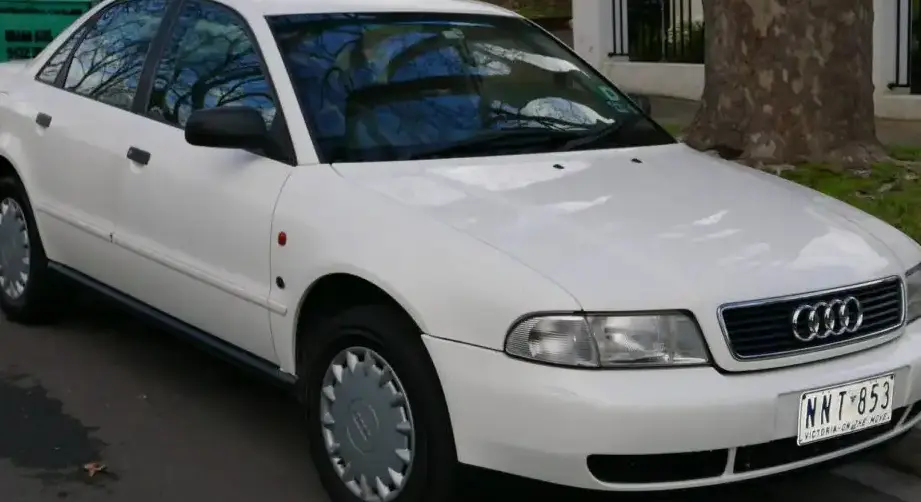
The Audi A4 (B5), produced from 1994 to 2001, represented a significant step forward for the German automaker, establishing a new benchmark in the compact executive car segment. Introduced in January 1995, the 1.9 TDI 90 horsepower automatic variant occupied an important position in the B5 A4 lineup, particularly in European markets where diesel engines were highly favored. This model, designated Typ 8D, offered a blend of fuel efficiency, practicality, and Audi’s renowned build quality, appealing to buyers seeking a comfortable and economical daily driver. It served as a more accessible entry point into the A4 range compared to the more powerful and expensive gasoline options, and even the higher-output TDI models.
Technical Specifications
| Brand | Audi |
| Model | A4 |
| Generation | A4 (B5, Typ 8D) |
| Type (Engine) | 1.9 TDI (90 Hp) Automatic |
| Start of production | January, 1995 |
| End of production | 1999 |
| Powertrain Architecture | Internal Combustion engine |
| Body type | Sedan |
| Seats | 5 |
| Doors | 4 |
| Fuel consumption (economy) – urban | 8.8 l/100 km (26.7 US mpg, 32.1 UK mpg, 11.4 km/l) |
| Fuel consumption (economy) – extra urban | 5 l/100 km (47 US mpg, 56.5 UK mpg, 20 km/l) |
| Fuel consumption (economy) – combined | 5.1 l/100 km (46.1 US mpg, 55.4 UK mpg, 19.6 km/l) |
| Fuel Type | Diesel |
| Acceleration 0 – 100 km/h | 14.8 sec |
| Acceleration 0 – 62 mph | 14.8 sec |
| Acceleration 0 – 60 mph | 14.1 sec |
| Maximum speed | 175 km/h (108.74 mph) |
| Weight-to-power ratio | 14 kg/Hp, 71.4 Hp/tonne |
| Weight-to-torque ratio | 6.2 kg/Nm, 160.3 Nm/tonne |
| Power | 90 Hp @ 4000 rpm |
| Power per litre | 47.5 Hp/l |
| Torque | 202 Nm @ 1900 rpm (148.99 lb.-ft. @ 1900 rpm) |
| Engine layout | Front, Longitudinal |
| Engine Model/Code | 1Z, AHU, AHH |
| Engine displacement | 1896 cm3 (115.7 cu. in.) |
| Number of cylinders | 4 |
| Engine configuration | Inline |
| Cylinder Bore | 79.5 mm (3.13 in.) |
| Piston Stroke | 95.5 mm (3.76 in.) |
| Compression ratio | 19.5:1 |
| Number of valves per cylinder | 2 |
| Fuel injection system | Direct injection |
| Engine aspiration | Turbocharger, Intercooler |
| Valvetrain | OHC |
| Engine oil capacity | 3.5 l (3.7 US qt | 3.08 UK qt) |
| Coolant | 6.5 l (6.87 US qt | 5.72 UK qt) |
| Kerb Weight | 1260 kg (2777.82 lbs.) |
| Max. weight | 1805 kg (3979.34 lbs.) |
| Max load | 545 kg (1201.52 lbs.) |
| Trunk (boot) space – minimum | 440 l (15.54 cu. ft.) |
| Fuel tank capacity | 62 l (16.38 US gal | 13.64 UK gal) |
| Length | 4479 mm (176.34 in.) |
| Width | 1733 mm (68.23 in.) |
| Height | 1415 mm (55.71 in.) |
| Wheelbase | 2617 mm (103.03 in.) |
| Front track | 1498 mm (58.98 in.) |
| Rear (Back) track | 1479 mm (58.23 in.) |
| Drag coefficient (Cd) | 0.31 |
| Minimum turning circle (turning diameter) | 11.1 m (36.42 ft.) |
| Drivetrain Architecture | The Internal combustion engine (ICE) drives the front wheels of the vehicle. |
| Drive wheel | Front wheel drive |
| Number of gears and type of gearbox | 4 gears, automatic transmission |
| Front suspension | Independent, type McPherson with coil spring and anti-roll bar |
| Rear suspension | Suspension with traction connecting levers |
| Front brakes | Disc |
| Rear brakes | Disc |
| Assisting systems | ABS (Anti-lock braking system) |
| Steering type | Steering rack and pinion |
| Power steering | Hydraulic Steering |
| Tires size | 195/65 R15 |
| Wheel rims size | 15 |
Powertrain & Engine Architecture
The heart of the A4 1.9 TDI 90 Automatic is the 1.9-liter inline-four diesel engine, typically identified by engine codes 1Z, AHU, or AHH. This engine utilized a direct injection system, a key technology for improving fuel efficiency and reducing emissions. Direct injection, in this case, involved injecting fuel directly into the combustion chamber under extremely high pressure, promoting more complete combustion. The engine featured an overhead camshaft (OHC) valvetrain operating two valves per cylinder. A turbocharger with an intercooler was employed to boost power output, increasing air density entering the engine. The automatic transmission was a four-speed unit, designed to provide smooth and convenient shifting. While not known for its sportiness, it was a reliable and durable transmission well-suited to the engine’s torque characteristics.
Driving Characteristics
The 1.9 TDI 90 hp automatic A4 offered a distinctly different driving experience compared to its more powerful siblings, such as those equipped with the 1.8T gasoline engine or the 110 hp TDI. Acceleration was modest, with a 0-60 mph time around 14.1 seconds. The focus was on fuel economy and relaxed cruising. The automatic transmission, while smooth, did contribute to some power loss compared to the manual versions. Gear ratios were optimized for efficiency rather than outright performance. The engine delivered its peak torque at a relatively low 1900 rpm, providing adequate pulling power for everyday driving situations, but lacked the responsiveness of higher-output engines. It was a comfortable and predictable car, ideal for commuting and long journeys where outright speed wasn’t a priority.
Equipment & Trim Levels
The 1.9 TDI 90 Automatic typically came with a reasonable level of standard equipment. This included power windows, central locking, and an AM/FM radio. Interior upholstery was usually cloth, with a relatively simple dashboard layout. Optional extras included air conditioning, alloy wheels, a sunroof, and upgraded audio systems. Trim levels varied slightly depending on the market, but generally, this variant represented a mid-range offering, positioned above the base models but below the more luxurious and well-equipped versions. Safety features like ABS were standard, reflecting Audi’s commitment to safety even in its more affordable models.
Chassis & Braking
The A4 B5 featured an independent McPherson strut front suspension and a semi-independent suspension with trailing arms at the rear. This setup provided a good balance between ride comfort and handling. The 1.9 TDI Automatic models typically used disc brakes on all four wheels, providing adequate stopping power for the vehicle’s weight and performance. The suspension was tuned for comfort, with a focus on absorbing bumps and providing a stable ride. Stabilizer bars were fitted to both the front and rear axles to reduce body roll during cornering.
Market Reception & Comparison
The Audi A4 1.9 TDI 90 Automatic was well-received in European markets, where diesel engines were popular due to their fuel efficiency and lower running costs. Critics praised its build quality, comfortable ride, and economical engine. However, some noted its relatively slow acceleration compared to gasoline-powered rivals. Compared to the 1.8T models, the TDI offered significantly better fuel economy but less power and excitement. Against the higher-output 110 hp TDI, it provided a more affordable entry point into the A4 range, albeit with a noticeable performance deficit. Its reliability was generally considered good, making it a popular choice for fleet operators and private buyers alike.
Legacy
The 1.9 TDI engine, in its various iterations, proved to be remarkably durable and reliable. Many examples of the A4 B5 1.9 TDI continue to be driven today, often with high mileage. The automatic transmission, while not as sporty as some, also proved to be relatively robust. In the used car market, these models are often sought after for their affordability, fuel efficiency, and reputation for reliability. While not a performance icon, the A4 1.9 TDI 90 Automatic played a significant role in establishing Audi as a leading manufacturer of premium compact cars, and its enduring presence on the roads is a testament to its solid engineering and build quality.