Technical Specifications
| Brand | Audi |
| Model | A4 |
| Generation | A4 (B5, Typ 8D) |
| Type (Engine) | 2.6 V6 (150 Hp) |
| Start of production | November, 1994 |
| End of production | July, 1997 |
| Powertrain Architecture | Internal Combustion engine |
| Body type | Sedan |
| Seats | 5 |
| Doors | 4 |
| Fuel consumption (urban) | 13.2 l/100 km (17.8 US mpg, 21.4 UK mpg, 7.6 km/l) |
| Fuel consumption (extra urban) | 7.2 l/100 km (32.7 US mpg, 39.2 UK mpg, 13.9 km/l) |
| Fuel consumption (combined) | 9.4 l/100 km (25 US mpg, 30.1 UK mpg, 10.6 km/l) |
| Fuel Type | Petrol (Gasoline) |
| Acceleration 0 – 100 km/h | 8.7 sec |
| Acceleration 0 – 62 mph | 8.7 sec |
| Acceleration 0 – 60 mph | 8.3 sec |
| Maximum speed | 220 km/h (136.7 mph) |
| Weight-to-power ratio | 8.4 kg/Hp, 119.5 Hp/tonne |
| Weight-to-torque ratio | 5.6 kg/Nm, 179.3 Nm/tonne |
| Power | 150 Hp @ 5500 rpm |
| Power per litre | 57.7 Hp/l |
| Torque | 225 Nm @ 3500 rpm (165.95 lb.-ft. @ 3500 rpm) |
| Engine layout | Front, Longitudinal |
| Engine Model/Code | ABC |
| Engine displacement | 2598 cm3 (158.54 cu. in.) |
| Number of cylinders | 6 |
| Engine configuration | V-engine |
| Cylinder Bore | 82.5 mm (3.25 in.) |
| Piston Stroke | 81 mm (3.19 in.) |
| Compression ratio | 10:1 |
| Number of valves per cylinder | 2 |
| Fuel injection system | Multi-port manifold injection |
| Engine aspiration | Naturally aspirated engine |
| Valvetrain | OHC |
| Engine oil capacity | 5 l (5.28 US qt | 4.4 UK qt) |
| Coolant | 6.5 l (6.87 US qt | 5.72 UK qt) |
| Kerb Weight | 1255 kg (2766.8 lbs.) |
| Max. weight | 1805 kg (3979.34 lbs.) |
| Max load | 550 kg (1212.54 lbs.) |
| Trunk (boot) space – minimum | 440 l (15.54 cu. ft.) |
| Fuel tank capacity | 62 l (16.38 US gal | 13.64 UK gal) |
| Length | 4479 mm (176.34 in.) |
| Width | 1733 mm (68.23 in.) |
| Height | 1415 mm (55.71 in.) |
| Wheelbase | 2617 mm (103.03 in.) |
| Front track | 1498 mm (58.98 in.) |
| Rear (Back) track | 1479 mm (58.23 in.) |
| Drag coefficient (Cd) | 0.31 |
| Minimum turning circle | 11.1 m (36.42 ft.) |
| Drivetrain Architecture | The Internal combustion engine (ICE) drives the front wheels of the vehicle. |
| Drive wheel | Front wheel drive |
| Number of gears and type of gearbox | 5 gears, manual transmission |
| Front suspension | Wishbone |
| Rear suspension | Suspension with traction connecting levers |
| Front brakes | Ventilated discs |
| Rear brakes | Disc |
| Assisting systems | ABS (Anti-lock braking system) |
| Steering type | Steering rack and pinion |
| Power steering | Hydraulic Steering |
| Tires size | 195/65 R15 |
| Wheel rims size | 15 |
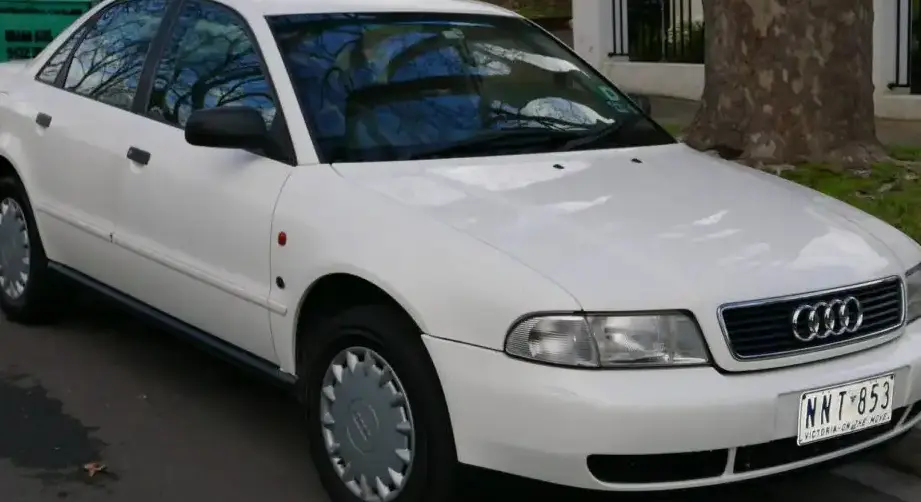
The Audi A4 (B5), produced from November 1994 to July 1997, marked a significant evolution for Audi’s compact executive car. The 2.6 V6 variant, paired with a five-speed manual transmission, occupied a middle ground in the B5 A4 lineup, offering a balance of performance and refinement. Positioned above the entry-level 1.8L four-cylinder models and below the more powerful 2.8L V6, the 2.6 V6 aimed to attract buyers desiring a more sophisticated driving experience without the premium price of the flagship engine. This model was primarily sold in the European market, where V6 engines were more prevalent in this vehicle class, with a limited number being imported to North America.
Powertrain & Engine Architecture
The core of the A4 2.6 V6 was the ABC engine code, a 2.6-liter (2598 cc) naturally aspirated V6. This engine featured a 90-degree V-angle, contributing to its smooth operation. It utilized a cast iron block with an aluminum cylinder head, a common configuration for Audi engines of the period. Fuel delivery was managed by a Bosch Motronic multi-port fuel injection system, providing precise control over the air-fuel mixture. The engine employed a single overhead camshaft (OHC) design per cylinder bank, operating two valves per cylinder (intake and exhaust). The five-speed manual transmission, a robust unit, was the standard offering, providing drivers with full control over the engine’s power. The longitudinal engine layout, typical of front-wheel-drive Audi models, allowed for a more balanced weight distribution.
Driving Characteristics
The 2.6 V6 A4 offered a noticeable performance increase compared to the base 1.8L models. With 150 horsepower and 166 lb-ft of torque, it provided brisk acceleration, reaching 60 mph in approximately 8.3 seconds. While not a sports car, the V6 delivered ample power for comfortable highway cruising and confident overtaking. The five-speed manual transmission allowed drivers to keep the engine in its sweet spot, maximizing performance. The gear ratios were well-matched to the engine’s torque curve, providing good responsiveness in everyday driving situations. Compared to the later 2.8L V6, the 2.6L felt less urgent, but it offered a more manageable and fuel-efficient driving experience. The front-wheel-drive configuration, while providing good traction in most conditions, could exhibit some torque steer under hard acceleration.
Equipment & Trim Levels
The A4 2.6 V6 typically came with a reasonably well-equipped standard package. This included power windows, power locks, central locking, and an AM/FM radio. Interior upholstery was typically cloth, although leather was available as an option. Air conditioning was a common option, as were alloy wheels. Higher trim levels could add features like a sunroof, upgraded audio systems, and wood trim. The dashboard layout was functional and straightforward, typical of German automotive design of the mid-1990s. Safety features included ABS anti-lock brakes and a driver’s airbag.
Chassis & Braking
The B5 A4 utilized a MacPherson strut front suspension and a semi-independent torsion beam rear suspension. This setup provided a good balance of ride comfort and handling. The 2.6 V6 models typically featured ventilated disc brakes at the front and solid disc brakes at the rear, providing adequate stopping power. The steering was a rack-and-pinion system with hydraulic power assistance, offering precise and responsive steering feel. Stabilizer bars were fitted to both the front and rear axles to reduce body roll during cornering.
Market Reception & Comparison
The Audi A4 2.6 V6 was generally well-received by automotive critics. It was praised for its smooth engine, comfortable ride, and refined interior. However, some critics noted that the performance, while adequate, wasn’t particularly exciting compared to some of its rivals. Compared to the 1.8L models, the 2.6 V6 offered a significant improvement in performance, but at a higher price point. The 2.8L V6 provided even more power, but it was considerably more expensive and less fuel-efficient. In terms of reliability, the ABC engine was generally considered to be a robust unit, but it was susceptible to oil leaks as it aged. Fuel economy was reasonable for a V6 engine of this era, averaging around 25 mpg in combined driving.
Legacy
The Audi A4 B5 2.6 V6 remains a popular choice among enthusiasts and classic car collectors. The ABC engine, while requiring regular maintenance, is known for its durability and smooth operation. Parts availability is generally good, although some specific components may be becoming increasingly difficult to find. Today, these cars offer a compelling combination of German engineering, classic styling, and affordable pricing. The 2.6 V6 variant, in particular, represents a sweet spot in the B5 A4 lineup, offering a balance of performance, refinement, and value that continues to appeal to drivers today. Well-maintained examples are increasingly sought after by those looking for a classic European sedan with a touch of sophistication.