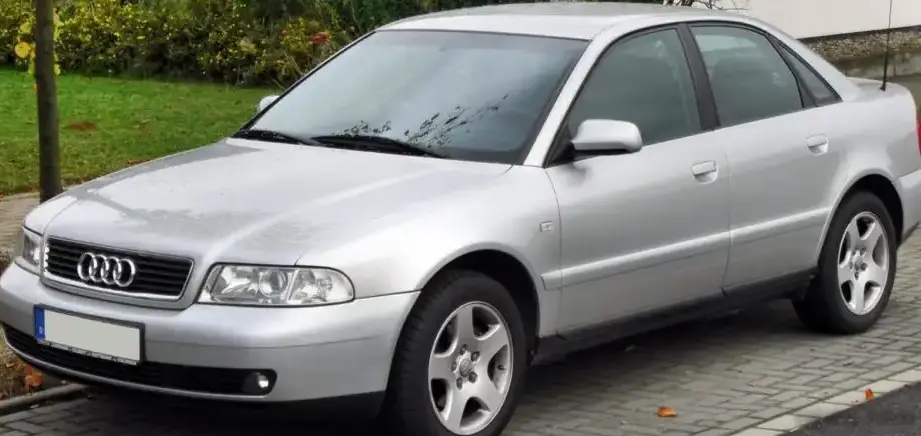
The Audi A4 (B5) 1.6i, produced from 1999 to 2000, represented the entry point into the A4 range following the 1999 facelift of the B5 generation (Typ 8D). Positioned as an affordable and practical option, this variant aimed to broaden the A4’s appeal to a wider customer base. It served as a more economical alternative to the higher-performance 1.8T and 2.8 V6 models, offering a balance between fuel efficiency and Audi’s renowned build quality. This model was primarily sold in Europe, where smaller displacement engines were favored due to tax regulations and driving conditions.
Technical Specifications
| Brand | Audi |
| Model | A4 |
| Generation | A4 (B5, Typ 8D, facelift 1999) |
| Type (Engine) | 1.6i (101 Hp) |
| Start of production | 1999 |
| End of production | 2000 |
| Powertrain Architecture | Internal Combustion engine |
| Body type | Sedan |
| Seats | 5 |
| Doors | 4 |
| Fuel consumption (urban) | 11.3 l/100 km (20.8 US mpg, 25 UK mpg, 8.8 km/l) |
| Fuel consumption (extra urban) | 6 l/100 km (39.2 US mpg, 47.1 UK mpg, 16.7 km/l) |
| Fuel consumption (combined) | 7.5 l/100 km (31.4 US mpg, 37.7 UK mpg, 13.3 km/l) |
| Fuel Type | Petrol (Gasoline) |
| Acceleration 0 – 100 km/h | 12.4 sec |
| Acceleration 0 – 62 mph | 12.4 sec |
| Acceleration 0 – 60 mph | 11.8 sec |
| Maximum speed | 190 km/h (118.06 mph) |
| Emission standard | Euro 2 |
| Weight-to-power ratio | 11.9 kg/Hp, 84.2 Hp/tonne |
| Weight-to-torque ratio | 8.6 kg/Nm, 116.7 Nm/tonne |
| Power | 101 Hp @ 5300 rpm |
| Power per litre | 63.3 Hp/l |
| Torque | 140 Nm @ 3800 rpm (103.26 lb.-ft. @ 3800 rpm) |
| Engine layout | Front, Longitudinal |
| Engine Model/Code | AHL, ANA, ARM |
| Engine displacement | 1595 cm3 (97.33 cu. in.) |
| Number of cylinders | 4 |
| Engine configuration | Inline |
| Cylinder Bore | 81 mm (3.19 in.) |
| Piston Stroke | 77.4 mm (3.05 in.) |
| Compression ratio | 10.3:1 |
| Number of valves per cylinder | 2 |
| Fuel injection system | Multi-port manifold injection |
| Engine aspiration | Naturally aspirated engine |
| Valvetrain | SOHC |
| Engine oil capacity | 3.7 l (3.91 US qt | 3.26 UK qt) |
| Coolant | 7.5 l (7.93 US qt | 6.6 UK qt) |
| Kerb Weight | 1200 kg (2645.55 lbs.) |
| Max. weight | 1750 kg (3858.09 lbs.) |
| Max load | 550 kg (1212.54 lbs.) |
| Trunk (boot) space – minimum | 440 l (15.54 cu. ft.) |
| Fuel tank capacity | 62 l (16.38 US gal | 13.64 UK gal) |
| Length | 4479 mm (176.34 in.) |
| Width | 1733 mm (68.23 in.) |
| Height | 1415 mm (55.71 in.) |
| Wheelbase | 2617 mm (103.03 in.) |
| Front track | 1498 mm (58.98 in.) |
| Rear (Back) track | 1479 mm (58.23 in.) |
| Drag coefficient (Cd) | 0.31 |
| Minimum turning circle | 11.1 m (36.42 ft.) |
| Drivetrain Architecture | The Internal combustion engine (ICE) drives the front wheels of the vehicle. |
| Drive wheel | Front wheel drive |
| Number of gears and type of gearbox | 5 gears, manual transmission |
| Front suspension | Independent multi-link suspension |
| Rear suspension | Suspension with traction connecting levers |
| Front brakes | Ventilated discs |
| Rear brakes | Disc |
| Assisting systems | ABS (Anti-lock braking system) |
| Steering type | Steering rack and pinion |
| Power steering | Hydraulic Steering |
| Tires size | 195/65 R15 |
| Wheel rims size | 15 |
Powertrain & Engine Architecture
The 1.6i engine, utilizing engine codes AHL, ANA, and ARM depending on the specific market and year, is a naturally aspirated, inline-four cylinder gasoline engine. It features a single overhead camshaft (SOHC) valvetrain operating two valves per cylinder. Fuel delivery is managed by a multi-port fuel injection system, providing a balance between efficiency and responsiveness. The engine’s 1595cc displacement produces 101 horsepower at 5300 rpm and 140 Nm (103 lb-ft) of torque at 3800 rpm. This engine was known for its relative simplicity and durability, though it lacked the performance of the larger displacement engines available in the A4 range. The engine is longitudinally mounted in the front of the vehicle, driving the front wheels. The standard transmission for this variant was a 5-speed manual gearbox, although an optional 4-speed automatic transmission was available, impacting performance and fuel economy.
Driving Characteristics
The A4 1.6i with the manual transmission offered adequate performance for everyday driving, but it wasn’t particularly sporty. Acceleration from 0-60 mph took around 11.8 seconds, and top speed was limited to 190 km/h (118 mph). The automatic transmission further reduced these figures, making the car feel noticeably slower. The engine’s torque curve was relatively flat, providing usable power across a reasonable rev range, but it required frequent downshifts to maintain momentum when overtaking or climbing hills. Compared to the 1.8T models, the 1.6i felt significantly underpowered, while the 1.9 TDI diesel offered superior fuel economy and low-end torque. The 1.6i prioritized fuel efficiency and affordability over outright performance.
Equipment & Trim Levels
The 1.6i A4 typically came with a fairly basic level of equipment, reflecting its position as the entry-level model. Standard features generally included power windows, central locking, and an AM/FM radio. Air conditioning was often an optional extra, as were alloy wheels and upgraded interior trim. Interior upholstery was typically cloth, and the dashboard featured a straightforward design. Higher trim levels, available as options, could add features like a sunroof, upgraded sound system, and leather upholstery. The focus was on providing a functional and comfortable interior without excessive luxury.
Chassis & Braking
The A4 B5 chassis featured independent multi-link suspension at the front and a semi-independent suspension with traction connecting levers at the rear. This setup provided a good balance between ride comfort and handling. The 1.6i models typically used ventilated disc brakes at the front and solid disc brakes at the rear. Anti-lock braking system (ABS) was standard. The suspension was tuned for comfort rather than outright sportiness, and the steering was hydraulically assisted for ease of use. The relatively light weight of the 1.6i engine contributed to balanced handling, although it didn’t offer the same level of grip as the higher-powered models.
Market Reception & Comparison
The A4 1.6i was generally well-received as an affordable and practical option within the A4 range. Critics praised its build quality and comfortable ride, but noted its lack of performance compared to the more powerful engines. Fuel economy was a strong point, making it an attractive choice for drivers who prioritized efficiency. Compared to the 1.8T, the 1.6i offered significantly lower running costs but lacked the same level of driving enjoyment. The 1.9 TDI diesel provided a compelling alternative for those seeking even better fuel economy and more torque. The 1.6i appealed to buyers who needed a reliable and comfortable family car without the expense of the higher-spec models.
Legacy
The 1.6i A4 (B5) powertrain, while not known for its blistering performance, proved to be relatively reliable. The engine is generally considered durable, and with proper maintenance, can last for many years. In the used car market, these models are often available at very affordable prices, making them an attractive option for budget-conscious buyers. However, potential buyers should be aware of the age-related issues common to all B5 A4s, such as corrosion and wear and tear on suspension components. The 1.6i A4 represents a solid, if unspectacular, entry point into the Audi A4 ownership experience.