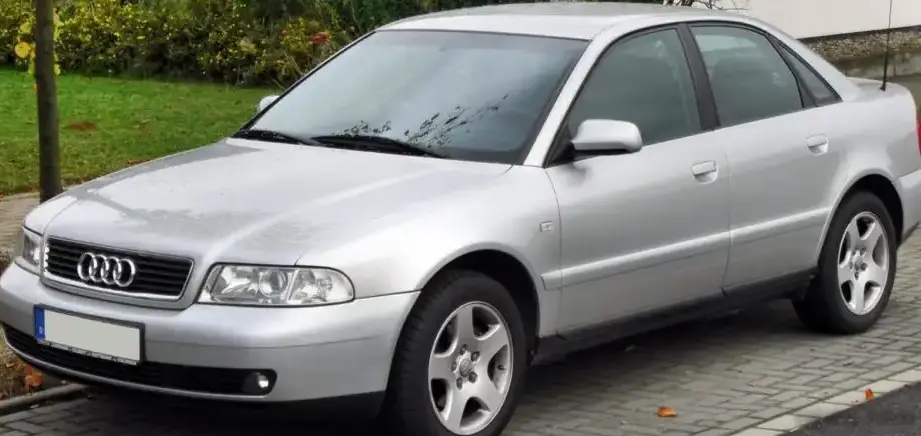
The Audi A4 (B5) facelift, produced from 1999 to 2000, represented a significant mid-cycle refresh of Audi’s popular compact executive car. Among the various engine and transmission combinations offered, the 1.8-liter 20-valve turbocharged engine paired with the Tiptronic automatic transmission holds a specific place in the lineup. This variant aimed to provide a balance of performance and convenience, appealing to buyers who desired the A4’s refinement without the involvement of a manual gearbox. It was positioned as a mid-range offering, slotting between the base 1.8L non-turbo models and the more potent 2.8L V6 and TDI diesel options.
Technical Specifications
| Brand | Audi |
| Model | A4 |
| Generation | A4 (B5, Typ 8D, facelift 1999) |
| Type (Engine) | 1.8 20V Turbo (150 Hp) Tiptronic |
| Start of production | 1999 |
| End of production | 2000 |
| Powertrain Architecture | Internal Combustion engine |
| Body type | Sedan |
| Seats | 5 |
| Doors | 4 |
| Fuel consumption (urban) | 13.3 l/100 km (17.7 US mpg, 21.2 UK mpg, 7.5 km/l) |
| Fuel consumption (extra urban) | 6.9 l/100 km (34.1 US mpg, 40.9 UK mpg, 14.5 km/l) |
| Fuel consumption (combined) | 9.3 l/100 km (25.3 US mpg, 30.4 UK mpg, 10.8 km/l) |
| Fuel Type | Petrol (Gasoline) |
| Acceleration 0 – 100 km/h | 9.6 sec |
| Acceleration 0 – 62 mph | 9.6 sec |
| Acceleration 0 – 60 mph | 9.1 sec |
| Maximum speed | 214 km/h (132.97 mph) |
| Weight-to-power ratio | 8.7 kg/Hp, 114.9 Hp/tonne |
| Weight-to-torque ratio | 6.2 kg/Nm, 160.9 Nm/tonne |
| Power | 150 Hp @ 5700 rpm |
| Power per litre | 84.2 Hp/l |
| Torque | 210 Nm @ 1750-4600 rpm (154.89 lb.-ft. @ 1750-4600 rpm) |
| Engine layout | Front, Longitudinal |
| Engine Model/Code | AEB, ANB, APU, AWT |
| Engine displacement | 1781 cm3 (108.68 cu. in.) |
| Number of cylinders | 4 |
| Engine configuration | Inline |
| Cylinder Bore | 81 mm (3.19 in.) |
| Piston Stroke | 86.4 mm (3.4 in.) |
| Compression ratio | 9.5:1 |
| Number of valves per cylinder | 5 |
| Fuel injection system | Multi-port manifold injection |
| Engine aspiration | Turbocharger |
| Valvetrain | DOHC |
| Engine oil capacity | 3.5 l (3.7 US qt | 3.08 UK qt) |
| Coolant | 6.5 l (6.87 US qt | 5.72 UK qt) |
| Kerb Weight | 1305 kg (2877.03 lbs.) |
| Max. weight | 1855 kg (4089.57 lbs.) |
| Max load | 550 kg (1212.54 lbs.) |
| Trunk (boot) space – minimum | 440 l (15.54 cu. ft.) |
| Fuel tank capacity | 62 l (16.38 US gal | 13.64 UK gal) |
| Length | 4479 mm (176.34 in.) |
| Width | 1733 mm (68.23 in.) |
| Height | 1415 mm (55.71 in.) |
| Wheelbase | 2617 mm (103.03 in.) |
| Front track | 1498 mm (58.98 in.) |
| Rear (Back) track | 1479 mm (58.23 in.) |
| Drag coefficient (Cd) | 0.31 |
| Minimum turning circle | 11.1 m (36.42 ft.) |
| Drivetrain Architecture | The Internal combustion engine (ICE) drives the front wheels of the vehicle. |
| Drive wheel | Front wheel drive |
| Number of gears and type of gearbox | 5 gears, automatic transmission Tiptronic |
| Front suspension | Wishbone |
| Rear suspension | Suspension with traction connecting levers |
| Front brakes | Disc |
| Rear brakes | Disc |
| Assisting systems | ABS (Anti-lock braking system) |
| Steering type | Steering rack and pinion |
| Power steering | Hydraulic Steering |
| Tires size | 195/65 R15 |
| Wheel rims size | 15 |
INTRODUCTION
The B5 generation Audi A4, launched in 1994, quickly established itself as a benchmark in the compact executive segment. The 1999 facelift brought subtle but important changes to the exterior styling, interior materials, and engine options. The 1.8-liter 20-valve turbocharged engine, available with the Tiptronic automatic transmission, was a popular choice for buyers seeking a blend of performance and convenience. This configuration, utilizing engine codes like AEB, ANB, APU, and AWT, offered a step up in power and refinement compared to the naturally aspirated 1.8L models, while remaining more accessible than the flagship V6.
Powertrain & Engine Architecture
The heart of this A4 variant is the 1.8-liter (1781cc) inline-four cylinder engine. This engine is characterized by its 20-valve cylinder head (five valves per cylinder – three intake, two exhaust) and a K03 turbocharger. The engine utilizes Bosch Motronic fuel injection, delivering precise fuel metering for optimal performance and emissions. The turbocharger provides a significant boost in power and torque compared to naturally aspirated engines of similar displacement. The Tiptronic transmission is a five-speed automatic with a manual shift mode, allowing drivers to have more control over gear selection. It’s a conventional torque converter automatic, known for its smooth operation but not necessarily its outright speed compared to later dual-clutch transmissions.
Driving Characteristics
The 1.8T with Tiptronic delivers a comfortable and refined driving experience. While not as overtly sporty as the manual transmission versions or the 2.8 V6, it provides ample power for everyday driving and highway cruising. Acceleration from 0-60 mph takes around 9.1 seconds, and the top speed is approximately 133 mph. The Tiptronic transmission, while smooth, can feel slightly hesitant during quick downshifts. The gear ratios are tuned for fuel efficiency and comfort, rather than outright performance. Compared to the manual transmission 1.8T, the Tiptronic version sacrifices some responsiveness for ease of use.
Equipment & Trim Levels
The 1.8T Tiptronic A4 typically came well-equipped, even by late 1990s standards. Standard features often included power windows, power locks, air conditioning, a driver’s airbag, and an AM/FM radio with cassette player. Higher trim levels added features like leather upholstery, sunroof, heated front seats, and a premium sound system. Optional extras included traction control (ASR), electronic stability control (ESP – though less common on this variant), and upgraded alloy wheels. Interior trim levels varied, with cloth upholstery being standard and leather available as an upgrade.
Chassis & Braking
The B5 A4 utilizes a fully independent suspension system, with wishbones at the front and a semi-independent suspension with trailing arms at the rear. This setup provides a good balance of ride comfort and handling. The 1.8T Tiptronic models typically came equipped with disc brakes on all four wheels, providing adequate stopping power. ABS (Anti-lock Braking System) was standard. Stabilizer bars were fitted front and rear to reduce body roll during cornering. The suspension tuning was generally geared towards comfort, making it a pleasant car for long journeys.
Market Reception & Comparison
The 1.8T Tiptronic A4 was generally well-received by automotive critics. It was praised for its refined engine, comfortable ride, and well-appointed interior. However, some critics noted that the Tiptronic transmission could feel sluggish at times, and that the car lacked the sporty feel of the manual transmission versions. Compared to the 2.8 V6, the 1.8T offered a more affordable entry point into the A4 range, with comparable fuel economy. The 1.8T also proved to be more reliable than the V6, with fewer reports of mechanical issues.
Legacy
The 1.8T engine, in various iterations, became a mainstay of the Volkswagen Group’s lineup for many years. The B5 A4 1.8T Tiptronic remains a popular choice among used car buyers, offering a good balance of affordability, reliability, and refinement. While age and mileage can take their toll, these cars are generally known for their durability. Common maintenance items include timing belt replacement (critical due to the engine’s interference design), turbocharger maintenance, and addressing potential oil leaks. The Tiptronic transmission, while generally reliable, may require servicing or eventual rebuild depending on its history. Today, well-maintained examples are sought after by enthusiasts and those looking for a classic European driving experience.