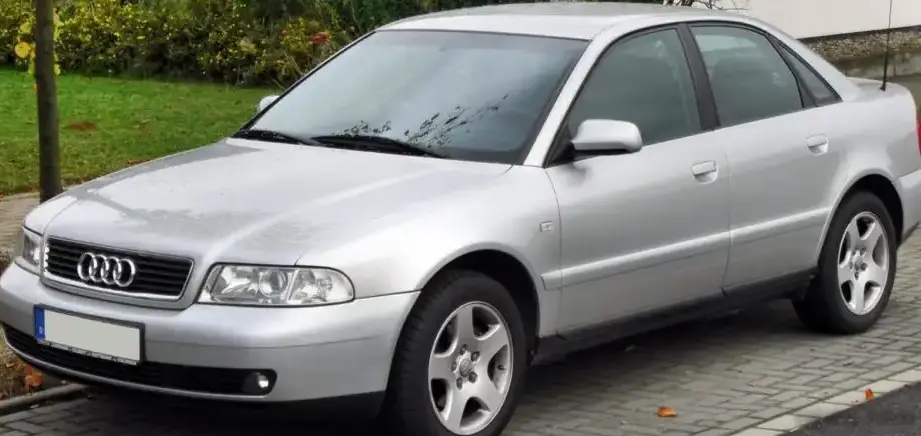
The Audi A4 (B5) 1.8 Turbo, produced from 1999 to 2000, represents a significant iteration of Audi’s popular compact executive car. This facelifted version of the B5 platform, internally designated Typ 8D, aimed to refine the original A4’s design and enhance its performance and features. The 1.8 Turbo variant, producing 180 horsepower, occupied a key position in the A4 lineup, offering a balance between performance, fuel efficiency, and affordability. It served as a step up from the base 1.8 non-turbo models, while remaining more accessible than the higher-performance S4 or the diesel-powered TDI options.
Technical Specifications
| Brand | Audi |
| Model | A4 |
| Generation | A4 (B5, Typ 8D, facelift 1999) |
| Type (Engine) | 1.8 Turbo (180 Hp) |
| Start of production | 1999 |
| End of production | 2000 |
| Powertrain Architecture | Internal Combustion engine |
| Body type | Sedan |
| Seats | 5 |
| Doors | 4 |
| Fuel consumption (urban) | 10.7 l/100 km (22 US mpg, 26.4 UK mpg, 9.3 km/l) |
| Fuel consumption (extra urban) | 6.4 l/100 km (36.8 US mpg, 44.1 UK mpg, 15.6 km/l) |
| Fuel consumption (combined) | 8 l/100 km (29.4 US mpg, 35.3 UK mpg, 12.5 km/l) |
| Fuel Type | Petrol (Gasoline) |
| Acceleration 0 – 100 km/h | 8 sec |
| Acceleration 0 – 62 mph | 8 sec |
| Acceleration 0 – 60 mph | 7.6 sec |
| Maximum speed | 231 km/h (143.54 mph) |
| Weight-to-power ratio | 7 kg/Hp, 142.9 Hp/tonne |
| Weight-to-torque ratio | 5.4 kg/Nm, 186.5 Nm/tonne |
| Power | 180 Hp @ 5500 rpm |
| Power per litre | 101.1 Hp/l |
| Torque | 235 Nm @ 1950-5000 rpm (173.33 lb.-ft. @ 1950-5000 rpm) |
| Engine layout | Front, Longitudinal |
| Engine Model/Code | AJL |
| Engine displacement | 1781 cm3 (108.68 cu. in.) |
| Number of cylinders | 4 |
| Engine configuration | Inline |
| Cylinder Bore | 81 mm (3.19 in.) |
| Piston Stroke | 86.4 mm (3.4 in.) |
| Compression ratio | 9.5:1 |
| Number of valves per cylinder | 5 |
| Fuel injection system | Multi-port manifold injection |
| Engine aspiration | Turbocharger, Intercooler |
| Engine oil capacity | 3.5 l (3.7 US qt | 3.08 UK qt) |
| Coolant | 6.5 l (6.87 US qt | 5.72 UK qt) |
| Kerb Weight | 1260 kg (2777.82 lbs.) |
| Max. weight | 1810 kg (3990.37 lbs.) |
| Max load | 550 kg (1212.54 lbs.) |
| Trunk (boot) space – minimum | 440 l (15.54 cu. ft.) |
| Fuel tank capacity | 62 l (16.38 US gal | 13.64 UK gal) |
| Length | 4479 mm (176.34 in.) |
| Width | 1733 mm (68.23 in.) |
| Height | 1415 mm (55.71 in.) |
| Wheelbase | 2617 mm (103.03 in.) |
| Front track | 1498 mm (58.98 in.) |
| Rear (Back) track | 1479 mm (58.23 in.) |
| Drag coefficient (Cd) | 0.31 |
| Minimum turning circle | 11.1 m (36.42 ft.) |
| Drivetrain Architecture | The Internal combustion engine (ICE) drives the front wheels of the vehicle. |
| Drive wheel | Front wheel drive |
| Number of gears and type of gearbox | 5 gears, manual transmission |
| Tires size | 195/65 R15 |
| Wheel rims size | 15 |
Powertrain & Engine Architecture
The heart of the A4 1.8 Turbo is the 1.8-liter, inline-four cylinder engine, specifically the AJL engine code. This engine utilizes a single overhead camshaft (SOHC) design with five valves per cylinder – three intake and two exhaust – contributing to improved breathing and efficiency. A key feature is its turbocharger with an intercooler, which forces more air into the cylinders, significantly boosting power output. The fuel system employs multi-port fuel injection, delivering precise fuel metering for optimal combustion. The engine’s longitudinal mounting allowed for a front-wheel-drive configuration with a transaxle gearbox. The five-speed manual transmission was standard, offering precise gear changes and a direct connection to the engine. The engine’s torque curve is relatively flat, providing usable power across a wide RPM range, peaking at 235 Nm (173 lb-ft) between 1950 and 5000 rpm.
Driving Characteristics
The 180 horsepower and 235 Nm of torque provided by the 1.8 Turbo engine delivered brisk acceleration, with a 0-60 mph time of around 7.6 seconds. While not as quick as the more powerful S4, the 1.8 Turbo offered a satisfying driving experience for everyday use. The five-speed manual transmission allowed drivers to fully exploit the engine’s powerband. Compared to the non-turbo 1.8-liter engine, the turbocharger provided a noticeable increase in responsiveness and pulling power, particularly at higher speeds. The front-wheel-drive configuration, while providing good traction in most conditions, could exhibit some torque steer under hard acceleration. The suspension, tuned for comfort, provided a relatively smooth ride, although it wasn’t as sporty as the setup found in the S4.
Equipment & Trim Levels
The A4 1.8 Turbo typically came with a respectable level of standard equipment. This included power windows, power locks, air conditioning, and an AM/FM radio with cassette player. Higher trim levels offered options such as leather upholstery, sunroof, heated front seats, and a premium sound system. The interior design was functional and well-built, reflecting Audi’s reputation for quality. Exterior features included alloy wheels, body-colored bumpers, and a relatively understated aesthetic. Optional extras could significantly enhance the car’s comfort and convenience, but also increased the price.
Chassis & Braking
The B5 A4 utilized a MacPherson strut front suspension and a semi-independent torsion beam rear suspension. This setup provided a good balance between ride comfort and handling. The 1.8 Turbo models typically featured disc brakes on the front wheels and drum brakes on the rear. Anti-lock Braking System (ABS) was standard, enhancing safety and control during braking. Stabilizer bars were fitted to both the front and rear axles to reduce body roll during cornering. The chassis was relatively lightweight, contributing to the car’s agility.
Market Reception & Comparison
The Audi A4 1.8 Turbo was generally well-received by automotive critics. It was praised for its refined engine, comfortable ride, and well-appointed interior. Compared to its competitors, such as the BMW 3 Series and Mercedes-Benz C-Class, the A4 offered a compelling combination of performance, luxury, and value. The 1.8 Turbo offered better fuel economy than the higher-performance S4, making it a more practical choice for daily commuting. However, some critics noted that the front-wheel-drive configuration lacked the dynamic handling of rear-wheel-drive competitors. Reliability was generally good, although turbocharger issues could occasionally arise with improper maintenance.
Legacy
The Audi A4 B5 1.8 Turbo remains a popular choice among enthusiasts and used car buyers. The AJL engine, when properly maintained, is known for its durability and longevity. Parts availability is generally good, and the car’s relatively simple mechanical design makes it relatively easy to repair. Today, these A4s can be found in good condition for reasonable prices, offering a taste of German engineering and a comfortable driving experience. The 1.8 Turbo engine’s reputation for tunability has also contributed to its enduring appeal, with many owners opting to modify their cars for increased performance. The B5 A4 1.8 Turbo represents a pivotal moment in Audi’s history, solidifying its position as a leading manufacturer of premium compact cars.