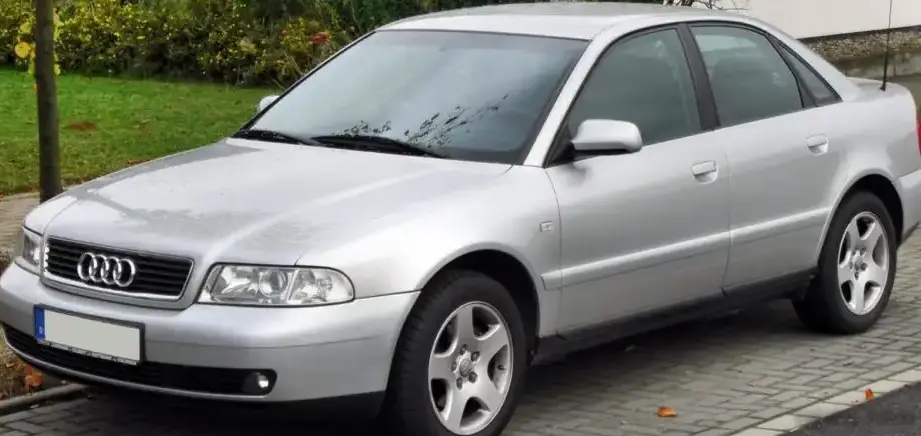
The Audi A4 (B5) facelift, produced from 1999 to 2000, represented a significant mid-cycle refresh of Audi’s popular compact executive car. Among the various engine and transmission options available, the 1.9 TDI with 116 horsepower was a common choice, particularly in European markets. This variant occupied a middle ground in the A4 B5 lineup, offering a balance between fuel efficiency, reasonable performance, and affordability. It was positioned below the more powerful gasoline engines like the 1.8T and the higher-output TDI variants, but above the base 1.6-liter gasoline model.
Technical Specifications
| Brand | Audi |
| Model | A4 |
| Generation | A4 (B5, Typ 8D, facelift 1999) |
| Type (Engine) | 1.9 TDI (116 Hp) |
| Start of production | 1999 |
| End of production | 2000 |
| Powertrain Architecture | Internal Combustion engine |
| Body type | Sedan |
| Seats | 5 |
| Doors | 4 |
| Fuel consumption (urban) | 6.8 l/100 km (34.6 US mpg, 41.5 UK mpg, 14.7 km/l) |
| Fuel consumption (extra urban) | 4.4 l/100 km (53.5 US mpg, 64.2 UK mpg, 22.7 km/l) |
| Fuel consumption (combined) | 5.3 l/100 km (44.4 US mpg, 53.3 UK mpg, 18.9 km/l) |
| Fuel Type | Diesel |
| Acceleration 0 – 100 km/h | 10.7 sec |
| Acceleration 0 – 62 mph | 10.7 sec |
| Acceleration 0 – 60 mph | 10.2 sec |
| Maximum speed | 200 km/h (124.27 mph) |
| Weight-to-power ratio | 11.1 kg/Hp, 90.3 Hp/tonne |
| Weight-to-torque ratio | 4.5 kg/Nm, 221.8 Nm/tonne |
| Power | 116 Hp @ 4000 rpm |
| Power per litre | 61.2 Hp/l |
| Torque | 285 Nm @ 1900 rpm (210.21 lb.-ft. @ 1900 rpm) |
| Engine layout | Front, Longitudinal |
| Engine Model/Code | AJM, ATJ |
| Engine displacement | 1896 cm3 (115.7 cu. in.) |
| Number of cylinders | 4 |
| Engine configuration | Inline |
| Cylinder Bore | 79.5 mm (3.13 in.) |
| Piston Stroke | 95.5 mm (3.76 in.) |
| Compression ratio | 19.5:1 |
| Number of valves per cylinder | 2 |
| Fuel injection system | Pump-nozzle (Unit Injector) |
| Engine aspiration | Turbocharger |
| Valvetrain | OHC |
| Engine oil capacity | 3.8 l (4.02 US qt | 3.34 UK qt) |
| Coolant | 6.5 l (6.87 US qt | 5.72 UK qt) |
| Kerb Weight | 1285 kg (2832.94 lbs.) |
| Max. weight | 1835 kg (4045.48 lbs.) |
| Max load | 550 kg (1212.54 lbs.) |
| Trunk (boot) space – minimum | 440 l (15.54 cu. ft.) |
| Fuel tank capacity | 62 l (16.38 US gal | 13.64 UK gal) |
| Length | 4479 mm (176.34 in.) |
| Width | 1733 mm (68.23 in.) |
| Height | 1415 mm (55.71 in.) |
| Wheelbase | 2617 mm (103.03 in.) |
| Front track | 1498 mm (58.98 in.) |
| Rear (Back) track | 1479 mm (58.23 in.) |
| Drag coefficient (Cd) | 0.31 |
| Minimum turning circle | 11.1 m (36.42 ft.) |
| Drivetrain Architecture | The Internal combustion engine (ICE) drives the front wheels of the vehicle. |
| Drive wheel | Front wheel drive |
| Number of gears and type of gearbox | 5 gears, manual transmission |
| Front suspension | Wishbone |
| Rear suspension | Suspension with traction connecting levers |
| Front brakes | Ventilated discs |
| Rear brakes | Disc |
| Assisting systems | ABS (Anti-lock braking system) |
| Steering type | Steering rack and pinion |
| Power steering | Hydraulic Steering |
| Tires size | 195/65 R15 |
| Wheel rims size | 15 |
INTRODUCTION
The Audi A4 B5 facelift, launched in 1999, built upon the success of the original B5 platform (introduced in 1994). This refresh brought subtle but important changes to the exterior styling, interior materials, and mechanical components. The 1.9 TDI 116 hp variant was a particularly popular choice in Europe, where diesel engines were favored for their fuel efficiency and torque. It offered a practical and economical option for buyers seeking a comfortable and well-built compact executive car. The engine codes AJM and ATJ were commonly associated with this specific power output.
Powertrain & Engine Architecture
The heart of this A4 variant is the 1.9-liter inline-four cylinder diesel engine. The AJM and ATJ engine codes denote slight variations in calibration and emissions control equipment, but the fundamental architecture remains the same. This engine utilizes a direct injection system employing pump-nozzle (Unit Injector) technology developed by Bosch. This system delivers fuel directly into the combustion chamber at extremely high pressure, promoting efficient combustion and reducing emissions. The engine features an overhead camshaft (OHC) valvetrain operating two valves per cylinder. A turbocharger, typically a Garrett or BorgWarner unit, provides forced induction, boosting power and torque. The 116 hp output is achieved through careful tuning of the turbocharger and fuel injection system. The engine is longitudinally mounted in the front of the vehicle, driving the front wheels. The five-speed manual transmission was the standard offering, providing a balance between fuel economy and performance.
Driving Characteristics
The 1.9 TDI 116 hp A4 offered a distinctly different driving experience compared to its gasoline-powered siblings or the higher-output TDI models. While not particularly quick, it provided ample torque from low engine speeds, making it easy to drive in everyday traffic. The turbocharger provides a noticeable boost in power once above 1800 rpm, allowing for confident overtaking maneuvers. The five-speed manual transmission is well-matched to the engine’s characteristics, with gear ratios optimized for fuel efficiency and usability. Compared to the 1.8T, the TDI lacked the high-end power and responsiveness, but it offered significantly better fuel economy. The higher-output TDI variants (typically 130 hp or 150 hp) provided more exhilarating performance, but at the cost of increased fuel consumption and potentially higher maintenance costs. The front-wheel-drive configuration provides predictable handling, although it can exhibit some understeer when pushed hard.
Equipment & Trim Levels
The 1.9 TDI 116 hp A4 typically came equipped with a reasonable level of standard features. This included power windows, central locking, power steering, and an anti-lock braking system (ABS). Interior upholstery was typically cloth, with options for leather available at an extra cost. The dashboard layout was functional and well-designed, with clear instrumentation. Optional extras included a sunroof, alloy wheels, a CD changer, and climate control. Trim levels varied depending on the market, but generally followed a progression from base models to more luxurious SE or Sport variants. These higher trims often included additional features such as upgraded interior trim, sport suspension, and larger wheels.
Chassis & Braking
The A4 B5 utilized a MacPherson strut front suspension and a semi-independent rear suspension with trailing arms. This setup provided a comfortable ride and predictable handling. The 1.9 TDI models typically featured smaller brakes compared to the higher-performance variants, with ventilated discs at the front and solid discs at the rear. ABS was standard, providing enhanced braking control in slippery conditions. Stabilizer bars were fitted to both the front and rear axles to reduce body roll during cornering. The suspension tuning was geared towards comfort and everyday usability, rather than outright sportiness.
Market Reception & Comparison
The 1.9 TDI 116 hp A4 was well-received by critics and buyers alike. It was praised for its fuel efficiency, comfortable ride, and build quality. However, some reviewers noted that the engine could be somewhat noisy and lacked the refinement of some of its competitors. Compared to other cars in its class, such as the BMW 3 Series and Mercedes-Benz C-Class, the A4 offered a compelling combination of value and practicality. Its fuel economy was particularly competitive, making it an attractive option for drivers who covered long distances. Reliability was generally good, although the pump-nozzle fuel injection system could be prone to issues if not properly maintained.
Legacy
The 1.9 TDI engine, in its various iterations, became renowned for its durability and fuel efficiency. The AJM and ATJ codes, specifically, are considered relatively robust. Today, well-maintained examples of the 1.9 TDI A4 B5 are sought after by enthusiasts and those looking for a reliable and economical classic car. While age and mileage inevitably take their toll, these cars can still provide years of dependable service with proper maintenance. The pump-nozzle injection system requires careful attention, and regular servicing is essential to prevent costly repairs. The A4 B5 1.9 TDI remains a testament to Audi’s engineering prowess and a popular choice in the used car market.