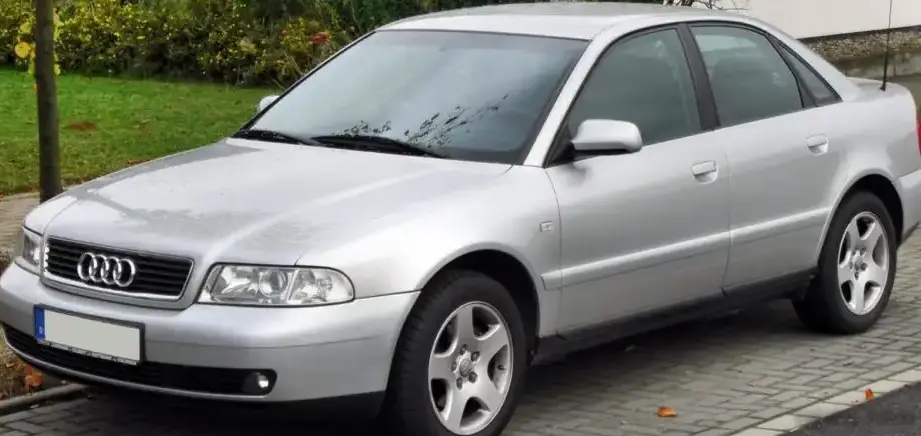
The Audi A4 (B5) facelift, produced from 1999 to 2000, represented a significant mid-cycle refresh of Audi’s popular compact executive car. Among the various engine and drivetrain configurations offered, the 1.9 TDI quattro model, producing 116 horsepower, occupied a unique position. This variant aimed to deliver a blend of fuel efficiency, all-weather capability through its quattro all-wheel-drive system, and respectable performance for everyday driving. It was primarily marketed in Europe, where diesel engines and all-wheel drive were highly valued, and represented a practical choice for buyers seeking a premium vehicle without the expense of higher-powered options.
Technical Specifications
| Brand | Audi |
| Model | A4 |
| Generation | A4 (B5, Typ 8D, facelift 1999) |
| Type (Engine) | 1.9 TDI (116 Hp) quattro |
| Start of production | 1999 |
| End of production | 2000 |
| Powertrain Architecture | Internal Combustion engine |
| Body type | Sedan |
| Seats | 5 |
| Doors | 4 |
| Fuel consumption (urban) | 7.8 l/100 km (30.2 US mpg, 36.2 UK mpg, 12.8 km/l) |
| Fuel consumption (extra urban) | 4.9 l/100 km (48 US mpg, 57.6 UK mpg, 20.4 km/l) |
| Fuel consumption (combined) | 6 l/100 km (39.2 US mpg, 47.1 UK mpg, 16.7 km/l) |
| Fuel Type | Diesel |
| Acceleration 0 – 100 km/h | 11.1 sec |
| Acceleration 0 – 62 mph | 11.1 sec |
| Acceleration 0 – 60 mph | 10.5 sec |
| Maximum speed | 196 km/h (121.79 mph) |
| Weight-to-power ratio | 12.3 kg/Hp, 81.4 Hp/tonne |
| Weight-to-torque ratio | 4.6 kg/Nm, 217.5 Nm/tonne |
| Power | 116 Hp @ 4000 rpm |
| Power per litre | 61.2 Hp/l |
| Torque | 310 Nm @ 1900 rpm (228.64 lb.-ft. @ 1900 rpm) |
| Engine layout | Front, Longitudinal |
| Engine Model/Code | AJM, ATJ |
| Engine displacement | 1896 cm3 (115.7 cu. in.) |
| Number of cylinders | 4 |
| Engine configuration | Inline |
| Cylinder Bore | 79.5 mm (3.13 in.) |
| Piston Stroke | 95.5 mm (3.76 in.) |
| Compression ratio | 19.5:1 |
| Number of valves per cylinder | 2 |
| Fuel injection system | Pump-nozzle (Unit Injector) |
| Engine aspiration | Turbocharger, Intercooler |
| Valvetrain | OHC |
| Engine oil capacity | 3.8 l (4.02 US qt | 3.34 UK qt) |
| Coolant | 6.5 l (6.87 US qt | 5.72 UK qt) |
| Kerb Weight | 1425 kg (3141.59 lbs.) |
| Max. weight | 1965 kg (4332.08 lbs.) |
| Max load | 540 kg (1190.5 lbs.) |
| Trunk (boot) space – minimum | 440 l (15.54 cu. ft.) |
| Fuel tank capacity | 60 l (15.85 US gal | 13.2 UK gal) |
| Length | 4479 mm (176.34 in.) |
| Width | 1733 mm (68.23 in.) |
| Height | 1415 mm (55.71 in.) |
| Wheelbase | 2607 mm (102.64 in.) |
| Front track | 1498 mm (58.98 in.) |
| Rear (Back) track | 1477 mm (58.15 in.) |
| Drag coefficient (Cd) | 0.31 |
| Minimum turning circle | 11.1 m (36.42 ft.) |
| Drive wheel | All wheel drive (4×4) |
| Number of gears | 6 |
| Gearbox type | Manual transmission |
| Front suspension | Wishbone |
| Rear suspension | Double wishbone |
| Front brakes | Ventilated discs |
| Rear brakes | Disc |
| Assisting systems | ABS (Anti-lock braking system) |
| Steering type | Steering rack and pinion |
| Power steering | Hydraulic Steering |
| Tires size | 195/65 R15 |
| Wheel rims size | 15 |
INTRODUCTION
The Audi A4 (B5) facelift, launched in 1999, built upon the success of the original B5 platform (introduced in 1994). This refresh brought revised styling, improved interior materials, and updated engine options. The 1.9 TDI quattro variant, powered by the AJM or ATJ engine code, was a key offering in European markets. It slotted into the A4 range as a practical, fuel-efficient, and capable all-weather option, positioned below the more powerful 2.8 V6 and 1.8T models, but above the base 1.6-liter gasoline engine. The B5 A4, including this variant, was a pivotal model for Audi, solidifying its reputation for build quality, sophisticated design, and advanced technology.
Powertrain & Engine Architecture
The heart of the 1.9 TDI quattro is the 1.9-liter inline-four diesel engine, specifically the AJM or ATJ variant. These engines utilize a direct injection system employing pump-nozzle (Unit Injector) technology developed by Bosch. This system delivers highly pressurized fuel directly into the combustion chamber, improving combustion efficiency and reducing emissions. The engine features an overhead camshaft (OHC) valvetrain with two valves per cylinder. A turbocharger with an intercooler is employed to boost power and torque. The intercooler cools the compressed air from the turbocharger, increasing its density and further enhancing performance.
The engine’s 116 horsepower at 4000 rpm and 310 Nm (228.64 lb-ft) of torque at 1900 rpm provided a good balance of power and efficiency. The engine is longitudinally mounted, a characteristic of Audi’s quattro all-wheel-drive system. The 6-speed manual transmission was standard, offering precise gear changes and contributing to the car’s overall driving experience. The transmission’s gear ratios were tuned to maximize fuel economy while still providing adequate acceleration.
Driving Characteristics
The 1.9 TDI quattro, with its 116 hp and manual transmission, offered a respectable, if not exhilarating, driving experience. Acceleration from 0-60 mph took around 10.5 seconds, and top speed was approximately 121.79 mph. While not as quick as the gasoline-powered A4 variants, the TDI provided ample torque for everyday driving and overtaking maneuvers. The turbocharger provided a noticeable boost in power, particularly at lower engine speeds. The quattro all-wheel-drive system provided excellent traction in all weather conditions, enhancing stability and control. The 6-speed manual transmission allowed drivers to keep the engine in its optimal power band, maximizing performance and efficiency. Compared to the 1.8T models, the TDI felt less refined and had more engine noise, but it offered significantly better fuel economy.
Equipment & Trim Levels
The 1.9 TDI quattro typically came with a reasonable level of standard equipment. This included power windows, central locking, power steering, and an ABS anti-lock braking system. Interior upholstery was typically cloth, although leather options were available. The dashboard layout was functional and well-designed, with clear instrumentation. Optional extras included a sunroof, alloy wheels, a premium sound system, and climate control. The trim level could vary depending on the specific market and customer preferences.
Chassis & Braking
The B5 A4 featured a robust chassis with independent suspension at all four wheels. The front suspension utilized a wishbone setup, while the rear employed a double wishbone configuration. This provided a comfortable ride and good handling characteristics. The 1.9 TDI quattro was equipped with ventilated disc brakes at the front and solid disc brakes at the rear. The ABS system helped to prevent wheel lockup during braking, enhancing safety. Stabilizer bars were fitted to both the front and rear axles to reduce body roll during cornering.
Market Reception & Comparison
The Audi A4 1.9 TDI quattro was well-received by automotive critics in Europe. It was praised for its fuel efficiency, all-weather capability, and comfortable ride. However, some critics noted that the engine was somewhat noisy and lacked the refinement of the gasoline-powered A4 models. Compared to the 1.8T and 2.8 V6 variants, the TDI offered significantly better fuel economy, making it a popular choice for high-mileage drivers. It also provided superior traction and stability in adverse weather conditions thanks to the quattro system. The 1.9 TDI was often seen as a more sensible and practical choice than its more powerful siblings.
Legacy
The 1.9 TDI engine, in its various iterations, proved to be remarkably durable and reliable. The AJM and ATJ codes are known for their longevity, and well-maintained examples can still be found on the road today. The B5 A4, as a whole, has gained a reputation as a classic Audi, appreciated for its build quality and timeless design. The 1.9 TDI quattro variant remains a popular choice among enthusiasts seeking a practical, fuel-efficient, and capable all-weather vehicle. On the used car market, these models typically command a reasonable price, reflecting their age and mileage, but also their enduring appeal and reputation for reliability.