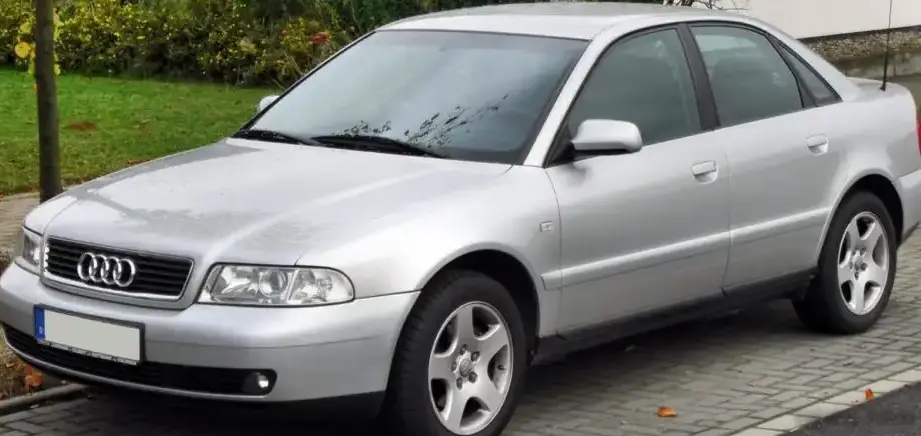
The Audi A4 (B5) facelift, produced from 1999 to 2000, represented a significant mid-cycle refresh of Audi’s popular compact executive car. Among the various engine and drivetrain configurations offered, the 2.5 TDI V6 with 150 horsepower coupled with the quattro all-wheel drive system and a Tiptronic automatic transmission was a notable offering, particularly in European markets. This variant aimed to provide a blend of performance, refinement, and practicality for buyers seeking a comfortable and capable touring sedan. It sat within the B5 A4 range as a premium diesel option, positioned above the entry-level 1.8L petrol models and below the more potent 2.8L V6 petrol and higher-output TDI variants.
Technical Specifications
| Brand | Audi |
| Model | A4 |
| Generation | A4 (B5, Typ 8D, facelift 1999) |
| Type (Engine) | 2.5 TDI V6 (150 Hp) quattro Tiptronic |
| Start of production | 1999 |
| End of production | 2000 |
| Powertrain Architecture | Internal Combustion engine |
| Body type | Sedan |
| Seats | 5 |
| Doors | 4 |
| Fuel consumption (urban) | 12 l/100 km (19.6 US mpg, 23.5 UK mpg, 8.3 km/l) |
| Fuel consumption (extra urban) | 6.5 l/100 km (36.2 US mpg, 43.5 UK mpg, 15.4 km/l) |
| Fuel consumption (combined) | 8.5 l/100 km (27.7 US mpg, 33.2 UK mpg, 11.8 km/l) |
| Fuel Type | Diesel |
| Acceleration 0 – 100 km/h | 10.4 sec |
| Acceleration 0 – 62 mph | 10.4 sec |
| Acceleration 0 – 60 mph | 9.9 sec |
| Maximum speed | 212 km/h (131.73 mph) |
| Weight-to-power ratio | 10.3 kg/Hp, 97.4 Hp/tonne |
| Weight-to-torque ratio | 5 kg/Nm, 201.3 Nm/tonne |
| Power | 150 Hp @ 4000 rpm |
| Power per litre | 60.1 Hp/l |
| Torque | 310 Nm @ 1500-3200 rpm (228.64 lb.-ft. @ 1500-3200 rpm) |
| Engine layout | Front, Longitudinal |
| Engine Model/Code | AFB |
| Engine displacement | 2496 cm3 (152.32 cu. in.) |
| Number of cylinders | 6 |
| Engine configuration | V-engine |
| Cylinder Bore | 78.3 mm (3.08 in.) |
| Piston Stroke | 86.4 mm (3.4 in.) |
| Compression ratio | 19.5:1 |
| Number of valves per cylinder | 4 |
| Fuel injection system | Direct injection |
| Engine aspiration | Turbocharger, Intercooler |
| Valvetrain | DOHC |
| Engine oil capacity | 5.5 l (5.81 US qt | 4.84 UK qt) |
| Coolant | 8 l (8.45 US qt | 7.04 UK qt) |
| Kerb Weight | 1540 kg (3395.12 lbs.) |
| Max. weight | 2090 kg (4607.66 lbs.) |
| Max load | 550 kg (1212.54 lbs.) |
| Trunk (boot) space – minimum | 440 l (15.54 cu. ft.) |
| Fuel tank capacity | 60 l (15.85 US gal | 13.2 UK gal) |
| Length | 4479 mm (176.34 in.) |
| Width | 1733 mm (68.23 in.) |
| Height | 1415 mm (55.71 in.) |
| Wheelbase | 2607 mm (102.64 in.) |
| Front track | 1498 mm (58.98 in.) |
| Rear (Back) track | 1477 mm (58.15 in.) |
| Drag coefficient (Cd) | 0.31 |
| Minimum turning circle | 11.1 m (36.42 ft.) |
| Drive wheel | All wheel drive (4×4) |
| Number of gears and type of gearbox | 5 gears, automatic transmission Tiptronic |
| Front suspension | Wishbone |
| Rear suspension | Double wishbone |
| Front brakes | Ventilated discs |
| Rear brakes | Disc |
| Assisting systems | ABS (Anti-lock braking system) |
| Steering type | Steering rack and pinion |
| Power steering | Hydraulic Steering |
| Tires size | 195/65 R15 |
| Wheel rims size | 15 |
INTRODUCTION
The Audi A4 (B5) facelift, launched in 1999, built upon the success of the original B5 platform (introduced in 1994). This refresh brought revised styling, improved interior materials, and updated engine options. The 2.5 TDI V6 quattro Tiptronic variant was a key part of this update, offering a sophisticated diesel powertrain combined with Audi’s renowned quattro all-wheel drive system and the convenience of an automatic transmission. This model was primarily aimed at the European market, where diesel engines enjoyed significant popularity due to their fuel efficiency and torque characteristics. It provided a comfortable and capable grand touring experience, appealing to drivers who prioritized long-distance cruising and all-weather capability.
Powertrain & Engine Architecture
The heart of this A4 variant is the 2.5-liter V6 TDI engine, designated with the code AFB. This engine utilizes a direct injection diesel system, a technology that significantly improved fuel efficiency and reduced emissions compared to older indirect injection systems. The AFB engine features a robust cast iron block and aluminum cylinder heads, incorporating a single turbocharger with an intercooler to boost power and torque. The engine’s valvetrain employs double overhead camshafts (DOHC) with four valves per cylinder, optimizing airflow for improved performance. The Tiptronic transmission is a 5-speed automatic gearbox that allows for both fully automatic operation and manual gear selection via steering wheel-mounted paddles or the gear selector. This transmission is known for its smooth shifting and responsiveness, enhancing the driving experience.
Driving Characteristics
The 2.5 TDI V6 with the Tiptronic transmission delivered a refined and capable driving experience. While not as overtly sporty as the petrol-powered A4 variants, the diesel engine’s substantial 310 Nm (228.64 lb-ft) of torque provided strong acceleration from low engine speeds. The Tiptronic transmission, while smooth, did introduce a slight efficiency loss compared to a manual gearbox. The quattro all-wheel drive system provided excellent traction in all weather conditions, enhancing stability and confidence, particularly on slippery surfaces. The gear ratios were tuned for comfortable cruising, with a focus on maximizing fuel efficiency at highway speeds. Acceleration from 0-60 mph took approximately 9.9 seconds, and the car had a top speed of 212 km/h (131.73 mph). Compared to the 1.8L petrol models, the TDI offered significantly more torque and better fuel economy, but lacked the higher-revving character of the petrol engine. Compared to the more powerful 2.8L V6, the 2.5 TDI provided a more economical and relaxed driving experience.
Equipment & Trim Levels
The 2.5 TDI V6 quattro Tiptronic typically came well-equipped, reflecting its position as a premium variant. Standard features often included climate control, power windows and mirrors, central locking, and an upgraded audio system. Interior upholstery was typically cloth or leather, with wood or aluminum trim accents available. Optional extras included sunroof, heated seats, navigation system, and upgraded alloy wheels. The facelift models also benefited from improved interior materials and a more modern dashboard design compared to the pre-facelift B5 A4s. The level of equipment could vary depending on the specific market and optional packages selected by the original buyer.
Chassis & Braking
The B5 A4 featured a fully independent suspension system, with wishbone suspension at the front and a double wishbone setup at the rear. This provided a comfortable ride and good handling characteristics. The 2.5 TDI V6 models typically featured slightly stiffer suspension components compared to the base models to cope with the engine’s added weight. Braking was handled by ventilated discs at the front and solid discs at the rear, with ABS (Anti-lock Braking System) as standard. The braking system provided adequate stopping power for everyday driving, although the increased weight of the V6 engine and quattro drivetrain meant that stopping distances were slightly longer than those of lighter A4 variants.
Market Reception & Comparison
The Audi A4 2.5 TDI V6 quattro Tiptronic was generally well-received by automotive critics. It was praised for its refined engine, comfortable ride, and all-weather capability. However, some critics noted that the Tiptronic transmission could feel slightly sluggish at times, and that the car wasn’t as engaging to drive as some of its rivals. Fuel economy was a strong point, with combined fuel consumption figures of around 8.5 l/100 km (27.7 US mpg). Reliability was generally good, although the complex direct injection system and turbocharger could require occasional maintenance. Compared to other trims, the 2.5 TDI offered a compelling blend of performance, efficiency, and luxury, making it a popular choice for drivers who prioritized comfort and practicality.
Legacy
The 2.5 TDI V6 engine, particularly the AFB code, proved to be a durable and reliable powertrain when properly maintained. Today, these A4s are increasingly sought after by enthusiasts and collectors. While finding well-maintained examples can be challenging, the 2.5 TDI V6 quattro Tiptronic remains a capable and comfortable classic car. Common issues include turbocharger wear, injector problems, and wear in the automatic transmission. However, with regular servicing and preventative maintenance, these cars can provide many years of reliable service. The B5 A4, and particularly this diesel variant, holds a significant place in Audi’s history as a pivotal model that helped establish the brand as a leader in the premium compact executive segment.