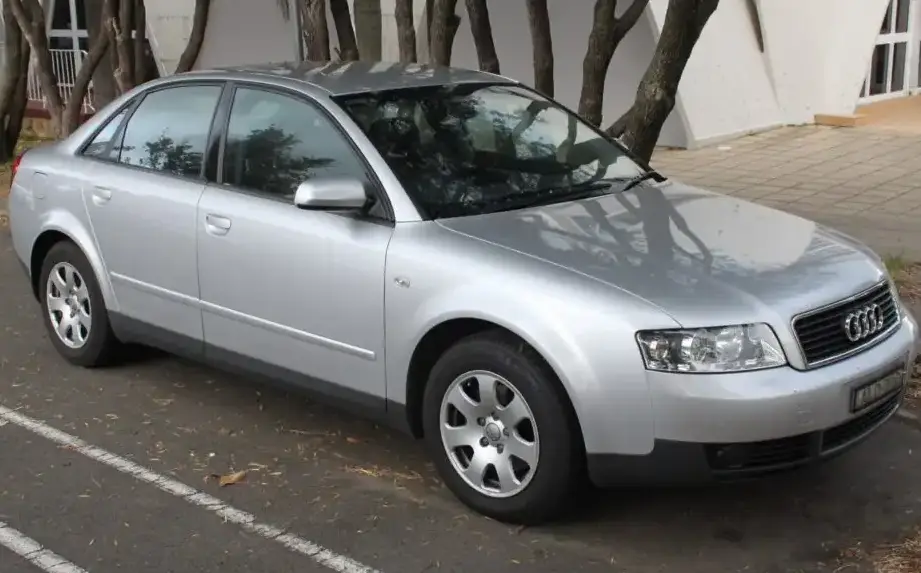
The Audi A4 (B6), produced between 2002 and 2005, represented a significant step forward for Audi’s popular executive car. The 1.8T variant, specifically the 163 horsepower version, occupied an important middle ground in the B6 A4 lineup. Positioned above the base 1.6-liter models (not offered in the US market) and below the more potent 2.0T and 3.0 V6 options, it aimed to deliver a balance of performance, fuel efficiency, and affordability. This model was a key player in Audi’s strategy to attract a broader customer base, particularly in European markets where smaller displacement engines were favored. The B6 A4 utilized the Volkswagen Group’s PL45 platform, also known as the 1HX0 platform, shared with the Volkswagen Passat B5.5.
Technical Specifications
| Brand | Audi |
| Model | A4 |
| Generation | A4 (B6 8E) |
| Type (Engine) | 1.8 T (163 Hp) |
| Start of production | 2002 |
| End of production | 2004 |
| Powertrain Architecture | Internal Combustion engine |
| Body type | Sedan |
| Seats | 5 |
| Doors | 4 |
| Fuel consumption (urban) | 11.3 l/100 km (20.8 US mpg) |
| Fuel consumption (extra urban) | 6.4 l/100 km (36.8 US mpg) |
| Fuel consumption (combined) | 8.2 l/100 km (28.7 US mpg) |
| Fuel Type | Petrol (Gasoline) |
| Acceleration 0 – 100 km/h | 8.6 sec |
| Acceleration 0 – 62 mph | 8.6 sec |
| Acceleration 0 – 60 mph | 8.2 sec |
| Maximum speed | 228 km/h (141.67 mph) |
| Weight-to-power ratio | 8.4 kg/Hp |
| Weight-to-torque ratio | 6.1 kg/Nm |
| Power | 163 Hp @ 5700 rpm |
| Torque | 225 Nm @ 1950-4700 rpm (165.95 lb.-ft. @ 1950-4700 rpm) |
| Engine layout | Front, Longitudinal |
| Engine Model/Code | BFB |
| Engine displacement | 1781 cm3 (108.68 cu. in.) |
| Number of cylinders | 4 |
| Engine configuration | Inline |
| Cylinder Bore | 81 mm (3.19 in.) |
| Piston Stroke | 86.4 mm (3.4 in.) |
| Compression ratio | 9.3:1 |
| Number of valves per cylinder | 5 |
| Fuel injection system | Multi-port manifold injection |
| Engine aspiration | Turbocharger, Intercooler |
| Valvetrain | DOHC |
| Engine oil capacity | 4.1 l (4.33 US qt | 3.61 UK qt) |
| Coolant | 8 l (8.45 US qt | 7.04 UK qt) |
| Kerb Weight | 1375 kg (3031.36 lbs.) |
| Max. weight | 1925 kg (4243.9 lbs.) |
| Max load | 550 kg (1212.54 lbs.) |
| Trunk (boot) space – minimum | 445 l (15.72 cu. ft.) |
| Trunk (boot) space – maximum | 720 l (25.43 cu. ft.) |
| Fuel tank capacity | 70 l (18.49 US gal | 15.4 UK gal) |
| Length | 4548 mm (179.06 in.) |
| Width | 1772 mm (69.76 in.) |
| Height | 1428 mm (56.22 in.) |
| Wheelbase | 2650 mm (104.33 in.) |
| Front track | 1528 mm (60.16 in.) |
| Rear (Back) track | 1526 mm (60.08 in.) |
| Drag coefficient (Cd) | 0.30 |
| Minimum turning circle | 11.1 m (36.42 ft.) |
| Drivetrain Architecture | Front wheel drive |
| Number of gears | 5 |
| Type of gearbox | Manual transmission |
| Front suspension | Independent multi-link suspension |
| Rear suspension | Independent multi-link suspension |
| Front brakes | Ventilated discs |
| Rear brakes | Disc |
| Assisting systems | ABS (Anti-lock braking system) |
| Steering type | Steering rack and pinion |
| Tires size | 205/55 R16 |
| Wheel rims size | 7J x 16 |
Powertrain & Engine Architecture
The heart of the A4 1.8T was the BFB engine code, a 1.8-liter inline-four cylinder gasoline engine. This engine was a member of Audi/Volkswagen’s EA888 family, known for its robust construction and tuning potential. The BFB featured a cast iron block and an aluminum cylinder head, incorporating five valves per cylinder (three intake, two exhaust) for improved breathing. Fuel delivery was handled by a multi-port fuel injection system, and the engine was equipped with a K03 turbocharger and an intercooler to boost power output. The turbocharger provided significant improvements in torque across the rev range. The 5-speed manual transmission was the standard offering, known for its relatively smooth shifts. A four-speed automatic transmission was also available, though it was often criticized for being somewhat dated and impacting fuel economy and performance.
Driving Characteristics
The 163 hp 1.8T A4 offered a respectable driving experience. Acceleration from 0-60 mph took around 8.2 seconds, making it competitive with other cars in its class. The turbocharger provided a noticeable surge of power in the mid-range, making overtaking maneuvers relatively easy. However, compared to the more powerful 2.0T or 3.0 V6 models, the 1.8T felt less responsive, particularly at higher speeds. The automatic transmission, while convenient, resulted in a slight decrease in performance and fuel economy compared to the manual version. The gear ratios were tuned for comfort and fuel efficiency rather than outright speed. The front-wheel-drive configuration provided good traction in most conditions, but could exhibit some torque steer under hard acceleration.
Equipment & Trim Levels
The 1.8T A4 typically came standard with features such as air conditioning, power windows and locks, a CD stereo system, and alloy wheels. Higher trim levels, such as the Attraction and Ambition packages, added features like a sunroof, upgraded upholstery, automatic climate control, and a premium sound system. Optional extras included leather seats, navigation system, and xenon headlights. Interior upholstery was typically cloth, with leather available as an upgrade. The dashboard layout was functional and well-designed, with clear instrumentation and intuitive controls.
Chassis & Braking
The B6 A4 featured fully independent multi-link suspension at both the front and rear, providing a comfortable ride and good handling characteristics. The front suspension utilized coil springs and shock absorbers, while the rear suspension incorporated separate springs and dampers. The 1.8T models typically came equipped with ventilated disc brakes at the front and solid disc brakes at the rear. Anti-lock braking system (ABS) was standard. Stabilizer bars were fitted to both the front and rear axles to reduce body roll during cornering. The suspension tuning was geared towards providing a balance between comfort and handling, making it suitable for both daily commuting and spirited driving.
Market Reception & Comparison
The A4 1.8T was generally well-received by automotive critics. It was praised for its comfortable ride, refined interior, and balanced handling. However, some critics noted that the engine lacked the outright punch of its larger displacement counterparts. Compared to the 2.0T, the 1.8T offered a more affordable entry point into the A4 range, but at the expense of performance. The 1.8T also offered better fuel economy than the 2.0T and 3.0 V6 models. Against competitors like the BMW 3 Series and Mercedes-Benz C-Class, the A4 1.8T offered a compelling combination of features, performance, and value.
Legacy
The B6 A4 1.8T has proven to be a relatively reliable car, with many examples still on the road today. The EA888 engine is known for its durability, although regular maintenance is essential to prevent issues such as oil leaks and turbocharger failure. The automatic transmission, while not as refined as modern units, can be reliable if properly maintained. The B6 A4 1.8T remains a popular choice in the used car market, offering a comfortable and stylish driving experience at an affordable price. Its relatively simple mechanicals make it a good option for DIY mechanics, and parts availability is generally good.