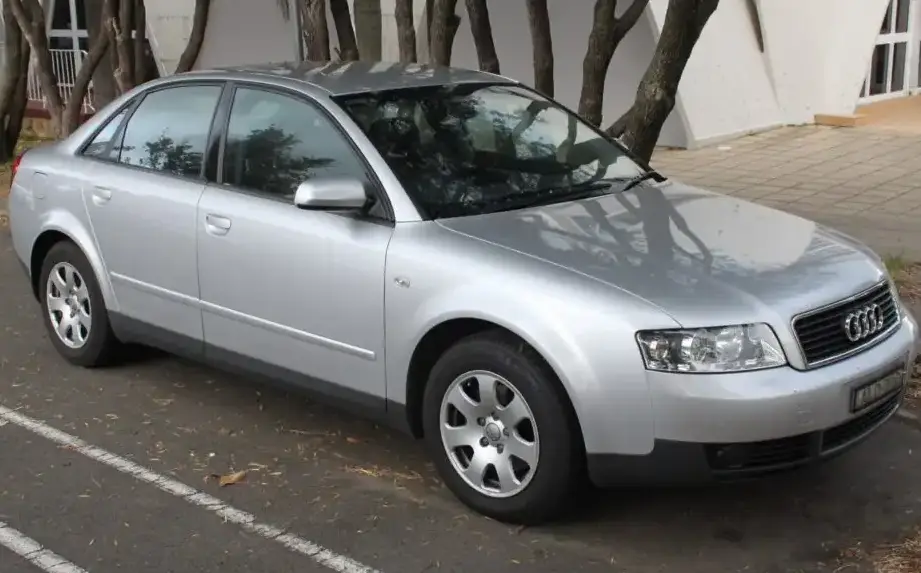
The Audi A4 (B6) 2.0i 20V Multitronic, produced from September 2000 to 2004, represented a key entry point into the B6 A4 range. Positioned as a more accessible alternative to the higher-performance and more expensive models, it offered a blend of practicality, comfort, and Audi’s renowned build quality. This variant, powered by the ALT engine code, was primarily aimed at buyers seeking a refined and fuel-efficient sedan within the compact executive class. It played a significant role in establishing the B6 A4 as a popular choice in both European and North American markets.
Technical Specifications
| Brand | Audi |
| Model | A4 |
| Generation | A4 (B6 8E) |
| Type (Engine) | 2.0i 20V (131 Hp) Multitronic |
| Start of production | September, 2000 |
| End of production | 2004 |
| Powertrain Architecture | Internal Combustion engine |
| Body type | Sedan |
| Seats | 5 |
| Doors | 4 |
| Fuel consumption (urban) | 10.9 l/100 km (21.6 US mpg) |
| Fuel consumption (extra urban) | 6.2 l/100 km (37.9 US mpg) |
| Fuel consumption (combined) | 7.9 l/100 km (29.8 US mpg) |
| Fuel Type | Petrol (Gasoline) |
| Acceleration 0 – 100 km/h | 10.4 sec |
| Acceleration 0 – 62 mph | 10.4 sec |
| Acceleration 0 – 60 mph | 9.9 sec |
| Maximum speed | 205 km/h (127.38 mph) |
| Weight-to-power ratio | 10.3 kg/Hp |
| Weight-to-torque ratio | 6.9 kg/Nm |
| Power | 131 Hp @ 5700 rpm |
| Torque | 195 Nm @ 3300 rpm (143.82 lb.-ft. @ 3300 rpm) |
| Engine layout | Front, Longitudinal |
| Engine Model/Code | ALT |
| Engine displacement | 1984 cm3 (121.07 cu. in.) |
| Number of cylinders | 4 |
| Engine configuration | Inline |
| Cylinder Bore | 82.5 mm (3.25 in.) |
| Piston Stroke | 92.8 mm (3.65 in.) |
| Compression ratio | 10.3:1 |
| Number of valves per cylinder | 5 |
| Fuel injection system | Multi-port manifold injection |
| Engine aspiration | Naturally aspirated engine |
| Valvetrain | DOHC |
| Engine oil capacity | 4.2 l (4.44 US qt | 3.7 UK qt) |
| Coolant capacity | 7 l (7.4 US qt | 6.16 UK qt) |
| Kerb Weight | 1345 kg (2965.22 lbs.) |
| Max. weight | 1895 kg (4177.76 lbs.) |
| Max load | 550 kg (1212.54 lbs.) |
| Trunk (boot) space – minimum | 445 l (15.72 cu. ft.) |
| Trunk (boot) space – maximum | 720 l (25.43 cu. ft.) |
| Fuel tank capacity | 70 l (18.49 US gal | 15.4 UK gal) |
| Length | 4548 mm (179.06 in.) |
| Width | 1772 mm (69.76 in.) |
| Height | 1428 mm (56.22 in.) |
| Wheelbase | 2650 mm (104.33 in.) |
| Front track | 1528 mm (60.16 in.) |
| Rear track | 1526 mm (60.08 in.) |
| Drag coefficient (Cd) | 0.28 |
| Minimum turning circle | 11.1 m (36.42 ft.) |
| Drivetrain Architecture | Front wheel drive |
| Number of gears and type of gearbox | automatic transmission Multitronic |
| Front suspension | Independent multi-link suspension |
| Rear suspension | Independent multi-link suspension |
| Front brakes | Ventilated discs |
| Rear brakes | Disc |
| Assisting systems | ABS (Anti-lock braking system) |
| Steering type | Steering rack and pinion |
| Power steering | Hydraulic Steering |
| Tires size | 195/65 R15 |
| Wheel rims size | 6.5J x 15 |
Powertrain & Engine Architecture
At the heart of the A4 2.0i Multitronic lies the Audi ALT engine, a 1.984-liter (121.07 cubic inches) inline-four cylinder gasoline engine. This engine is part of Audi’s EA827 family, known for its robust construction and relatively simple design. The ALT features a five-valve-per-cylinder (DOHC) configuration, enhancing volumetric efficiency. Fuel delivery is managed by a multi-port fuel injection system, providing precise fuel metering for optimal combustion. The engine produces 131 horsepower at 5700 rpm and 195 Nm (143.82 lb-ft) of torque at 3300 rpm. The engine’s longitudinal mounting allowed for front-wheel drive configuration, common in European models. Paired with this engine is Audi’s Multitronic continuously variable transmission (CVT). This transmission, a six-speed unit, offered smooth, stepless gear changes, prioritizing fuel efficiency and driving comfort over outright performance. The Multitronic utilized a chain-driven system, differing from the earlier toroidal CVTs, and proved generally reliable, though requiring specific maintenance intervals.
Driving Characteristics
The 2.0i Multitronic A4 offered a comfortable and refined driving experience. Acceleration from 0 to 60 mph took approximately 9.9 seconds, and top speed was limited to 127.38 mph. While not a sports car, the engine provided adequate power for everyday driving situations. The Multitronic transmission contributed to a smooth and seamless power delivery, eliminating the shift shock associated with traditional automatic transmissions. However, the CVT’s programming sometimes resulted in a “rubber band” feel during hard acceleration, where engine speed would rise before the car responded with increased velocity. Compared to the more powerful 1.8T models or the diesel variants, the 2.0i felt less responsive, particularly during overtaking maneuvers. The gear ratios were optimized for fuel economy rather than outright performance.
Equipment & Trim Levels
The 2.0i Multitronic typically came with a respectable level of standard equipment. This included power windows, power locks, air conditioning, and an AM/FM radio with CD player. Interior upholstery was typically cloth, though leather options were available. Safety features such as ABS brakes and front airbags were standard. Optional extras included sunroof, upgraded audio systems, alloy wheels, and parking sensors. The trim level was generally considered entry-level to mid-range within the B6 A4 lineup, offering a good balance of features and affordability.
Chassis & Braking
The B6 A4 featured fully independent multi-link suspension at both the front and rear, providing a comfortable ride and good handling characteristics. The 2.0i variant typically used ventilated disc brakes at the front and solid disc brakes at the rear. ABS (Anti-lock Braking System) was standard. The suspension was tuned for comfort, prioritizing ride quality over aggressive handling. Stabilizer bars were fitted to both axles to reduce body roll during cornering. The chassis was relatively lightweight, contributing to the car’s overall agility.
Market Reception & Comparison
The A4 2.0i Multitronic was generally well-received by automotive critics as a practical and comfortable daily driver. It was praised for its smooth transmission, comfortable ride, and refined interior. However, some critics noted its lack of outright performance compared to other A4 variants. Fuel economy was a strong point, with combined figures around 29.8 US mpg. Compared to the 1.8T models, the 2.0i offered lower running costs but less excitement. The 1.9 TDI diesel variants provided even better fuel economy but with a different driving experience. The Multitronic transmission, while smooth, required more diligent maintenance than a traditional automatic.
Legacy
The Audi A4 B6 2.0i Multitronic remains a relatively common sight on used car markets today. The ALT engine is generally considered reliable, though regular maintenance is crucial. The Multitronic transmission, while generally durable, requires fluid changes every 40,000 miles to prevent premature wear. Parts availability is good, and the car’s relatively simple design makes it relatively easy to maintain. The B6 A4, in general, is remembered as a significant step forward for Audi, establishing the brand as a serious competitor in the premium compact executive segment. The 2.0i Multitronic variant, while not the most powerful or sporty, offered a compelling combination of comfort, efficiency, and Audi’s renowned build quality, making it a popular choice for many buyers.