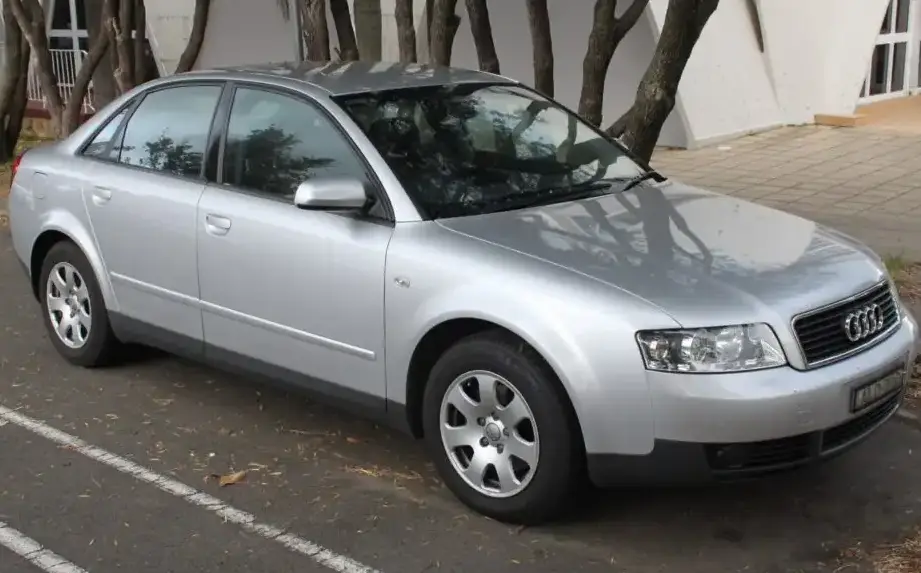
The Audi A4 (B6), produced between 2000 and 2005, represented a significant step forward for Audi’s popular compact executive car. The 3.0i V6 variant, available from September 2000 through 2004, occupied the upper echelon of the B6 A4 lineup, offering a substantial performance upgrade over the four-cylinder models. Positioned as a premium offering, it catered to buyers seeking a blend of luxury, performance, and all-weather capability. This model was built on the Volkswagen Group’s B6 platform (internally designated 8E), shared with the Volkswagen Passat, Škoda Superb, and SEAT Exeo.
Technical Specifications
| Brand | Audi |
| Model | A4 |
| Generation | A4 (B6 8E) |
| Type (Engine) | 3.0i V6 (220 Hp) |
| Start of production | September, 2000 |
| End of production | 2004 |
| Powertrain Architecture | Internal Combustion engine |
| Body type | Sedan |
| Seats | 5 |
| Doors | 4 |
| Fuel consumption (urban) | 13.7 l/100 km (17.2 US mpg, 20.6 UK mpg, 7.3 km/l) |
| Fuel consumption (extra urban) | 7.1 l/100 km (33.1 US mpg, 39.8 UK mpg, 14.1 km/l) |
| Fuel consumption (combined) | 9.5 l/100 km (24.8 US mpg, 29.7 UK mpg, 10.5 km/l) |
| Fuel Type | Petrol (Gasoline) |
| Acceleration 0 – 100 km/h | 6.9 sec |
| Acceleration 0 – 62 mph | 6.9 sec |
| Acceleration 0 – 60 mph | 6.6 sec |
| Maximum speed | 245 km/h (152.24 mph) |
| Weight-to-power ratio | 6.5 kg/Hp, 154.4 Hp/tonne |
| Weight-to-torque ratio | 4.8 kg/Nm, 210.5 Nm/tonne |
| Power | 220 Hp @ 6300 rpm |
| Power per litre | 73.9 Hp/l |
| Torque | 300 Nm @ 3200 rpm (221.27 lb.-ft. @ 3200 rpm) |
| Engine layout | Front, Longitudinal |
| Engine Model/Code | ASN, AVK |
| Engine displacement | 2976 cm3 (181.61 cu. in.) |
| Number of cylinders | 6 |
| Engine configuration | V-engine |
| Cylinder Bore | 82.5 mm (3.25 in.) |
| Piston Stroke | 92.8 mm (3.65 in.) |
| Compression ratio | 10.5:1 |
| Number of valves per cylinder | 5 |
| Fuel injection system | Multi-port manifold injection |
| Engine aspiration | Naturally aspirated engine |
| Valvetrain | DOHC |
| Engine oil capacity | 6.3 l (6.66 US qt | 5.54 UK qt) |
| Coolant | 9 l (9.51 US qt | 7.92 UK qt) |
| Kerb Weight | 1425 kg (3141.59 lbs.) |
| Max. weight | 1975 kg (4354.13 lbs.) |
| Max load | 550 kg (1212.54 lbs.) |
| Trunk (boot) space – minimum | 445 l (15.72 cu. ft.) |
| Trunk (boot) space – maximum | 720 l (25.43 cu. ft.) |
| Fuel tank capacity | 70 l (18.49 US gal | 15.4 UK gal) |
| Length | 4548 mm (179.06 in.) |
| Width | 1772 mm (69.76 in.) |
| Height | 1428 mm (56.22 in.) |
| Wheelbase | 2650 mm (104.33 in.) |
| Front track | 1528 mm (60.16 in.) |
| Rear (Back) track | 1526 mm (60.08 in.) |
| Drag coefficient (Cd) | 0.31 |
| Minimum turning circle | 11.1 m (36.42 ft.) |
| Drivetrain Architecture | The Internal combustion engine (ICE) drives the front wheels of the vehicle. |
| Drive wheel | Front wheel drive |
| Number of gears and type of gearbox | 5 gears, manual transmission |
| Front suspension | Independent multi-link suspension |
| Rear suspension | Independent multi-link suspension |
| Front brakes | Ventilated discs |
| Rear brakes | Disc |
| Assisting systems | ABS (Anti-lock braking system) |
| Steering type | Steering rack and pinion |
| Power steering | Hydraulic Steering |
| Tires size | 215/55 R16 |
| Wheel rims size | 7J x 16 |
Powertrain & Engine Architecture
The heart of the 3.0i A4 is the ASN or AVK engine code, a 2.976-liter (181.6 cu in) naturally aspirated V6. This engine is a 60-degree V-engine, utilizing an aluminum alloy block and cylinder heads. It features a dual overhead camshaft (DOHC) design with five valves per cylinder (three intake, two exhaust), contributing to its strong breathing and high-end power. Fuel delivery is managed by a multi-port fuel injection system, providing precise fuel metering for optimal combustion. The engine’s robust construction and well-engineered valvetrain allowed it to produce 220 horsepower at 6300 rpm and 300 Nm (221 lb-ft) of torque at 3200 rpm. The engine is longitudinally mounted, driving the front wheels through a five-speed manual transmission. While an automatic transmission was available, the manual was favored by enthusiasts for its more engaging driving experience.
Driving Characteristics
The 3.0i A4 offered a noticeably more spirited driving experience than its four-cylinder counterparts. The V6 engine provided ample power throughout the rev range, delivering smooth and linear acceleration. The 0-60 mph sprint was dispatched in approximately 6.6 seconds, making it a genuinely quick car for its time. The five-speed manual transmission was well-matched to the engine’s characteristics, offering precise shifts and a satisfying mechanical feel. The front-wheel-drive configuration, while providing good traction in most conditions, could exhibit some torque steer under hard acceleration. The suspension, tuned for a balance of comfort and handling, provided a composed ride, even on less-than-perfect road surfaces.
Equipment & Trim Levels
The 3.0i A4 typically came well-equipped, reflecting its position as a premium model. Standard features included automatic climate control, power windows and locks, a premium audio system, and alloy wheels. Leather upholstery was often standard or available as an option. Optional extras included a sunroof, navigation system, and upgraded sound systems. The interior design was typically understated and elegant, with a focus on quality materials and build quality. Trim levels varied slightly depending on the market, but generally, the 3.0i A4 offered a higher level of refinement than the base models.
Chassis & Braking
The B6 A4 featured an independent multi-link suspension at all four corners, providing a comfortable ride and good handling characteristics. The front suspension utilized a four-link design, while the rear employed a trapezoidal link setup. This configuration minimized body roll and provided precise steering response. Braking duties were handled by ventilated disc brakes at the front and solid discs at the rear. Anti-lock braking system (ABS) was standard, enhancing safety and control during emergency braking situations. The chassis was designed to be rigid and durable, contributing to the car’s overall stability and handling prowess.
Market Reception & Comparison
The 3.0i A4 was generally well-received by automotive critics, who praised its powerful engine, refined interior, and comfortable ride. It was often compared favorably to its rivals, such as the BMW 3 Series and Mercedes-Benz C-Class. However, some critics noted that the front-wheel-drive configuration limited its handling potential compared to rear-wheel-drive competitors. Fuel economy was reasonable for a V6 engine, but not exceptional. Compared to the 1.8T four-cylinder models, the 3.0i offered significantly more power and torque, but at the cost of increased fuel consumption and a higher purchase price. The 3.0i also provided a more refined and luxurious experience than the diesel variants.
Legacy
The 3.0i A4 (B6) has proven to be a relatively reliable car, with the V6 engine generally considered to be durable and long-lasting. However, like any used car, it’s important to be aware of potential maintenance issues. Common concerns include oil leaks, cooling system problems, and wear and tear on suspension components. Today, the 3.0i A4 (B6) represents a compelling value proposition for buyers seeking a well-equipped, sporty, and reliable European sedan. Its combination of performance, luxury, and affordability has made it a popular choice among enthusiasts and everyday drivers alike. The ASN and AVK engines, while requiring regular maintenance, are known for their longevity when properly cared for, ensuring that these A4s continue to provide years of driving enjoyment.