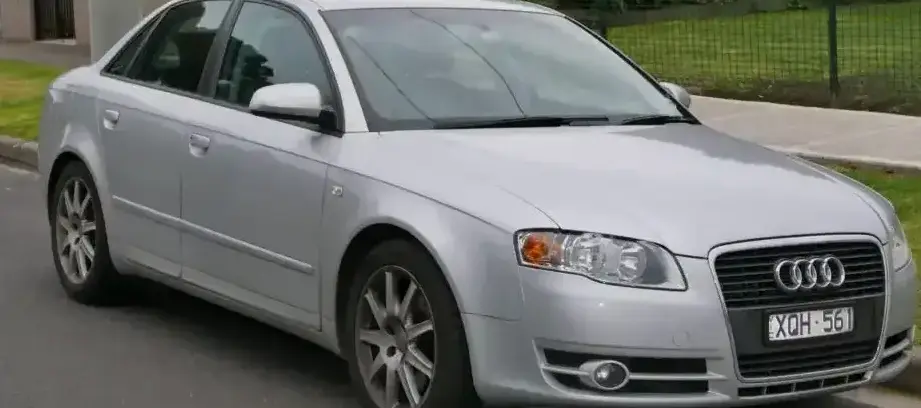
The Audi A4 (B7) 2.0, producing 130 horsepower, was a mainstay of the Audi lineup from 2004 to 2008. Representing the seventh generation of Audi’s popular compact executive car, the B7 chassis was a significant refresh of the B6, offering revised styling, improved interior quality, and updated technology. This particular 2.0-liter variant occupied a middle ground in the A4 range, positioned as a more affordable and fuel-efficient alternative to the higher-performance 1.8T quattro and 3.2 FSI models. It was primarily aimed at buyers seeking a comfortable, well-equipped sedan with a balance of performance and economy.
Technical Specifications
| Brand | Audi |
| Model | A4 |
| Generation | A4 (B7 8E) |
| Type (Engine) | 2.0 (130 Hp) |
| Start of production | 2004 |
| End of production | 2008 |
| Powertrain Architecture | Internal Combustion engine |
| Body type | Sedan |
| Seats | 5 |
| Doors | 4 |
| Fuel consumption (urban) | 11.5 l/100 km (20.5 US mpg) |
| Fuel consumption (extra urban) | 6 l/100 km (39.2 US mpg) |
| Fuel consumption (combined) | 8 l/100 km (29.4 US mpg) |
| CO2 emissions | 192 g/km |
| Fuel Type | Petrol (Gasoline) |
| Acceleration 0 – 100 km/h | 9.9 sec |
| Acceleration 0 – 62 mph | 9.9 sec |
| Acceleration 0 – 60 mph | 9.4 sec |
| Maximum speed | 212 km/h (131.73 mph) |
| Emission standard | Euro 4 |
| Weight-to-power ratio | 10.3 kg/Hp |
| Weight-to-torque ratio | 6.9 kg/Nm |
| Power | 130 Hp @ 5700 rpm |
| Torque | 195 Nm @ 3300 rpm (143.82 lb.-ft. @ 3300 rpm) |
| Engine layout | Front, Longitudinal |
| Engine Model/Code | ALT |
| Engine displacement | 1984 cm3 (121.07 cu. in.) |
| Number of cylinders | 4 |
| Engine configuration | Inline |
| Cylinder Bore | 82.5 mm (3.25 in.) |
| Piston Stroke | 92.8 mm (3.65 in.) |
| Compression ratio | 10.3:1 |
| Number of valves per cylinder | 5 |
| Fuel injection system | Multi-port manifold injection |
| Engine aspiration | Naturally aspirated engine |
| Valvetrain | DOHC |
| Engine oil capacity | 4.2 l (4.44 US qt | 3.7 UK qt) |
| Coolant | 8 l (8.45 US qt | 7.04 UK qt) |
| Kerb Weight | 1340 kg (2954.19 lbs.) |
| Max. weight | 1890 kg (4166.74 lbs.) |
| Max load | 550 kg (1212.54 lbs.) |
| Trunk (boot) space – minimum | 460 l (16.24 cu. ft.) |
| Trunk (boot) space – maximum | 720 l (25.43 cu. ft.) |
| Fuel tank capacity | 70 l (18.49 US gal | 15.4 UK gal) |
| Max. roof load | 75 kg (165.35 lbs.) |
| Permitted trailer load with brakes (8%) | 1500 kg (3306.93 lbs.) |
| Permitted trailer load with brakes (12%) | 1300 kg (2866.01 lbs.) |
| Permitted trailer load without brakes | 700 kg (1543.24 lbs.) |
| Permitted towbar download | 80 kg (176.37 lbs.) |
| Length | 4586 mm (180.55 in.) |
| Width | 1772 mm (69.76 in.) |
| Width including mirrors | 1937 mm (76.26 in.) |
| Height | 1427 mm (56.18 in.) |
| Wheelbase | 2648 mm (104.25 in.) |
| Front track | 1522 mm (59.92 in.) |
| Rear (Back) track | 1522 mm (59.92 in.) |
| Drag coefficient (Cd) | 0.28 |
| Minimum turning circle (turning diameter) | 11.1 m (36.42 ft.) |
| Drivetrain Architecture | The Internal combustion engine (ICE) drives the front wheels of the vehicle. |
| Drive wheel | Front wheel drive |
| Number of gears and type of gearbox | 5 gears, manual transmission |
| Front suspension | Independent multi-link suspension |
| Rear suspension | Independent multi-link suspension |
| Front brakes | Ventilated discs |
| Rear brakes | Disc |
| Assisting systems | ABS (Anti-lock braking system) |
| Steering type | Steering rack and pinion |
| Power steering | Hydraulic Steering |
| Tires size | 205/55 R16 |
| Wheel rims size | 7J x 16 |
Powertrain & Engine Architecture
The heart of the A4 2.0 was the ALT engine code, a 1.984-liter (121.07 cubic inches) inline-four cylinder gasoline engine. This engine featured a cast iron block and an aluminum cylinder head, incorporating a dual overhead camshaft (DOHC) valvetrain with five valves per cylinder. Fuel delivery was handled by a multi-port fuel injection system, providing precise fuel metering for optimal combustion. The engine produced 130 horsepower at 5700 rpm and 195 Nm (143.82 lb-ft) of torque at 3300 rpm. The engine’s relatively high compression ratio of 10.3:1 contributed to its efficiency. The standard transmission for this variant was a 5-speed manual gearbox, although a 6-speed automatic transmission was also available as an option. The automatic transmission was known for its smooth shifts but wasn’t particularly sporty or quick to respond.
Driving Characteristics
The A4 2.0 with the manual transmission offered adequate performance for everyday driving. Acceleration from 0 to 60 mph took around 9.4 seconds, and the top speed was 131.73 mph. The engine felt responsive enough in the mid-range, making it suitable for highway cruising and overtaking. However, it lacked the punch of the 1.8T models, especially at higher engine speeds. The automatic transmission, while comfortable, noticeably dulled acceleration. The gear ratios were tuned for fuel economy rather than outright performance. The front-wheel-drive configuration provided good traction in most conditions, but could exhibit torque steer under hard acceleration.
Equipment & Trim Levels
The A4 2.0 typically came standard with features such as air conditioning, power windows and locks, a CD stereo system, and alloy wheels. Higher trim levels, such as the Attraction and Ambition packages, added features like a sunroof, upgraded upholstery, automatic climate control, and parking sensors. Optional extras included leather seats, a navigation system, and a premium sound system. Interior upholstery was typically cloth, but leather was available as an upgrade. The dashboard layout was functional and well-designed, with clear instrumentation and intuitive controls.
Chassis & Braking
The B7 A4 featured an independent multi-link suspension system at both the front and rear, providing a comfortable ride and good handling characteristics. The front suspension utilized coil springs and shock absorbers, while the rear suspension incorporated separate springs and dampers. Braking duties were handled by ventilated discs at the front and solid discs at the rear, equipped with an Anti-lock Braking System (ABS). The steering was a rack-and-pinion system with hydraulic power assistance, offering precise and responsive steering feel. The standard tire size was 205/55 R16.
Market Reception & Comparison
The A4 2.0 was generally well-received by automotive critics as a practical and well-rounded compact executive car. It was praised for its comfortable ride, refined interior, and good fuel economy. However, some critics noted that the engine lacked the power and excitement of its turbocharged counterparts. Compared to the 1.8T models, the 2.0 offered lower running costs but sacrificed performance. The 1.8T quattro provided superior grip and acceleration, while the 2.0 was more affordable and fuel-efficient. The 2.0 also offered a more economical alternative to the more expensive 3.2 FSI.
Legacy
The Audi A4 (B7) 2.0 remains a popular choice in the used car market today. The ALT engine is generally considered reliable, although regular maintenance is essential. Common issues include oil leaks and occasional problems with the cooling system. The 5-speed manual transmission is known for its durability, while the automatic transmission may require more frequent servicing. Overall, the A4 2.0 (B7) represents a solid and dependable compact executive car that offers a good balance of comfort, economy, and practicality. Its relatively simple engine design and readily available parts contribute to its continued appeal among enthusiasts and budget-conscious buyers.