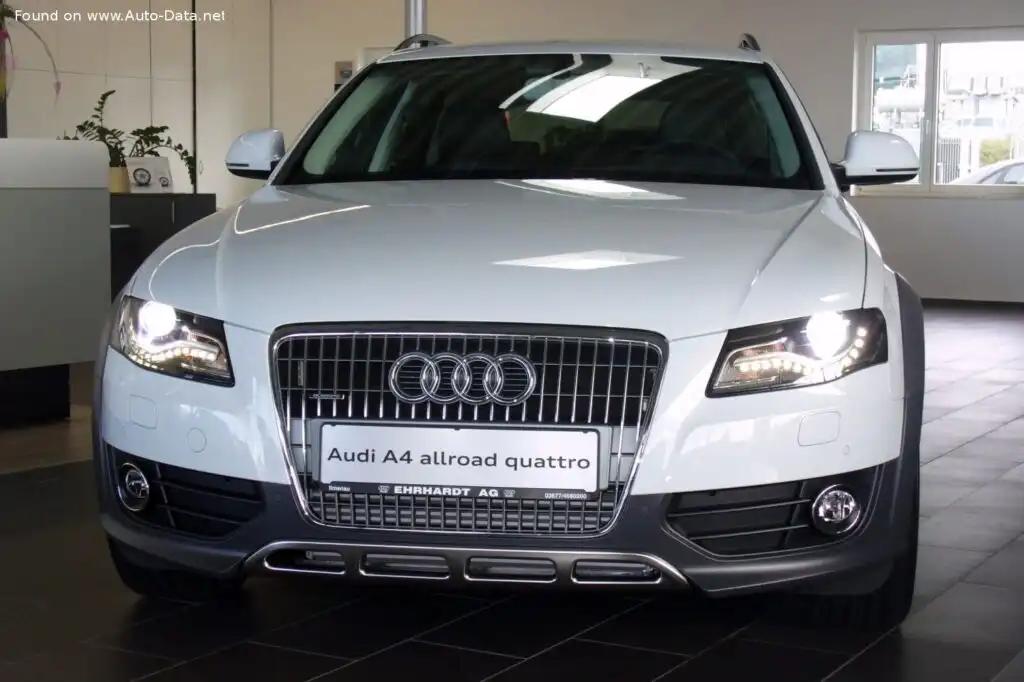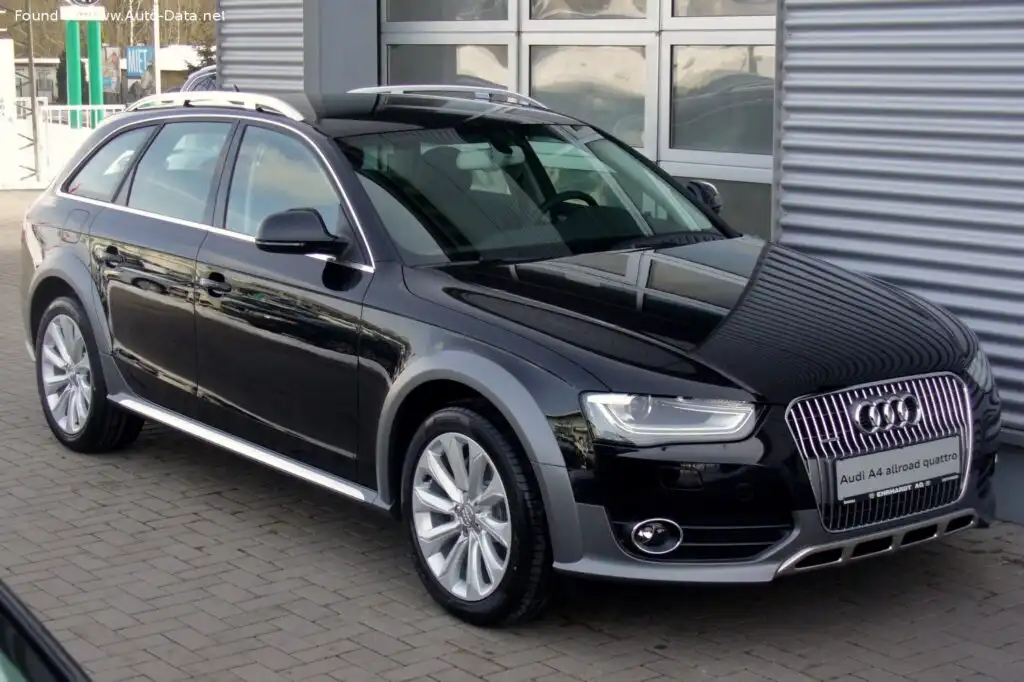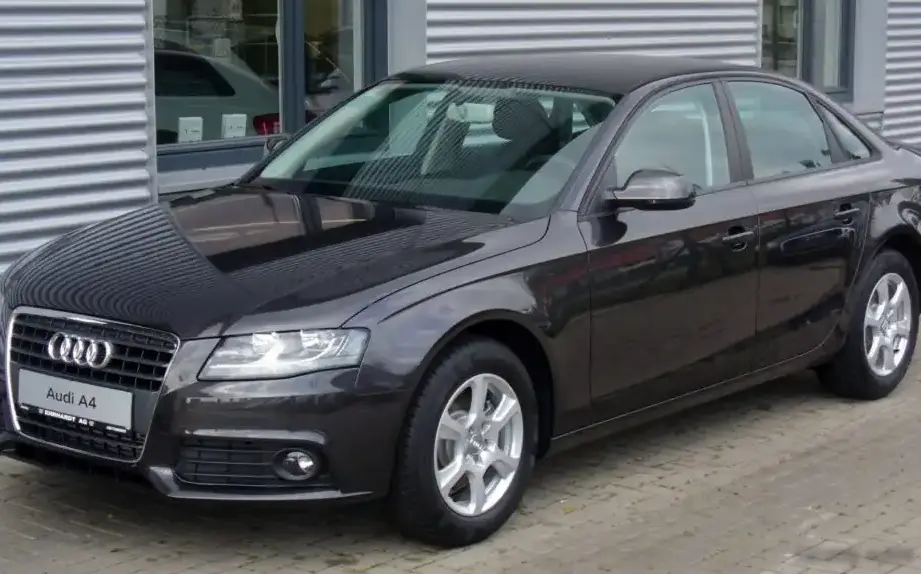
The Audi A4 (B8 8K) 2.0 TFSI, producing 211 horsepower, represents a significant iteration of Audi’s popular executive sedan. Introduced in August 2008 and continuing through 2011, this variant occupied a key position within the B8 A4 lineup, offering a balance of performance and efficiency. It was positioned as a step up from the base 1.8 TFSI models, while remaining more accessible than the high-performance S4 or the diesel-powered TDI variants. The B8 generation A4, built on the Volkswagen Group’s B8 (PL46) platform, aimed to improve upon its predecessor with enhanced refinement, technology, and driving dynamics.
Technical Specifications
| Brand | Audi |
| Model | A4 |
| Generation | A4 (B8 8K) |
| Type (Engine) | 2.0 TFSI (211 Hp) |
| Start of production | August, 2008 |
| End of production | 2011 |
| Powertrain Architecture | Internal Combustion engine |
| Body type | Sedan |
| Seats | 5 |
| Doors | 4 |
| Fuel consumption (economy) – urban | 9 l/100 km (26.1 US mpg, 31.4 UK mpg, 11.1 km/l) |
| Fuel consumption (economy) – extra urban | 5.2 l/100 km (45.2 US mpg, 54.3 UK mpg, 19.2 km/l) |
| Fuel consumption (economy) – combined | 6.6 l/100 km (35.6 US mpg, 42.8 UK mpg, 15.2 km/l) |
| CO2 emissions | 154 g/km |
| Fuel Type | Petrol (Gasoline) |
| Acceleration 0 – 100 km/h | 6.9 sec |
| Acceleration 0 – 62 mph | 6.9 sec |
| Acceleration 0 – 60 mph | 6.6 sec |
| Maximum speed | 250 km/h (155.34 mph) |
| Emission standard | Euro 5 |
| Weight-to-power ratio | 6.8 kg/Hp, 147 Hp/tonne |
| Weight-to-torque ratio | 4.1 kg/Nm, 243.9 Nm/tonne |
| Power | 211 Hp @ 4300-6000 rpm |
| Power per litre | 106.4 Hp/l |
| Torque | 350 Nm @ 1500-4200 rpm (258.15 lb.-ft. @ 1500-4200 rpm) |
| Engine layout | Front, Longitudinal |
| Engine Model/Code | EA888 / CAEB |
| Engine displacement | 1984 cm3 (121.07 cu. in.) |
| Number of cylinders | 4 |
| Engine configuration | Inline |
| Cylinder Bore | 82.5 mm (3.25 in.) |
| Piston Stroke | 92.8 mm (3.65 in.) |
| Compression ratio | 9.6:1 |
| Number of valves per cylinder | 4 |
| Fuel injection system | Direct injection |
| Engine aspiration | Turbocharger, Intercooler |
| Valvetrain | DOHC |
| Engine oil capacity | 4.6 l (4.86 US qt | 4.05 UK qt) |
| Coolant | 7 l (7.4 US qt | 6.16 UK qt) |
| Kerb Weight | 1435 kg (3163.63 lbs.) |
| Max. weight | 1985 kg (4376.18 lbs.) |
| Max load | 550 kg (1212.54 lbs.) |
| Trunk (boot) space – minimum | 480 l (16.95 cu. ft.) |
| Trunk (boot) space – maximum | 962 l (33.97 cu. ft.) |
| Fuel tank capacity | 65 l (17.17 US gal | 14.3 UK gal) |
| Max. roof load | 90 kg (198.42 lbs.) |
| Permitted trailer load with brakes (8%) | 1700 kg (3747.86 lbs.) |
| Permitted trailer load with brakes (12%) | 1500 kg (3306.93 lbs.) |
| Permitted trailer load without brakes | 750 kg (1653.47 lbs.) |
| Permitted towbar download | 80 kg (176.37 lbs.) |
| Length | 4703 mm (185.16 in.) |
| Width | 1826 mm (71.89 in.) |
| Height | 1427 mm (56.18 in.) |
| Wheelbase | 2808 mm (110.55 in.) |
| Front track | 1564 mm (61.57 in.) |
| Rear (Back) track | 1551 mm (61.06 in.) |
| Drag coefficient (Cd) | 0.280 |
| Minimum turning circle (turning diameter) | 11.4 m (37.4 ft.) |
| Drivetrain Architecture | The Internal combustion engine (ICE) drives the front wheels of the vehicle. |
| Drive wheel | Front wheel drive |
| Number of gears and type of gearbox | 6 gears, manual transmission |
| Front suspension | Independent multi-link suspension |
| Rear suspension | Independent multi-link spring suspension with stabilizer |
| Front brakes | Ventilated discs |
| Rear brakes | Disc |
| Assisting systems | ABS (Anti-lock braking system) |
| Steering type | Steering rack and pinion |
| Power steering | Electric Steering |
| Tires size | 225/55 R16; 225/50 R17 |
| Wheel rims size | 7.5J x 16; 7.5J x 17 |
INTRODUCTION
The Audi A4 (B8) 2.0 TFSI 211 hp model, produced from 2008 to 2011, was a cornerstone of Audi’s success in the compact executive car segment. It represented a significant upgrade over the outgoing B7 generation, boasting a more sophisticated chassis, improved interior quality, and a range of advanced technologies. This particular variant, powered by the EA888 engine, aimed to deliver a compelling blend of performance, fuel efficiency, and everyday usability. Within the B8 A4 range, it served as a popular mid-range option, appealing to buyers who desired more power than the base 1.8 TFSI but didn’t require the higher cost and performance of the S4.
Powertrain & Engine Architecture
At the heart of the A4 2.0 TFSI lies the EA888 engine, specifically the CAEB code variant. This 1984cc, turbocharged, direct-injection four-cylinder engine was a key component of the Volkswagen Group’s modular engine family. The engine utilizes a single turbocharger with an intercooler to boost power and torque. Direct fuel injection (FSI) ensures precise fuel delivery, optimizing combustion efficiency and reducing emissions. The engine features a dual overhead camshaft (DOHC) valvetrain with four valves per cylinder, contributing to its responsive nature. The 211 horsepower and 350 Nm (258 lb-ft) of torque are delivered across a broad rev range, making it a flexible and enjoyable engine to drive. The standard transmission for this model was a 6-speed manual, although a Multitronic continuously variable transmission (CVT) was also available as an option. The Multitronic transmission offered smooth, stepless gear changes, prioritizing fuel efficiency and comfort over outright performance.
Driving Characteristics
The A4 2.0 TFSI offered a noticeably more engaging driving experience than its 1.8 TFSI sibling. The increased power and torque resulted in quicker acceleration – 0 to 60 mph in approximately 6.6 seconds – and more effortless overtaking. While not a sports car, the 2.0 TFSI provided ample power for everyday driving and occasional spirited runs. The manual transmission offered precise shifts and a direct connection to the engine, while the optional Multitronic CVT provided a smooth and refined driving experience, albeit with a slightly less engaging feel. The front-wheel-drive configuration, standard on this model, provided good traction in most conditions, although torque steer could be noticeable under hard acceleration. The suspension, tuned for comfort and control, provided a balanced ride, absorbing bumps effectively while maintaining good body control in corners.
Equipment & Trim Levels
The A4 2.0 TFSI typically came well-equipped, even in base trim. Standard features included automatic climate control, a multi-function steering wheel, power windows and mirrors, and an Audi Concert audio system. Higher trim levels, such as the Attraction and Ambition packages, added features like alloy wheels, parking sensors, a more advanced audio system, and upgraded interior trim. Optional extras included leather upholstery, a sunroof, navigation system, and bi-xenon headlights. Interior upholstery was typically cloth in the base models, with leather options available. The dashboard layout was clean and functional, with a focus on ergonomics and ease of use.
Chassis & Braking
The B8 A4 featured a fully independent suspension system, with multi-link setups at both the front and rear. This configuration provided excellent ride quality and handling characteristics. The front suspension utilized MacPherson struts, while the rear employed a more complex multi-link design. Brakes consisted of ventilated discs at the front and solid discs at the rear. Anti-lock Braking System (ABS) was standard, along with Electronic Stability Control (ESC). The chassis was designed to be lightweight yet rigid, contributing to the car’s overall handling prowess. Stabilizer bars were fitted to both axles to reduce body roll during cornering.
Market Reception & Comparison
The Audi A4 2.0 TFSI was generally well-received by automotive critics. It was praised for its refined interior, comfortable ride, and strong performance. Compared to its rivals, such as the BMW 320i and Mercedes-Benz C200, the A4 offered a compelling combination of features and value. The 2.0 TFSI variant was often seen as a sweet spot in the A4 lineup, offering a noticeable performance upgrade over the 1.8 TFSI without the higher price tag of the S4. Fuel economy was respectable, averaging around 35.6 US mpg in combined driving. Reliability was generally good, although some owners reported issues with the turbocharger and direct injection system. Compared to the 1.8 TFSI, the 2.0 TFSI offered significantly more power and torque, making it a more enjoyable car to drive, but it also consumed slightly more fuel.
Legacy
The EA888 2.0 TFSI engine, as found in the B8 A4, has proven to be a durable and reliable powerplant when properly maintained. However, like all turbocharged direct-injection engines, it is susceptible to carbon buildup on the intake valves, which can reduce performance over time. Regular oil changes and the use of high-quality fuel are essential for maintaining its longevity. Today, the B8 A4 2.0 TFSI remains a popular choice in the used car market, offering a good balance of performance, comfort, and value. Its sophisticated design and advanced features continue to appeal to buyers looking for a refined and capable executive sedan.