Technical Specifications
| Brand | Audi |
| Model | A4 |
| Generation | A4 (B8 8K, facelift 2011) |
| Type (Engine) | 2.0 TDI (190 Hp) Multitronic |
| Start of production | September, 2013 |
| End of production | 2015 |
| Powertrain Architecture | Internal Combustion engine |
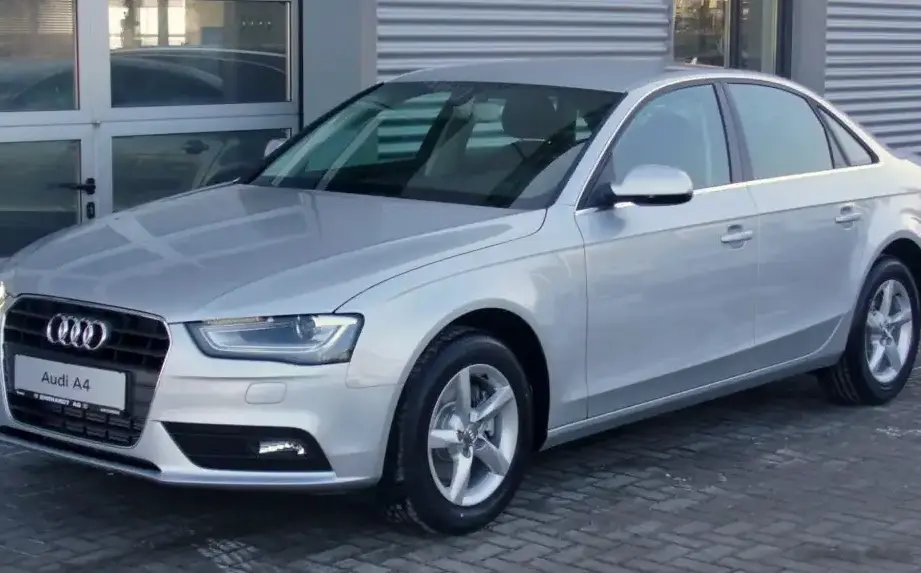
| Body type | Sedan |
| Seats | 5 |
| Doors | 4 |
| Fuel consumption (urban) | 5.3 l/100 km (44.4 US mpg, 53.3 UK mpg, 18.9 km/l) |
| Fuel consumption (extra urban) | 4.1 l/100 km (57.4 US mpg, 68.9 UK mpg, 24.4 km/l) |
| Fuel consumption (combined) | 4.5 l/100 km (52.3 US mpg, 62.8 UK mpg, 22.2 km/l) |
| CO2 emissions | 119 g/km |
| Fuel Type | Diesel |
| Acceleration 0 – 100 km/h | 7.8 sec |
| Acceleration 0 – 62 mph | 7.8 sec |
| Acceleration 0 – 60 mph | 7.4 sec |
| Maximum speed | 230 km/h (142.92 mph) |
| Emission standard | Euro 6 |
| Weight-to-power ratio | 8.3 kg/Hp, 120.6 Hp/tonne |
| Weight-to-torque ratio | 4.1 kg/Nm, 241.3 Nm/tonne |
| Power | 190 Hp @ 3000-4200 rpm |
| Power per litre | 96.5 Hp/l |
| Torque | 380 Nm @ 1750-3000 rpm (280.27 lb.-ft. @ 1750-3000 rpm) |
| Engine layout | Front, Longitudinal |
| Engine Model/Code | CNHA |
| Engine displacement | 1968 cm3 (120.09 cu. in.) |
| Number of cylinders | 4 |
| Engine configuration | Inline |
| Cylinder Bore | 81 mm (3.19 in.) |
| Piston Stroke | 95.5 mm (3.76 in.) |
| Compression ratio | 15.5:1 |
| Number of valves per cylinder | 4 |
| Fuel injection system | Diesel Commonrail |
| Engine aspiration | Turbocharger, Intercooler |
| Valvetrain | DOHC |
| Engine oil capacity | 4.7 l (4.97 US qt | 4.14 UK qt) |
| Kerb Weight | 1575 kg (3472.28 lbs.) |
| Max. weight | 2125 kg (4684.82 lbs.) |
| Max load | 550 kg (1212.54 lbs.) |
| Trunk (boot) space – minimum | 480 l (16.95 cu. ft.) |
| Trunk (boot) space – maximum | 962 l (33.97 cu. ft.) |
| Fuel tank capacity | 63 l (16.64 US gal | 13.86 UK gal) |
| Max. roof load | 90 kg (198.42 lbs.) |
| Permitted trailer load with brakes (8%) | 1900 kg (4188.78 lbs.) |
| Permitted trailer load without brakes | 750 kg (1653.47 lbs.) |
| Permitted towbar download | 80 kg (176.37 lbs.) |
| Length | 4701 mm (185.08 in.) |
| Width | 1826 mm (71.89 in.) |
| Width including mirrors | 2040 mm (80.31 in.) |
| Height | 1427 mm (56.18 in.) |
| Wheelbase | 2808 mm (110.55 in.) |
| Front track | 1564 mm (61.57 in.) |
| Rear (Back) track | 1551 mm (61.06 in.) |
| Front overhang | 862 mm (33.94 in.) |
| Rear overhang | 1031 mm (40.59 in.) |
| Drag coefficient (Cd) | 0.28 |
| Minimum turning circle (turning diameter) | 11.5 m (37.73 ft.) |
| Drivetrain Architecture | The Internal combustion engine (ICE) drives the front wheels of the vehicle. |
| Drive wheel | Front wheel drive |
| Number of gears and type of gearbox | automatic transmission Multitronic |
| Front suspension | Independent multi-link suspension |
| Rear suspension | Independent on trapezoidal lever |
| Front brakes | Ventilated discs |
| Rear brakes | Disc |
| Assisting systems | ABS (Anti-lock braking system) |
| Steering type | Steering rack and pinion |
| Power steering | Electric Steering |
| Tires size | 225/55 R16 |
| Wheel rims size | 7.5J x 16 |
The Audi A4 (B8 8K) facelift, produced from 2011 to 2015, represented a significant mid-cycle refresh of Audi’s popular compact executive car. The 2.0 TDI 190 hp variant with the Multitronic continuously variable transmission (CVT) was introduced in September 2013 and remained in production until 2015. This model occupied a middle ground within the B8 range, offering a balance between performance, fuel efficiency, and refinement, appealing to buyers seeking a more economical alternative to the higher-powered petrol engines or the more utilitarian TDI trims. It was primarily marketed in Europe, where diesel engines held a substantial market share, and offered as a premium alternative to mainstream competitors like the BMW 3 Series and Mercedes-Benz C-Class.
Powertrain & Engine Architecture
The heart of this A4 variant is the CNHA engine, a 2.0-liter inline-four cylinder diesel engine. This engine belongs to the Volkswagen Group’s modular engine family and features common-rail direct injection, a turbocharger with intercooling, and a double overhead camshaft (DOHC) valvetrain with four valves per cylinder. The high compression ratio of 15.5:1 is typical for diesel engines, contributing to their efficiency. The Multitronic transmission is a continuously variable transmission (CVT) that offers smooth, stepless gear changes. Unlike traditional automatic transmissions with fixed gear ratios, the Multitronic uses a chain-driven system to provide an infinite number of ratios within its operating range. This allows the engine to operate at its most efficient point for any given driving condition. The Multitronic was known for its efficiency and smoothness, but also for requiring specific maintenance intervals with fluid changes.
Driving Characteristics
The 190 hp and 380 Nm (280 lb-ft) of torque provided by the 2.0 TDI engine and Multitronic transmission resulted in a respectable, if not exhilarating, driving experience. Acceleration from 0 to 100 km/h (0-62 mph) took approximately 7.8 seconds. The Multitronic transmission, while smooth, didn’t offer the immediate responsiveness of a dual-clutch transmission or a traditional automatic. It tended to hold engine RPMs in the optimal torque band, providing good in-gear acceleration for overtaking. Compared to the more powerful 3.0 TDI or petrol variants, this 2.0 TDI felt less urgent, but it offered significantly better fuel economy. The front-wheel-drive configuration provided predictable handling, although it could exhibit some torque steer under hard acceleration.
Equipment & Trim Levels
The 2.0 TDI 190 hp Multitronic typically came equipped with a generous level of standard features. These included automatic climate control, a multi-function steering wheel, an infotainment system with a color display, alloy wheels, and a comprehensive suite of safety features like ABS, ESP, and multiple airbags. Interior upholstery was typically cloth or a combination of cloth and leatherette. Optional extras included leather seats, a sunroof, a navigation system, and advanced driver-assistance systems like adaptive cruise control and parking sensors. Trim levels varied slightly depending on the market, but generally followed a progression from ‘SE’ or ‘Sport’ to ‘S-Line’ which added more aggressive styling and sport-tuned suspension.
Chassis & Braking
The B8 A4 featured a well-engineered chassis with independent suspension all around. The front suspension utilized a multi-link setup, while the rear employed a trapezoidal link design. This configuration provided a good balance between ride comfort and handling precision. The 2.0 TDI models typically used ventilated front disc brakes and solid rear discs. The braking system was assisted by ABS and Electronic Stability Program (ESP), ensuring safe and controlled stopping power. Stabilizer bars were fitted front and rear to reduce body roll during cornering.
Market Reception & Comparison
The Audi A4 2.0 TDI 190 hp Multitronic was generally well-received by automotive critics. It was praised for its fuel efficiency, comfortable ride, and refined interior. However, some reviewers noted that the Multitronic transmission lacked the engagement of a traditional automatic or dual-clutch gearbox. Compared to the 177 hp version of the same engine, the 190 hp variant offered a noticeable performance improvement. Against competitors like the BMW 320d EfficientDynamics and Mercedes-Benz C220 CDI, the A4 offered a compelling combination of features, performance, and brand prestige.
Legacy
The CNHA engine, while generally reliable, is known to require regular maintenance, particularly regarding the diesel particulate filter (DPF) and the timing belt. The Multitronic transmission also requires specific fluid changes at recommended intervals to prevent premature failure. In the used car market, these A4s represent a good value proposition, offering a blend of luxury, efficiency, and practicality. However, potential buyers should be aware of the maintenance requirements and ensure that the car has been properly serviced. The B8 A4, in general, has proven to be a durable and well-built vehicle, and the 2.0 TDI 190 hp Multitronic remains a popular choice for those seeking a comfortable and economical executive car.