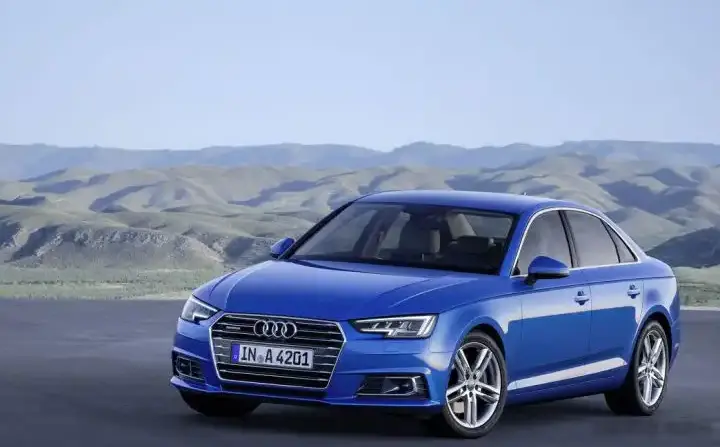
The Audi A4 (B9 8W) 1.4 TFSI, producing 150 horsepower, represents an entry point into the fifth generation of Audi’s popular executive sedan, produced from 2015 to 2018. Positioned within the broader B9 A4 lineup – which also included 2.0 TFSI, 3.0 TDI, and S4 variants – this model aimed to balance fuel efficiency with acceptable performance for everyday commuting and family use. It was primarily marketed in Europe and other regions where smaller displacement, turbocharged engines were favored due to tax incentives and fuel economy regulations. The B9 generation marked a significant step forward in terms of technology, build quality, and refinement compared to its predecessor, the B8.
Technical Specifications
| Brand | Audi |
| Model | A4 |
| Generation | A4 (B9 8W) |
| Type (Engine) | 1.4 TFSI (150 Hp) |
| Start of production | 2015 |
| End of production | 2018 |
| Powertrain Architecture | Internal Combustion engine |
| Body type | Sedan |
| Seats | 5 |
| Doors | 4 |
| Fuel consumption (urban) | 6.7-7.0 l/100 km (35.1 – 33.6 US mpg, 42.2 – 40.4 UK mpg, 14.9 – 14.3 km/l) |
| Fuel consumption (extra urban) | 4.4-4.8 l/100 km (53.5 – 49 US mpg, 64.2 – 58.9 UK mpg, 22.7 – 20.8 km/l) |
| Fuel consumption (combined) | 5.2-5.5 l/100 km (45.2 – 42.8 US mpg, 54.3 – 51.4 UK mpg, 19.2 – 18.2 km/l) |
| CO2 emissions | 123-131 g/km |
| Fuel Type | Petrol (Gasoline) |
| Acceleration 0 – 100 km/h | 8.7 sec |
| Acceleration 0 – 62 mph | 8.7 sec |
| Acceleration 0 – 60 mph | 8.3 sec |
| Maximum speed | 210 km/h (130.49 mph) |
| Emission standard | Euro 6 |
| Weight-to-power ratio | 8.8 kg/Hp, 113.6 Hp/tonne |
| Weight-to-torque ratio | 5.3 kg/Nm, 189.4 Nm/tonne |
| Power | 150 Hp @ 5000-6000 rpm |
| Power per litre | 107.5 Hp/l |
| Torque | 250 Nm @ 1500-3500 rpm (184.39 lb.-ft. @ 1500-3500 rpm) |
| Engine layout | Front, Longitudinal |
| Engine Model/Code | CVNA |
| Engine displacement | 1395 cm3 (85.13 cu. in.) |
| Number of cylinders | 4 |
| Engine configuration | Inline |
| Cylinder Bore | 74.5 mm (2.93 in.) |
| Piston Stroke | 80 mm (3.15 in.) |
| Compression ratio | 10.5:1 |
| Number of valves per cylinder | 4 |
| Fuel injection system | Direct injection |
| Engine aspiration | Turbocharger, Intercooler |
| Engine oil capacity | 4.3 l (4.54 US qt | 3.78 UK qt) |
| Kerb Weight | 1320 kg (2910.1 lbs.) |
| Max. weight | 1890 kg (4166.74 lbs.) |
| Max load | 570 kg (1256.63 lbs.) |
| Trunk (boot) space – minimum | 480 l (16.95 cu. ft.) |
| Trunk (boot) space – maximum | 965 l (34.08 cu. ft.) |
| Fuel tank capacity | 54 l (14.27 US gal | 11.88 UK gal) |
| Max. roof load | 90 kg (198.42 lbs.) |
| Permitted trailer load with brakes (8%) | 1600 kg (3527.4 lbs.) |
| Permitted trailer load with brakes (12%) | 1400 kg (3086.47 lbs.) |
| Permitted trailer load without brakes | 690 kg (1521.19 lbs.) |
| Permitted towbar download | 80 kg (176.37 lbs.) |
| Length | 4726 mm (186.06 in.) |
| Width | 1842 mm (72.52 in.) |
| Width including mirrors | 2022 mm (79.61 in.) |
| Height | 1427 mm (56.18 in.) |
| Wheelbase | 2820 mm (111.02 in.) |
| Front track | 1572 mm (61.89 in.) |
| Rear (Back) track | 1555 mm (61.22 in.) |
| Front overhang | 880 mm (34.65 in.) |
| Rear overhang | 1026 mm (40.39 in.) |
| Drag coefficient (Cd) | 0.27 |
| Minimum turning circle (turning diameter) | 11.6 m (38.06 ft.) |
| Drivetrain Architecture | The Internal combustion engine (ICE) drives the front wheels of the vehicle. |
| Drive wheel | Front wheel drive |
| Number of gears and type of gearbox | 6 gears, manual transmission |
| Front suspension | Independent multi-link suspension |
| Rear suspension | Independent multi-link suspension |
| Front brakes | Ventilated discs |
| Rear brakes | Ventilated discs |
| Assisting systems | ABS (Anti-lock braking system) |
| Steering type | Steering rack and pinion |
| Power steering | Electric Steering |
| Tires size | 205/60 R16; 225/50 R17; 245/40 R18; 245/35 R19 |
| Wheel rims size | 7J x 16 |
Powertrain & Engine Architecture
The heart of the A4 1.4 TFSI is the CVNA engine, a 1.4-liter inline-four cylinder gasoline engine. This engine utilizes direct fuel injection and a single turbocharger with an intercooler to boost power and efficiency. The engine’s design incorporates features like variable valve timing on both intake and exhaust sides, contributing to its broad torque curve. The 1.4 TFSI engine is known for its relatively complex design, featuring a belt-driven auxiliary drive and a timing chain. The six-speed manual transmission was standard, offering precise shifts and a direct connection to the engine. While an S tronic dual-clutch transmission was available as an option, the manual was often preferred by enthusiasts for its engagement and lower maintenance costs.
Driving Characteristics
The 150 horsepower and 250 Nm (184 lb-ft) of torque provided by the 1.4 TFSI engine delivered adequate performance for daily driving. Acceleration from 0-60 mph took around 8.3 seconds, which was noticeably slower than the 2.0 TFSI models. The engine felt responsive at lower RPMs thanks to the turbocharger, but power tapered off more quickly as the revs climbed. The manual transmission’s gear ratios were well-matched to the engine’s characteristics, allowing for comfortable cruising and reasonable overtaking ability. Compared to the more powerful variants, the 1.4 TFSI prioritized fuel economy over outright speed, making it a practical choice for those prioritizing efficiency.
Equipment & Trim Levels
The 1.4 TFSI typically came equipped with a respectable level of standard features. These included Audi’s Multi Media Interface (MMI) infotainment system with a 6.5-inch display, automatic climate control, alloy wheels, and a leather-wrapped steering wheel. Higher trim levels, such as Sport and Technik, added features like larger infotainment screens, upgraded audio systems, parking sensors, and heated seats. Interior upholstery was typically cloth, with leather options available as upgrades. Optional extras included a sunroof, navigation system, and advanced driver-assistance systems like adaptive cruise control.
Chassis & Braking
The B9 A4 featured a sophisticated chassis design with independent multi-link suspension at all four corners. This setup provided a comfortable ride and precise handling. The 1.4 TFSI models typically used ventilated disc brakes on all wheels, offering adequate stopping power for the car’s weight and performance. ABS (Anti-lock Braking System) was standard. The suspension tuning was generally geared towards comfort, but the A4 still offered a composed and engaging driving experience. Stabilizer bars were fitted front and rear to reduce body roll during cornering.
Market Reception & Comparison
The Audi A4 1.4 TFSI was generally well-received by automotive critics. It was praised for its refined interior, comfortable ride, and fuel efficiency. However, some reviewers noted that the engine lacked the punch of the larger 2.0 TFSI variants. Compared to the 2.0 TFSI, the 1.4 TFSI offered significantly better fuel economy, but at the expense of performance. The 3.0 TDI models provided even more torque and fuel efficiency, but came with a higher price tag. The 1.4 TFSI appealed to buyers who prioritized economy and refinement over outright performance.
Legacy
The 1.4 TFSI engine, while complex, proved to be reasonably reliable when properly maintained. Common issues included carbon buildup on the intake valves (a characteristic of direct-injection engines) and occasional turbocharger failures. The B9 A4, in general, has a good reputation for build quality and durability. On the used car market, the 1.4 TFSI models represent a more affordable entry point into the B9 A4 range. They remain a popular choice for buyers seeking a comfortable, refined, and fuel-efficient executive sedan.