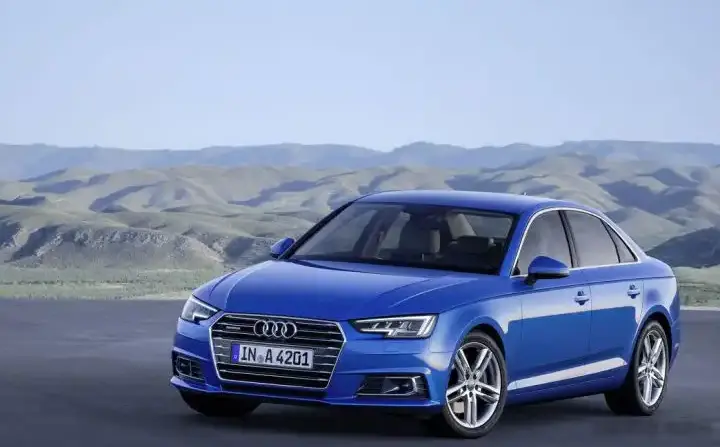
The Audi A4 (B9 8W) 2.0 TDI 122 hp S tronic represents a significant iteration of Audi’s popular executive sedan, produced from 2015 to 2018. Positioned as a mid-range offering within the B9 A4 lineup, this variant aimed to balance fuel efficiency with acceptable performance for everyday driving. It was primarily marketed in Europe and other regions where diesel engines held significant market share, offering a compelling alternative to gasoline-powered A4 models and competing brands like BMW and Mercedes-Benz. The B9 generation marked a substantial leap forward in technology and refinement for the A4, and the 2.0 TDI S tronic model benefited from these advancements.
Technical Specifications
| Brand | Audi |
| Model | A4 |
| Generation | A4 (B9 8W) |
| Type (Engine) | 2.0 TDI (122 Hp) S tronic |
| Start of production | 2015 |
| End of production | 2018 |
| Powertrain Architecture | Internal Combustion engine |
| Body type | Sedan |
| Seats | 5 |
| Doors | 4 |
| Fuel consumption (urban) | 4.7-5.1 l/100 km (50 – 46.1 US mpg, 60.1 – 55.4 UK mpg, 21.3 – 19.6 km/l) |
| Fuel consumption (extra urban) | 3.5-3.9 l/100 km (67.2 – 60.3 US mpg, 80.7 – 72.4 UK mpg, 28.6 – 25.6 km/l) |
| Fuel consumption (combined) | 3.9-4.3 l/100 km (60.3 – 54.7 US mpg, 72.4 – 65.7 UK mpg, 25.6 – 23.3 km/l) |
| CO2 emissions | 101-112 g/km |
| Fuel Type | Diesel |
| Acceleration 0 – 100 km/h | 10.2 sec |
| Acceleration 0 – 62 mph | 10.2 sec |
| Acceleration 0 – 60 mph | 9.7 sec |
| Maximum speed | 204 km/h (126.76 mph) |
| Emission standard | Euro 6 |
| Weight-to-power ratio | 12 kg/Hp, 83.3 Hp/tonne |
| Weight-to-torque ratio | 4.6 kg/Nm, 218.4 Nm/tonne |
| Power | 122 Hp @ 3500-4000 rpm |
| Power per litre | 62 Hp/l |
| Torque | 320 Nm @ 1500-3250 rpm (236.02 lb.-ft. @ 1500-3250 rpm) |
| Engine layout | Front, Longitudinal |
| Engine Model/Code | DEUC |
| Engine displacement | 1968 cm3 (120.09 cu. in.) |
| Number of cylinders | 4 |
| Engine configuration | Inline |
| Cylinder Bore | 81 mm (3.19 in.) |
| Piston Stroke | 95.5 mm (3.76 in.) |
| Compression ratio | 16.2:1 |
| Number of valves per cylinder | 4 |
| Fuel injection system | Diesel Commonrail |
| Engine aspiration | Turbocharger, Intercooler |
| Valvetrain | DOHC |
| Engine oil capacity | 4.7 l (4.97 US qt | 4.14 UK qt) |
| Kerb Weight | 1465 kg (3229.77 lbs.) |
| Max. weight | 2065 kg (4552.55 lbs.) |
| Max load | 600 kg (1322.77 lbs.) |
| Trunk (boot) space – minimum | 480 l (16.95 cu. ft.) |
| Trunk (boot) space – maximum | 965 l (34.08 cu. ft.) |
| Fuel tank capacity | 40 l (10.57 US gal | 8.8 UK gal) |
| Max. roof load | 90 kg (198.42 lbs.) |
| Permitted trailer load with brakes (8%) | 1700 kg (3747.86 lbs.) |
| Permitted trailer load with brakes (12%) | 1500 kg (3306.93 lbs.) |
| Permitted trailer load without brakes | 750 kg (1653.47 lbs.) |
| Permitted towbar download | 80 kg (176.37 lbs.) |
| Length | 4726 mm (186.06 in.) |
| Width | 1842 mm (72.52 in.) |
| Width including mirrors | 2022 mm (79.61 in.) |
| Height | 1427 mm (56.18 in.) |
| Wheelbase | 2820 mm (111.02 in.) |
| Front track | 1572 mm (61.89 in.) |
| Rear (Back) track | 1555 mm (61.22 in.) |
| Front overhang | 880 mm (34.65 in.) |
| Rear overhang | 1026 mm (40.39 in.) |
| Drag coefficient (Cd) | 0.27 |
| Minimum turning circle (turning diameter) | 11.6 m (38.06 ft.) |
| Drivetrain Architecture | The Internal combustion engine (ICE) drives the front wheels of the vehicle. |
| Drive wheel | Front wheel drive |
| Number of gears and type of gearbox | 7 gears, automatic transmission S tronic |
| Front suspension | Independent multi-link suspension |
| Rear suspension | Independent multi-link suspension |
| Front brakes | Ventilated discs |
| Rear brakes | Ventilated discs |
| Assisting systems | ABS (Anti-lock braking system) |
| Steering type | Steering rack and pinion |
| Power steering | Electric Steering |
| Tires size | 205/60 R16; 225/50 R17; 245/40 R18; 245/35 R19 |
| Wheel rims size | 7J x 16; 17; 18; 19 |
Powertrain & Engine Architecture
The heart of the A4 2.0 TDI 122 hp S tronic is the DEUC engine, a 2.0-liter inline-four cylinder diesel engine. This engine is part of the Volkswagen Group’s modular engine family, known for its efficiency and reliability. It utilizes a common rail direct injection system, delivering fuel directly into the combustion chamber at extremely high pressure for optimized combustion. The engine also features a turbocharger with an intercooler, boosting power output and improving torque delivery. The valvetrain employs a dual overhead camshaft (DOHC) design with four valves per cylinder, enhancing breathing and overall engine performance. The S tronic transmission is a seven-speed dual-clutch transmission (DCT). This transmission offers quick and smooth gear changes, contributing to a more engaging driving experience compared to a traditional automatic. It operates by pre-selecting the next gear, allowing for near-instantaneous shifts.
Driving Characteristics
The 122 hp output and 320 Nm (236 lb-ft) of torque provide adequate performance for daily commuting and highway cruising. Acceleration from 0-60 mph takes approximately 9.7 seconds, and the top speed is 126.76 mph. While not a sports car, the engine delivers a usable amount of power across a broad rev range, with peak torque available from 1500-3250 rpm. The S tronic transmission contributes to a responsive feel, although some drivers may find the gear changes slightly more noticeable than with a conventional automatic. Compared to the more powerful 190 hp TDI variants, this version offers a more relaxed driving experience, prioritizing fuel economy over outright speed. The gear ratios are tuned for efficiency, resulting in lower engine speeds at highway speeds.
Equipment & Trim Levels
The 2.0 TDI 122 hp S tronic typically came equipped with a respectable level of standard features. These included automatic climate control, a multi-function steering wheel, an infotainment system with a color display, and alloy wheels. Interior upholstery was generally cloth, although leather options were available as upgrades. Common optional extras included a sunroof, navigation system, parking sensors, and advanced driver-assistance systems like adaptive cruise control. Trim levels varied by market, but generally followed a progression from ‘SE’ or ‘Sport’ to higher-spec ‘S line’ models, with the latter offering more aggressive styling and additional features.
Chassis & Braking
The B9 A4 features a sophisticated chassis design with independent multi-link suspension at both the front and rear. This setup provides a comfortable ride quality while maintaining good handling characteristics. The 122 hp TDI model typically came with ventilated disc brakes on all four wheels, providing ample stopping power. ABS (Anti-lock Braking System) was standard. The steering system is an electric power steering rack and pinion, offering precise and responsive steering feel. Stabilizer bars were fitted front and rear to reduce body roll during cornering.
Market Reception & Comparison
The A4 2.0 TDI 122 hp S tronic was generally well-received by automotive critics. It was praised for its fuel efficiency, comfortable ride, and refined interior. However, some reviewers noted that the engine could feel slightly underpowered, particularly when fully loaded or tackling steep hills. Compared to the higher-output TDI variants, this model offered a more affordable entry point into the A4 range, but at the expense of performance. Its fuel economy figures were competitive with other diesel-powered sedans in its class, and its reliability proved to be generally good.
Legacy
The 2.0 TDI engine, in various iterations, has proven to be a durable and reliable powertrain. The S tronic transmission, while requiring more diligent maintenance than a traditional automatic, is also generally considered robust. In the used car market, the A4 2.0 TDI 122 hp S tronic represents a good value proposition for buyers seeking a comfortable, fuel-efficient, and well-equipped executive sedan. Regular maintenance, including oil changes and adherence to the manufacturer’s recommended service intervals, is crucial for ensuring the long-term reliability of this powertrain. The availability of parts and qualified mechanics is also good, making it a relatively easy car to maintain.