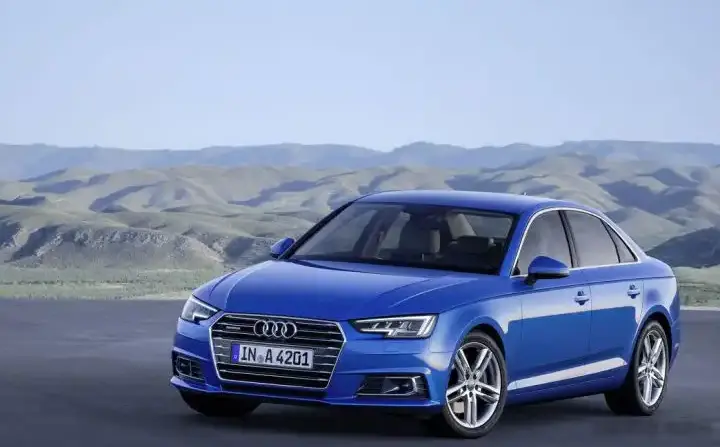
The Audi A4 (B9 8W) 2.0 TDI 150 hp variant, produced between 2015 and 2018, represented a core offering within the fifth generation of Audi’s popular executive sedan. Positioned as a balance between performance and economy, this model aimed to provide a refined driving experience with reasonable running costs. It formed part of the B9 platform generation (internally designated 8W), which brought advancements in technology, chassis refinement, and interior design compared to its B8 predecessor. This specific engine and drivetrain combination was a mainstay in European markets, where diesel engines held significant popularity due to fuel efficiency and tax incentives.
Technical Specifications
| Brand | Audi |
| Model | A4 |
| Generation | A4 (B9 8W) |
| Type (Engine) | 2.0 TDI (150 Hp) |
| Start of production | 2015 |
| End of production | 2018 |
| Powertrain Architecture | Internal Combustion engine |
| Body type | Sedan |
| Seats | 5 |
| Doors | 4 |
| Fuel consumption (urban) | 4.6-5.0 l/100 km (51.1 – 47 US mpg) |
| Fuel consumption (extra urban) | 3.4-3.9 l/100 km (69.2 – 60.3 US mpg) |
| Fuel consumption (combined) | 3.8-4.2 l/100 km (61.9 – 56 US mpg) |
| CO2 emissions | 99-111 g/km |
| Fuel Type | Diesel |
| Acceleration 0 – 100 km/h | 8.9 sec |
| Acceleration 0 – 62 mph | 8.9 sec |
| Acceleration 0 – 60 mph | 8.5 sec |
| Maximum speed | 221 km/h (137.32 mph) |
| Emission standard | Euro 6 |
| Weight-to-power ratio | 9.5 kg/Hp, 104.9 Hp/tonne |
| Weight-to-torque ratio | 4.5 kg/Nm, 223.8 Nm/tonne |
| Power | 150 Hp @ 3250-4200 rpm |
| Power per litre | 76.2 Hp/l |
| Torque | 320 Nm @ 1500-3250 rpm (236.02 lb.-ft. @ 1500-3250 rpm) |
| Engine layout | Front, Longitudinal |
| Engine Model/Code | DEUA |
| Engine displacement | 1968 cm3 (120.09 cu. in.) |
| Number of cylinders | 4 |
| Engine configuration | Inline |
| Cylinder Bore | 81 mm (3.19 in.) |
| Piston Stroke | 95.5 mm (3.76 in.) |
| Compression ratio | 16.2:1 |
| Number of valves per cylinder | 4 |
| Fuel injection system | Diesel Commonrail |
| Engine aspiration | Turbocharger, Intercooler |
| Valvetrain | DOHC |
| Engine oil capacity | 4.7 l (4.97 US qt | 4.14 UK qt) |
| Kerb Weight | 1430 kg (3152.61 lbs.) |
| Max. weight | 2030 kg (4475.38 lbs.) |
| Max load | 600 kg (1322.77 lbs.) |
| Trunk (boot) space – minimum | 480 l (16.95 cu. ft.) |
| Trunk (boot) space – maximum | 965 l (34.08 cu. ft.) |
| Fuel tank capacity | 40 l (10.57 US gal | 8.8 UK gal) |
| Max. roof load | 90 kg (198.42 lbs.) |
| Permitted trailer load with brakes (8%) | 1900 kg (4188.78 lbs.) |
| Permitted trailer load with brakes (12%) | 1700 kg (3747.86 lbs.) |
| Permitted trailer load without brakes | 750 kg (1653.47 lbs.) |
| Permitted towbar download | 80 kg (176.37 lbs.) |
| Length | 4726 mm (186.06 in.) |
| Width | 1842 mm (72.52 in.) |
| Width including mirrors | 2022 mm (79.61 in.) |
| Height | 1427 mm (56.18 in.) |
| Wheelbase | 2820 mm (111.02 in.) |
| Front track | 1572 mm (61.89 in.) |
| Rear (Back) track | 1555 mm (61.22 in.) |
| Front overhang | 880 mm (34.65 in.) |
| Rear overhang | 1026 mm (40.39 in.) |
| Drag coefficient (Cd) | 0.26 |
| Minimum turning circle (turning diameter) | 11.6 m (38.06 ft.) |
| Drivetrain Architecture | The Internal combustion engine (ICE) drives the front wheels of the vehicle. |
| Drive wheel | Front wheel drive |
| Number of gears and type of gearbox | 6 gears, manual transmission |
| Front suspension | Independent multi-link suspension |
| Rear suspension | Independent multi-link suspension |
| Front brakes | Ventilated discs |
| Rear brakes | Ventilated discs |
| Assisting systems | ABS (Anti-lock braking system) |
| Steering type | Steering rack and pinion |
| Power steering | Electric Steering |
| Tires size | 205/60 R16; 225/50 R17; 245/40 R18; 245/35 R19 |
| Wheel rims size | 7J x 16; 17; 18; 19 |
Powertrain & Engine Architecture
The heart of this A4 variant was the 2.0-liter four-cylinder diesel engine, specifically the DEUA engine code. This engine belonged to the Volkswagen Group’s modular engine family, known for its compact dimensions and efficiency. It featured a common rail direct injection system, delivering fuel at extremely high pressures for optimized combustion. The engine employed a single turbocharger with an intercooler to boost power and torque. The valvetrain utilized a dual overhead camshaft (DOHC) configuration with four valves per cylinder, enhancing breathing and overall performance. The engine’s 16.2:1 compression ratio was typical for a diesel engine, contributing to its thermal efficiency. The 6-speed manual transmission was standard, providing a balance between fuel economy and driver engagement.
Driving Characteristics
The 150 hp 2.0 TDI with a manual transmission offered a respectable, if not exhilarating, driving experience. Acceleration from 0-60 mph took around 8.5 seconds, making it suitable for everyday commuting and highway cruising. The engine’s 320 Nm (236 lb-ft) of torque, available from a low 1500 rpm, provided ample pulling power for overtaking and navigating hills. Compared to the more powerful 2.0 TDI variants (typically around 190 hp), this version felt less urgent in its acceleration. However, it offered better fuel economy and a more relaxed driving style. The gear ratios in the 6-speed manual were well-spaced, allowing the driver to keep the engine within its optimal torque band. The front-wheel-drive configuration provided predictable handling, although it could exhibit some torque steer under hard acceleration.
Equipment & Trim Levels
The 2.0 TDI 150 hp typically served as a mid-range trim level in the A4 lineup. Standard equipment generally included automatic climate control, a multi-function steering wheel, power windows and mirrors, and an infotainment system with a color display. Upholstery was usually cloth, although leather options were available as upgrades. Common optional extras included a sunroof, navigation system, parking sensors, and upgraded alloy wheels. Audi’s ‘S line’ package was also a popular choice, adding sportier styling cues and suspension upgrades.
Chassis & Braking
The B9 A4 featured a sophisticated chassis design, utilizing independent multi-link suspension at both the front and rear. This setup provided a comfortable ride quality while maintaining good handling characteristics. The front suspension geometry was optimized for steering precision, while the rear suspension focused on stability and minimizing body roll. Braking duties were handled by ventilated disc brakes on all four wheels, providing ample stopping power. Anti-lock braking system (ABS) was standard, enhancing safety in emergency braking situations. Stabilizer bars were fitted to both axles to further reduce body roll during cornering.
Market Reception & Comparison
The Audi A4 2.0 TDI 150 hp was generally well-received by automotive critics. It was praised for its refined engine, comfortable ride, and well-appointed interior. Fuel economy was a major selling point, with combined figures typically ranging from 3.8 to 4.2 l/100 km (56-62 mpg US). Compared to the higher-output TDI variants, this version offered a more affordable entry point into the A4 range. However, some critics noted that the performance was not as exciting as its more powerful siblings. Against competitors like the BMW 3 Series and Mercedes-Benz C-Class, the A4 2.0 TDI 150 hp held its own in terms of refinement, technology, and fuel efficiency.
Legacy
The 2.0 TDI engine, in various iterations, proved to be a reliable and durable powertrain. The DEUA engine code, while not without its share of potential issues (such as diesel particulate filter clogging and occasional turbocharger failures), generally offered good long-term reliability with proper maintenance. In the used car market, the A4 B9 2.0 TDI 150 hp remains a popular choice due to its balance of affordability, fuel economy, and practicality. However, potential buyers should be aware of the importance of regular servicing and the potential costs associated with diesel engine maintenance, particularly concerning the emissions control systems.