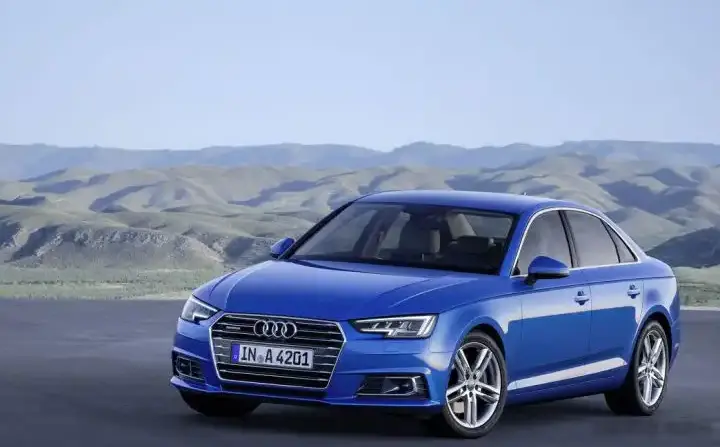
The Audi A4 (B9 8W) 2.0 TDI ultra, producing 190 horsepower, was a key variant within the fifth generation of Audi’s popular executive car, produced from 2015 to 2018. Positioned as a fuel-efficient option within the A4 lineup, it aimed to balance performance with economy, appealing to drivers seeking a refined driving experience without excessive running costs. This model represented Audi’s commitment to downsizing and utilizing advanced engine technology to meet increasingly stringent emissions regulations, particularly within the European market where diesel engines remained dominant. The “ultra” designation signified a focus on weight reduction and aerodynamic efficiency.
Technical Specifications
| Brand | Audi |
| Model | A4 |
| Generation | A4 (B9 8W) |
| Type (Engine) | 2.0 TDI ultra (190 Hp) |
| Start of production | 2015 |
| End of production | 2018 |
| Powertrain Architecture | Internal Combustion engine |
| Body type | Sedan |
| Seats | 5 |
| Doors | 4 |
| Fuel consumption (urban) | 5.1-5.4 l/100 km (46.1 – 43.6 US mpg, 55.4 – 52.3 UK mpg, 19.6 – 18.5 km/l) |
| Fuel consumption (extra urban) | 3.8-4.1 l/100 km (61.9 – 57.4 US mpg, 74.3 – 68.9 UK mpg, 26.3 – 24.4 km/l) |
| Fuel consumption (combined) | 4.3-4.5 l/100 km (54.7 – 52.3 US mpg, 65.7 – 62.8 UK mpg, 23.3 – 22.2 km/l) |
| CO2 emissions | 111-118 g/km |
| Fuel Type | Diesel |
| Acceleration 0 – 100 km/h | 7.7 sec |
| Acceleration 0 – 62 mph | 7.7 sec |
| Acceleration 0 – 60 mph | 7.3 sec |
| Maximum speed | 240 km/h (149.13 mph) |
| Emission standard | Euro 6 |
| Weight-to-power ratio | 7.6 kg/Hp, 131 Hp/tonne |
| Weight-to-torque ratio | 3.6 kg/Nm, 275.9 Nm/tonne |
| Power | 190 Hp @ 3800-4200 rpm |
| Torque | 400 Nm @ 1750-3000 rpm (295.02 lb.-ft. @ 1750-3000 rpm) |
| Engine layout | Front, Longitudinal |
| Engine Model/Code | DETA |
| Engine displacement | 1968 cm3 (120.09 cu. in.) |
| Number of cylinders | 4 |
| Engine configuration | Inline |
| Cylinder Bore | 81 mm (3.19 in.) |
| Piston Stroke | 95.5 mm (3.76 in.) |
| Compression ratio | 15.5:1 |
| Number of valves per cylinder | 4 |
| Fuel injection system | Diesel Commonrail |
| Engine aspiration | Turbocharger, Intercooler |
| Valvetrain | DOHC |
| Engine oil capacity | 4.7 l (4.97 US qt | 4.14 UK qt) |
| Kerb Weight | 1450 kg (3196.7 lbs.) |
| Max. weight | 2045 kg (4508.45 lbs.) |
| Max load | 595 kg (1311.75 lbs.) |
| Trunk (boot) space – minimum | 480 l (16.95 cu. ft.) |
| Trunk (boot) space – maximum | 965 l (34.08 cu. ft.) |
| Fuel tank capacity | 54 l (14.27 US gal | 11.88 UK gal) |
| Max. roof load | 90 kg (198.42 lbs.) |
| Permitted trailer load with brakes (8%) | 1900 kg (4188.78 lbs.) |
| Permitted trailer load with brakes (12%) | 1700 kg (3747.86 lbs.) |
| Permitted trailer load without brakes | 750 kg (1653.47 lbs.) |
| Permitted towbar download | 80 kg (176.37 lbs.) |
| Length | 4726 mm (186.06 in.) |
| Width | 1842 mm (72.52 in.) |
| Width including mirrors | 2022 mm (79.61 in.) |
| Height | 1427 mm (56.18 in.) |
| Wheelbase | 2820 mm (111.02 in.) |
| Front track | 1572 mm (61.89 in.) |
| Rear (Back) track | 1555 mm (61.22 in.) |
| Front overhang | 880 mm (34.65 in.) |
| Rear overhang | 1026 mm (40.39 in.) |
| Drag coefficient (Cd) | 0.27 |
| Minimum turning circle (turning diameter) | 11.6 m (38.06 ft.) |
| Drivetrain Architecture | The Internal combustion engine (ICE) drives the front wheels of the vehicle. |
| Drive wheel | Front wheel drive |
| Number of gears and type of gearbox | 6 gears, manual transmission |
| Front suspension | Independent multi-link suspension |
| Rear suspension | Independent multi-link suspension |
| Front brakes | Ventilated discs |
| Rear brakes | Ventilated discs |
| Assisting systems | ABS (Anti-lock braking system) |
| Steering type | Steering rack and pinion |
| Power steering | Electric Steering |
| Tires size | 225/50 R17; 245/40 R18; 245/35 R19 |
| Wheel rims size | 7.5J x 17; 18; 19 |
INTRODUCTION
The Audi A4 (B9) 2.0 TDI ultra 190 hp, launched in 2015, represented a significant step forward in diesel engine technology and efficiency. Built on the Volkswagen Group’s MLB Evo platform (1HX0/A3), this variant aimed to deliver a compelling blend of performance and fuel economy. It was positioned as a mid-range offering within the A4 lineup, slotting between the lower-powered diesel variants and the more potent petrol (gasoline) models. The B9 generation A4 marked a departure from its predecessor with a more angular design language and a greater emphasis on lightweight construction and advanced driver-assistance systems.
Powertrain & Engine Architecture
At the heart of the A4 2.0 TDI ultra lay the DETA engine, a 2.0-liter inline-four cylinder diesel engine. This engine utilized a sophisticated common rail direct injection system, capable of delivering multiple injections per combustion cycle for improved efficiency and reduced noise. The DETA engine featured a variable geometry turbocharger (VGT) and an intercooler to enhance power output and torque. The 190 horsepower and 400 Nm (295 lb-ft) of torque were achieved through careful calibration of the engine management system. The engine also incorporated advanced technologies like exhaust gas recirculation (EGR) and a diesel particulate filter (DPF) to minimize emissions and comply with Euro 6 standards. The standard transmission was a 6-speed manual gearbox, although a 7-speed S tronic dual-clutch transmission was available as an option. The engine’s longitudinal mounting allowed for front-wheel drive or Audi’s quattro all-wheel drive system, depending on the configuration.
Driving Characteristics
The 190 hp TDI ultra offered a refined and capable driving experience. While not as overtly sporty as some of the higher-powered A4 variants, it provided ample power for everyday driving and comfortable highway cruising. The 400 Nm of torque, available from 1750 to 3000 rpm, ensured strong acceleration in most situations. The 6-speed manual transmission was well-matched to the engine’s characteristics, offering precise shifts and a good spread of ratios. Compared to the lower-powered 1.6 TDI, the 2.0 TDI ultra felt noticeably more responsive and effortless, particularly when overtaking. However, it lacked the outright punch of the 2.0 TFSI petrol engine. The front-wheel drive configuration provided good traction in most conditions, but could exhibit some torque steer under hard acceleration.
Equipment & Trim Levels
The A4 2.0 TDI ultra typically came well-equipped, reflecting its mid-range positioning. Standard features included Audi’s MMI infotainment system with a 7-inch display, three-zone automatic climate control, and a leather-wrapped multifunction steering wheel. Upholstery was typically cloth, but leather options were available. Optional extras included Audi’s Virtual Cockpit (a fully digital instrument cluster), a head-up display, and a premium sound system. Trim levels varied by market, but generally offered progressively more luxurious appointments and technology features. The “Sport” trim added sporty styling cues and upgraded interior trim, while the “S line” trim offered a more aggressive appearance and further enhanced equipment levels.
Chassis & Braking
The B9 A4 featured a sophisticated chassis design focused on balancing comfort and handling. The front suspension utilized MacPherson struts, while the rear employed a multi-link setup. This configuration provided a comfortable ride while maintaining good body control. The A4 2.0 TDI ultra typically came equipped with ventilated disc brakes on all four wheels, providing ample stopping power. ABS (Anti-lock Braking System) and Electronic Stability Control (ESC) were standard safety features. The steering was an electromechanical power steering system, offering precise and responsive control. Wheel sizes ranged from 17 to 19 inches, depending on the trim level and options selected.
Market Reception & Comparison
The Audi A4 2.0 TDI ultra was generally well-received by automotive critics. It was praised for its fuel efficiency, refined driving experience, and comfortable interior. However, some reviewers noted that the engine could be somewhat noisy under hard acceleration. Compared to the 1.6 TDI, the 2.0 TDI ultra offered a significant performance upgrade with only a modest increase in fuel consumption. Against petrol-powered rivals, it provided comparable performance with superior fuel economy. The S tronic dual-clutch transmission was often preferred over the manual gearbox for its smoother shifts and quicker acceleration.
Legacy
The Audi A4 (B9) 2.0 TDI ultra 190 hp remains a popular choice in the used car market. The DETA engine has proven to be relatively reliable, although regular maintenance, including timely DPF regeneration, is crucial. The car’s fuel efficiency and comfortable ride continue to appeal to buyers seeking a practical and refined executive car. While newer A4 models offer even more advanced technology and improved fuel economy, the B9 generation represents a sweet spot in terms of value and reliability. The 2.0 TDI ultra variant, in particular, strikes a good balance between performance, economy, and equipment levels, making it a well-rounded and desirable option.