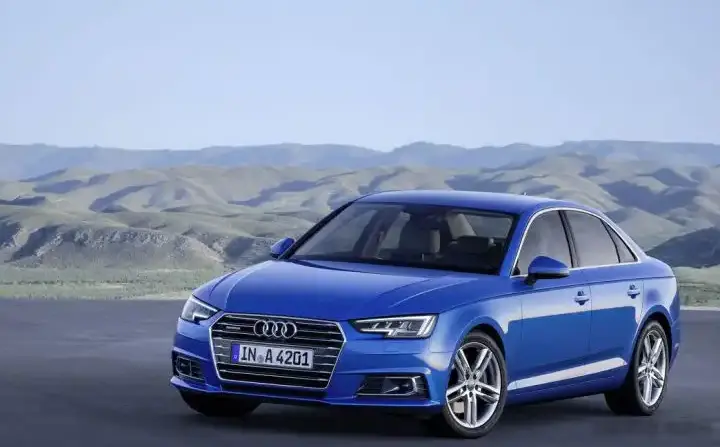
The Audi A4 (B9 8W) 2.0 TFSI S tronic, produced from 2015 to 2018, represents a significant iteration of Audi’s popular executive sedan. Positioned as a mid-to-upper trim level within the B9 A4 range, this variant combined a potent 2.0-liter turbocharged four-cylinder engine with Audi’s renowned seven-speed S tronic dual-clutch transmission. It was a key offering in European and North American markets, appealing to buyers seeking a balance of performance, efficiency, and sophisticated technology. The B9 generation, built on the Volkswagen Group’s MLB Evo platform, aimed to reduce weight and improve handling compared to its predecessor.
Technical Specifications
| Brand | Audi |
| Model | A4 |
| Generation | A4 (B9 8W) |
| Type (Engine) | 2.0 TFSI (252 Hp) S tronic |
| Start of production | 2015 |
| End of production | 2018 |
| Powertrain Architecture | Internal Combustion engine |
| Body type | Sedan |
| Seats | 5 |
| Doors | 4 |
| Fuel consumption (economy) – urban | 7.4 l/100 km (31.8 US mpg) |
| Fuel consumption (economy) – extra urban | 4.7-5 l/100 km (50 – 47 US mpg) |
| Fuel consumption (economy) – combined | 5.7-5.9 l/100 km (41.3 – 39.9 US mpg) |
| CO2 emissions | 129-137 g/km |
| Fuel Type | Petrol (Gasoline) |
| Acceleration 0 – 100 km/h | 6.3 sec |
| Acceleration 0 – 62 mph | 6.3 sec |
| Acceleration 0 – 60 mph | 6 sec |
| Maximum speed | 250 km/h (155.34 mph) |
| Emission standard | Euro 6 |
| Weight-to-power ratio | 5.7 kg/Hp |
| Weight-to-torque ratio | 3.9 kg/Nm |
| Power | 252 Hp @ 5000-6000 rpm |
| Torque | 370 Nm @ 1600-4500 rpm (272.9 lb.-ft. @ 1600-4500 rpm) |
| Engine layout | Front, Longitudinal |
| Engine Model/Code | EA888 / CYRB |
| Engine displacement | 1984 cm3 (121.07 cu. in.) |
| Number of cylinders | 4 |
| Engine configuration | Inline |
| Cylinder Bore | 82.5 mm (3.25 in.) |
| Piston Stroke | 92.8 mm (3.65 in.) |
| Compression ratio | 9.6:1 |
| Number of valves per cylinder | 4 |
| Fuel injection system | Direct injection and Multi-port manifold injection |
| Engine aspiration | Turbocharger, Intercooler |
| Valvetrain | DOHC |
| Engine oil capacity | 5.2 l (5.49 US qt | 4.58 UK qt) |
| Kerb Weight | 1430 kg (3152.61 lbs.) |
| Max. weight | 2000 kg (4409.25 lbs.) |
| Max load | 570 kg (1256.63 lbs.) |
| Trunk (boot) space – minimum | 480 l (16.95 cu. ft.) |
| Trunk (boot) space – maximum | 965 l (34.08 cu. ft.) |
| Fuel tank capacity | 54 l (14.27 US gal | 11.88 UK gal) |
| Max. roof load | 90 kg (198.42 lbs.) |
| Permitted trailer load with brakes (8%) | 1900 kg (4188.78 lbs.) |
| Permitted trailer load with brakes (12%) | 1700 kg (3747.86 lbs.) |
| Permitted trailer load without brakes | 720 kg (1587.33 lbs.) |
| Permitted towbar download | 80 kg (176.37 lbs.) |
| Length | 4726 mm (186.06 in.) |
| Width | 1842 mm (72.52 in.) |
| Width including mirrors | 2022 mm (79.61 in.) |
| Height | 1427 mm (56.18 in.) |
| Wheelbase | 2820 mm (111.02 in.) |
| Front track | 1572 mm (61.89 in.) |
| Rear (Back) track | 1555 mm (61.22 in.) |
| Front overhang | 880 mm (34.65 in.) |
| Rear overhang | 1026 mm (40.39 in.) |
| Drag coefficient (Cd) | 0.27 |
| Minimum turning circle (turning diameter) | 11.6 m (38.06 ft.) |
| Drivetrain Architecture | The Internal combustion engine (ICE) drives the front wheels of the vehicle. |
| Drive wheel | Front wheel drive |
| Number of gears and type of gearbox | 7 gears, automatic transmission S tronic |
Powertrain & Engine Architecture
At the heart of the A4 2.0 TFSI S tronic lies the EA888 engine, specifically the CYRB variant. This 1984cc (121.07 cu. in.) inline-four engine utilizes a combination of direct injection and multi-port fuel injection to optimize combustion efficiency and power delivery. The engine is turbocharged, employing a twin-scroll turbocharger with an intercooler to reduce intake air temperature and minimize turbo lag. The cylinder head features a dual overhead camshaft (DOHC) design with four valves per cylinder, contributing to improved breathing and higher engine speeds. The S tronic seven-speed dual-clutch transmission is a key component, offering rapid and seamless gear changes. It operates with two separate clutches, one for odd-numbered gears and one for even-numbered gears, allowing for pre-selection of the next gear and minimizing interruption in power delivery. The transmission also includes a start/stop system to enhance fuel economy in urban driving conditions.
Driving Characteristics
The 252 horsepower and 272.9 lb.-ft. of torque produced by the 2.0 TFSI engine, coupled with the quick-shifting S tronic transmission, resulted in brisk acceleration. The 0-60 mph sprint was typically achieved in around 6 seconds, and the car felt responsive in everyday driving situations. Compared to the base 1.8 TFSI models, the 2.0 TFSI offered a noticeable increase in performance, particularly during overtaking maneuvers. While not as engaging as a manual transmission, the S tronic provided smooth and efficient gear changes, making it well-suited for both commuting and longer journeys. The gear ratios were tuned to balance acceleration with fuel economy, with a relatively tall seventh gear for highway cruising. Compared to higher-performance variants like the S4, this 2.0 TFSI offered a more accessible and fuel-efficient driving experience.
Equipment & Trim Levels
The 2.0 TFSI S tronic typically came well-equipped, often positioned as a mid-range or upper-mid-range trim level. Standard features included Audi’s MMI infotainment system with a central display screen, automatic climate control, leather upholstery, and a suite of driver-assistance systems such as lane departure warning and automatic emergency braking. Optional extras included a virtual cockpit digital instrument cluster, a premium sound system, and adaptive cruise control. Interior trim options varied, with choices in wood, aluminum, or carbon fiber accents. Exterior styling cues often included alloy wheels, LED headlights, and chrome trim.
Chassis & Braking
The B9 A4 featured a sophisticated chassis design with independent multi-link suspension at both the front and rear. This setup provided a comfortable ride quality while maintaining good handling characteristics. The front suspension incorporated a transverse stabilizer bar to reduce body roll during cornering. Braking duties were handled by ventilated discs on all four wheels, providing ample stopping power. The electronic stability control (ESC) system helped to maintain control in challenging driving conditions. The steering system was an electric power steering setup, offering precise and responsive steering feel.
Market Reception & Comparison
The Audi A4 2.0 TFSI S tronic was generally well-received by automotive critics. It was praised for its refined engine, smooth transmission, comfortable ride, and high-quality interior. Fuel economy was considered competitive for its class, with combined figures ranging from 39.9 to 41.3 US mpg. Compared to other trims in the A4 lineup, the 2.0 TFSI offered a compelling balance of performance and efficiency. It was often seen as a sweet spot in the range, providing more power than the base models without the higher price tag of the S4. Reliability was generally good, although some owners reported minor issues with the infotainment system.
Legacy
The EA888 2.0 TFSI engine has proven to be a durable and reliable powerplant, and the B9 A4 2.0 TFSI S tronic continues to be a popular choice in the used car market. The S tronic transmission, while requiring more diligent maintenance than a traditional automatic, has also proven to be generally reliable when properly serviced. These vehicles offer a good combination of luxury, performance, and technology, making them attractive to buyers seeking a well-rounded executive sedan. Regular maintenance, including oil changes and transmission fluid services, is crucial to ensure the long-term reliability of this powertrain.