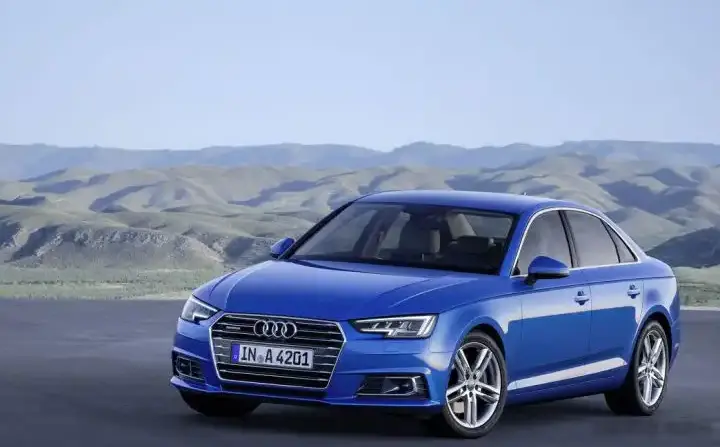
The Audi A4 (B9 8W) 2.0 TFSI ultra, produced from 2015 to 2018, represented a key variant within the fifth generation of Audi’s popular executive sedan. Positioned as a fuel-efficient option within the B9 lineup, it aimed to deliver a balance of performance and economy. This model utilized a 2.0-liter turbocharged four-cylinder engine paired with Audi’s seven-speed S tronic dual-clutch transmission, and was primarily marketed in Europe and other global markets where fuel efficiency and lower emissions were highly valued. The “ultra” designation signified Audi’s efforts to reduce weight and optimize aerodynamics for improved fuel consumption.
Technical Specifications
| Brand | Audi |
| Model | A4 |
| Generation | A4 (B9 8W) |
| Type (Engine) | 2.0 TFSI ultra (190 Hp) S tronic |
| Start of production | 2015 |
| End of production | 2018 |
| Powertrain Architecture | Internal Combustion engine |
| Body type | Sedan |
| Seats | 5 |
| Doors | 4 |
| Fuel consumption (urban) | 6.2-6.6 l/100 km (37.9 – 35.6 US mpg, 45.6 – 42.8 UK mpg, 16.1 – 15.2 km/l) |
| Fuel consumption (extra urban) | 4-4.7 l/100 km (58.8 – 50 US mpg, 70.6 – 60.1 UK mpg, 25 – 21.3 km/l) |
| Fuel consumption (combined) | 4.8-5.4 l/100 km (49 – 43.6 US mpg, 58.9 – 52.3 UK mpg, 20.8 – 18.5 km/l) |
| CO2 emissions | 109-122 g/km |
| Fuel Type | Petrol (Gasoline) |
| Acceleration 0 – 100 km/h | 7.3 sec |
| Acceleration 0 – 62 mph | 7.3 sec |
| Acceleration 0 – 60 mph | 6.9 sec |
| Maximum speed | 240 km/h (149.13 mph) |
| Emission standard | Euro 6 |
| Weight-to-power ratio | 7.4 kg/Hp, 135.2 Hp/tonne |
| Weight-to-torque ratio | 4.4 kg/Nm, 227.8 Nm/tonne |
| Power | 190 Hp @ 4200-6000 rpm |
| Torque | 320 Nm @ 1450-4200 rpm (236.02 lb.-ft. @ 1450-4200 rpm) |
| Engine layout | Front, Longitudinal |
| Engine Model/Code | EA888 / CVKB |
| Engine displacement | 1984 cm3 (121.07 cu. in.) |
| Number of cylinders | 4 |
| Engine configuration | Inline |
| Cylinder Bore | 82.5 mm (3.25 in.) |
| Piston Stroke | 92.8 mm (3.65 in.) |
| Compression ratio | 11.65:1 |
| Number of valves per cylinder | 4 |
| Fuel injection system | Direct injection and Multi-port manifold injection |
| Engine aspiration | Turbocharger, Intercooler |
| Valvetrain | DOHC |
| Engine oil capacity | 5.2 l (5.49 US qt | 4.58 UK qt) |
| Coolant | 7.8 l (8.24 US qt | 6.86 UK qt) |
| Kerb Weight | 1405 kg (3097.49 lbs.) |
| Max. weight | 1985 kg (4376.18 lbs.) |
| Max load | 580 kg (1278.68 lbs.) |
| Trunk (boot) space – minimum | 480 l (16.95 cu. ft.) |
| Trunk (boot) space – maximum | 965 l (34.08 cu. ft.) |
| Fuel tank capacity | 54 l (14.27 US gal | 11.88 UK gal) |
| Max. roof load | 90 kg (198.42 lbs.) |
| Permitted trailer load with brakes (8%) | 1700 kg (3747.86 lbs.) |
| Permitted trailer load with brakes (12%) | 1500 kg (3306.93 lbs.) |
| Permitted trailer load without brakes | 740 kg (1631.42 lbs.) |
| Permitted towbar download | 80 kg (176.37 lbs.) |
| Length | 4726 mm (186.06 in.) |
| Width | 1842 mm (72.52 in.) |
| Width including mirrors | 2022 mm (79.61 in.) |
| Height | 1427 mm (56.18 in.) |
| Wheelbase | 2820 mm (111.02 in.) |
| Front track | 1572 mm (61.89 in.) |
| Rear (Back) track | 1555 mm (61.22 in.) |
| Front overhang | 880 mm (34.65 in.) |
| Rear overhang | 1026 mm (40.39 in.) |
| Drag coefficient (Cd) | 0.27 |
| Minimum turning circle (turning diameter) | 11.6 m (38.06 ft.) |
| Drivetrain Architecture | The Internal combustion engine (ICE) drives the front wheels of the vehicle. |
| Drive wheel | Front wheel drive |
| Number of gears and type of gearbox | 7 gears, automatic transmission S tronic |
| Front suspension | Independent multi-link suspension, Transverse stabilizer |
| Rear suspension | Independent multi-link spring suspension with stabilizer |
| Front brakes | Ventilated discs |
| Rear brakes | Disc |
INTRODUCTION
The Audi A4 (B9) 2.0 TFSI ultra, launched in 2015, was a significant iteration of Audi’s best-selling A4 model. Built on the Volkswagen Group’s MLB Evo platform (1HX0/A3), this variant aimed to provide a compelling blend of performance, efficiency, and technology. The “ultra” badge denoted a focus on weight reduction and aerodynamic improvements, resulting in lower fuel consumption and emissions. This model was particularly popular in European markets, where taxation and fuel costs incentivize efficient vehicles. It served as a mid-range offering, positioned above the base 1.4 TFSI models but below the more powerful 2.0 TFSI variants and the S4 performance model.
Powertrain & Engine Architecture
At the heart of the A4 2.0 TFSI ultra lies the EA888 engine, specifically the CVKB code. This is a 1.984-liter (121.07 cu. in.) inline-four cylinder engine featuring direct injection and multi-port fuel injection, a combination designed to optimize combustion efficiency and reduce particulate emissions. The engine utilizes a single turbocharger with an intercooler to boost power output. The valvetrain employs a dual overhead camshaft (DOHC) configuration with four valves per cylinder. The engine produces 190 horsepower at 4200-6000 rpm and 320 Nm (236.02 lb.-ft.) of torque between 1450 and 4200 rpm. Paired with this engine is Audi’s renowned seven-speed S tronic dual-clutch transmission. This transmission offers quick and smooth gear changes, contributing to both performance and fuel efficiency. The S tronic features a wet clutch design for improved heat dissipation and durability.
Driving Characteristics
The 2.0 TFSI ultra with the S tronic transmission delivers a refined and responsive driving experience. While not as overtly sporty as higher-output A4 variants, it provides ample power for everyday driving and highway cruising. The S tronic transmission’s quick shifts contribute to brisk acceleration, with a 0-60 mph time of around 6.9 seconds. The gear ratios are tuned to prioritize fuel efficiency, meaning the engine doesn’t always feel as eager to rev as it does in sportier trims. However, the readily available torque from 1450 rpm ensures strong pull in most driving situations. Compared to the manual transmission versions of the 2.0 TFSI, the S tronic offers greater convenience and slightly improved fuel economy, though some enthusiasts may prefer the more engaging feel of a manual gearbox.
Equipment & Trim Levels
The A4 2.0 TFSI ultra typically came well-equipped as standard. Features included Audi’s MMI infotainment system with a 7-inch display, three-zone automatic climate control, and Audi Drive Select, allowing drivers to adjust steering, throttle, and transmission settings. Interior upholstery was typically cloth, with leather options available as upgrades. Standard safety features included ABS, electronic stability control, and multiple airbags. Optional extras included a larger MMI display, navigation system, a premium sound system, and various driver assistance systems such as adaptive cruise control and blind-spot monitoring. Trim levels varied by market, but generally offered packages that added features like heated seats, parking sensors, and upgraded interior trim.
Chassis & Braking
The B9 A4 featured a sophisticated chassis design. The front suspension utilized an independent multi-link setup with a transverse stabilizer bar, while the rear employed an independent multi-link spring suspension, also with a stabilizer bar. This configuration provided a comfortable ride and precise handling. Braking duties were handled by ventilated discs at the front and solid discs at the rear. ABS (Anti-lock Braking System) was standard, ensuring effective braking performance in various conditions. The suspension tuning was generally geared towards comfort, but the chassis remained capable and responsive during spirited driving.
Market Reception & Comparison
The A4 2.0 TFSI ultra was generally well-received by automotive critics. It was praised for its fuel efficiency, comfortable ride, and refined interior. However, some reviewers noted that it lacked the outright performance of the more powerful A4 variants. Compared to the 1.4 TFSI models, the 2.0 TFSI ultra offered a noticeable improvement in performance and refinement. Against the higher-output 2.0 TFSI versions, it traded some performance for better fuel economy. The 2.0 TDI diesel variants were also a popular alternative, offering even greater fuel efficiency but with a different driving character. The ultra model’s fuel economy figures of 4.8-5.4 l/100 km (49-43.6 US mpg) were competitive within its segment.
Legacy
The EA888 engine, in its various iterations, has proven to be a reliable and durable powerplant. The S tronic transmission, while requiring more specialized maintenance than a traditional automatic, is also generally considered reliable when properly serviced. The A4 B9 2.0 TFSI ultra remains a popular choice in the used car market, offering a good balance of practicality, efficiency, and Audi’s renowned build quality. Common maintenance items include regular oil changes, timing belt replacement (depending on mileage), and S tronic transmission fluid changes. Overall, this variant represents a well-rounded and dependable option for buyers seeking a comfortable and efficient executive sedan.