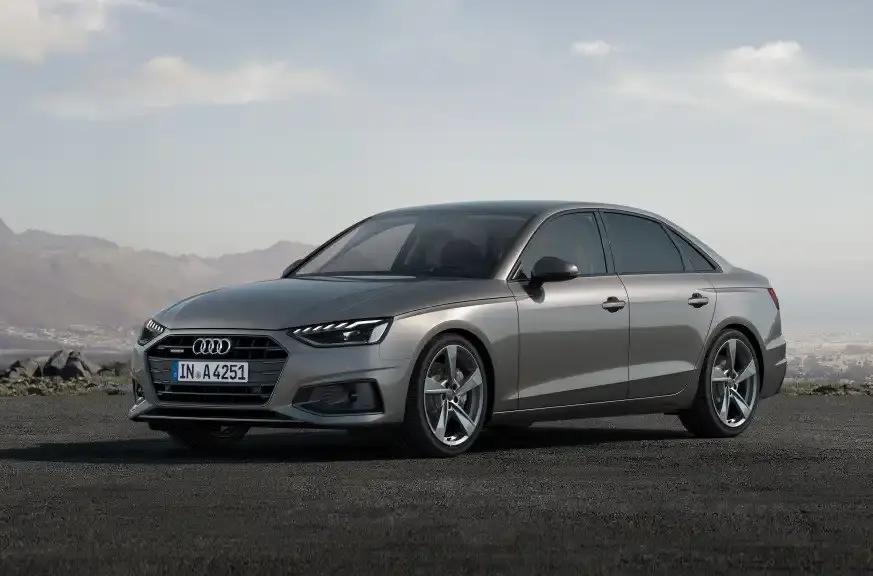
The Audi A4 35 TFSI Mild Hybrid, produced from July 2020 through 2024, represents a key iteration of the B9 (8W) generation A4, following the 2019 facelift. This variant occupied the entry-level position in the A4 sedan lineup in many markets, offering a balance of fuel efficiency, technology, and the Audi brand experience. It was primarily aimed at buyers seeking a premium compact sedan with lower running costs than the more powerful engine options. The 35 TFSI designation indicates a power output of 150 horsepower, coupled with a 48-volt mild hybrid system designed to enhance fuel economy and reduce emissions. This model played a significant role in Audi’s strategy to offer increasingly electrified powertrains across its range.
Technical Specifications
| Brand | Audi |
| Model | A4 |
| Generation | A4 (B9 8W, facelift 2019) |
| Type (Engine) | 35 TFSI (150 Hp) Mild Hybrid |
| Start of production | July, 2020 |
| End of production | 2024 |
| Powertrain Architecture | MHEV (Mild Hybrid Electric Vehicle) |
| Body type | Sedan |
| Seats | 5 |
| Doors | 4 |
| Combined fuel consumption (WLTP) | 5.9-6.9 l/100 km (39.9 – 34.1 US mpg) |
| CO2 emissions (WLTP) | 134-156 g/km |
| Fuel consumption (urban) | 7.6-8.0 l/100 km (30.9 – 29.4 US mpg) |
| Fuel consumption (extra urban) | 4.6-5.0 l/100 km (51.1 – 47 US mpg) |
| Fuel consumption (combined) | 5.7-6.0 l/100 km (41.3 – 39.2 US mpg) |
| CO2 emissions (NEDC) | 130-139 g/km |
| Fuel Type | Petrol (Gasoline) |
| Acceleration 0 – 100 km/h | 8.6 sec |
| Acceleration 0 – 62 mph | 8.6 sec |
| Acceleration 0 – 60 mph | 8.2 sec |
| Maximum speed | 210 km/h (130.49 mph) |
| Emission standard | Euro 6d-ISC-FCM |
| Weight-to-power ratio | 9.6 kg/Hp |
| Weight-to-torque ratio | 5.3 kg/Nm |
| Power | 150 Hp @ 4000-6000 rpm |
| Torque | 270 Nm @ 1300-3850 rpm (199.14 lb.-ft.) |
| Engine layout | Front, Longitudinal |
| Engine Model/Code | DMSB |
| Engine displacement | 1984 cm3 (121.07 cu. in.) |
| Number of cylinders | 4 |
| Engine configuration | Inline |
| Cylinder Bore | 82.5 mm (3.25 in.) |
| Piston Stroke | 92.8 mm (3.65 in.) |
| Compression ratio | 12.2:1 |
| Number of valves per cylinder | 4 |
| Fuel injection system | Direct injection |
| Engine aspiration | Turbocharger, Intercooler |
| Engine oil capacity | 5.2 l (5.49 US qt | 4.58 UK qt) |
| Coolant capacity | 10 l (10.57 US qt | 8.8 UK qt) |
| Kerb Weight | 1435 kg (3163.63 lbs.) |
| Max. weight | 2005 kg (4420.27 lbs.) |
| Max load | 570 kg (1256.63 lbs.) |
| Trunk (boot) space (minimum) | 460 l (16.24 cu. ft.) |
| Fuel tank capacity | 54 l (14.27 US gal | 11.88 UK gal) |
| Max. roof load | 90 kg (198.42 lbs.) |
| Permitted trailer load (brakes 8%) | 1600 kg (3527.4 lbs.) |
| Permitted trailer load (brakes 12%) | 1400 kg (3086.47 lbs.) |
| Permitted trailer load (no brakes) | 750 kg (1653.47 lbs.) |
| Permitted towbar download | 80 kg (176.37 lbs.) |
| Length | 4762 mm (187.48 in.) |
| Width | 1847 mm (72.72 in.) |
| Width including mirrors | 2022 mm (79.61 in.) |
| Height | 1431 mm (56.34 in.) |
| Wheelbase | 2820 mm (111.02 in.) |
| Front track | 1572 mm (61.89 in.) |
| Rear track | 1555 mm (61.22 in.) |
| Front overhang | 899 mm (35.39 in.) |
| Rear overhang | 1043 mm (41.06 in.) |
| Drag coefficient (Cd) | 0.25 |
| Minimum turning circle | 11.6 m (38.06 ft.) |
| Drivetrain Architecture | ICE and electric motor drive front wheels |
| Drive wheel | Front wheel drive |
| Number of gears | 6 |
| Gearbox type | Manual transmission |
| Front suspension | Independent multi-link |
| Rear suspension | Independent multi-link |
| Front brakes | Ventilated discs |
| Rear brakes | Disc |
| Assisting systems | ABS |
| Steering type | Steering rack and pinion |
| Power steering | Electric |
| Tires size | 205/60 R16 |
| Wheel rims size | 7.0 J x 16 |
Powertrain & Engine Architecture
The heart of the A4 35 TFSI is the DMSB engine, a 1.984-liter (121.07 cubic inches) inline-four cylinder gasoline engine. This engine utilizes direct fuel injection and is turbocharged, allowing for a relatively high power output from its displacement. The engine’s key feature is its integration with a 48-volt mild hybrid system. This system comprises a belt starter generator (BSG) and a small lithium-ion battery. The BSG allows for extended engine-off coasting, regenerative braking to recoup energy, and a smoother start-stop function. The engine produces 150 horsepower at 4000-6000 rpm and 270 Nm (199.14 lb.-ft.) of torque between 1300-3850 rpm. The engine’s architecture is designed for efficiency, with a relatively high compression ratio of 12.2:1. The 6-speed manual transmission was standard, providing a balance between fuel economy and driver engagement.
Driving Characteristics
The 150 hp 35 TFSI with a manual transmission delivers adequate performance for everyday driving. Acceleration from 0-60 mph takes approximately 8.2 seconds, and the top speed is electronically limited to 130.49 mph. While not a sports-oriented setup, the engine provides sufficient torque for comfortable highway cruising and overtaking. The mild hybrid system contributes to a smoother driving experience, particularly in urban environments, by allowing for near-silent coasting and quick restarts. Compared to the more powerful 45 TFSI variants, the 35 TFSI feels less urgent in its acceleration, but the fuel economy benefits are noticeable. The manual gearbox offers a more engaging driving experience than the optional S tronic dual-clutch transmission, but requires more driver involvement.
Equipment & Trim Levels
The A4 35 TFSI typically came standard with features such as Audi’s MMI infotainment system with a 7-inch touchscreen display, automatic climate control, and a suite of driver-assistance systems including lane departure warning and forward collision warning. Interior upholstery was typically cloth, with leather options available as upgrades. Trim levels varied by market, but generally included options for upgraded wheels, a larger infotainment screen, a digital instrument cluster (Audi Virtual Cockpit), and a premium sound system. Optional packages often bundled together popular features like navigation, parking sensors, and heated seats.
Chassis & Braking
The A4 B9 utilizes a sophisticated chassis design with independent multi-link suspension at both the front and rear axles. This setup provides a comfortable ride quality while maintaining good handling characteristics. The 35 TFSI variant typically featured ventilated front disc brakes and solid rear discs. ABS (Anti-lock Braking System) was standard. The suspension tuning was geared towards comfort, with a focus on absorbing road imperfections. Stabilizer bars were fitted to both axles to reduce body roll during cornering.
Market Reception & Comparison
The A4 35 TFSI Mild Hybrid was generally well-received by automotive critics as a sensible and efficient option within the A4 range. It was praised for its fuel economy, comfortable ride, and the benefits of the mild hybrid system. However, some reviewers noted that the engine lacked the outright performance of the more powerful variants. Compared to the 45 TFSI, the 35 TFSI offered significantly better fuel economy but at the cost of acceleration. Against competitors like the BMW 3 Series and Mercedes-Benz C-Class, the A4 35 TFSI offered a compelling combination of features, efficiency, and brand prestige.
Legacy
The A4 35 TFSI Mild Hybrid represents an important step in Audi’s transition towards electrification. The powertrain proved to be relatively reliable, with the mild hybrid system adding minimal complexity. On the used car market, these models are generally sought after for their fuel efficiency and lower running costs. The DMSB engine is known for its durability, provided it has been properly maintained. As with any used vehicle, potential buyers should check for regular service records and inspect the condition of the turbocharger and fuel injection system.