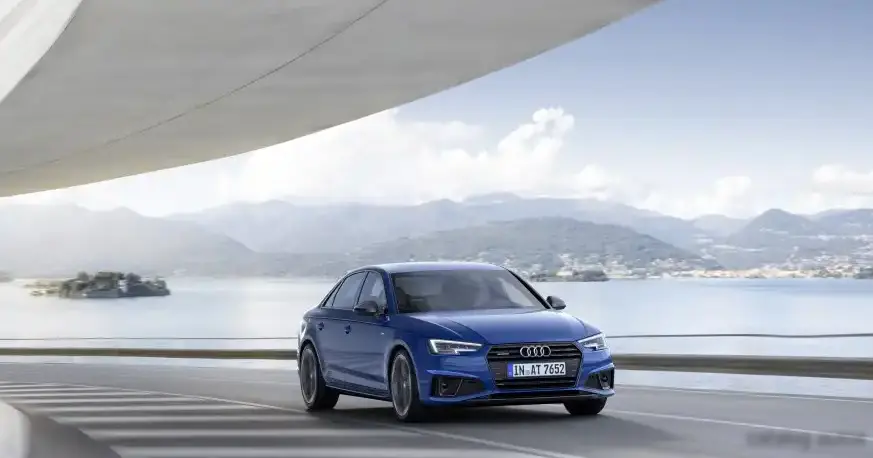
The Audi A4 B9 8W, specifically the 40 TDI variant with the 190 horsepower engine and S tronic dual-clutch transmission, represents a significant iteration of Audi’s popular executive sedan. Introduced with the facelift in 2018 and continuing through 2019, this model aimed to balance performance, efficiency, and technology within the A4 lineup. It occupied a sweet spot, offering a step up in power and refinement from the entry-level models while remaining more accessible than the higher-performance S4. This version was primarily marketed in Europe and other global markets where diesel engines remained highly favored, offering a compelling alternative to gasoline-powered options.
Technical Specifications
| Brand | Audi |
| Model | A4 |
| Generation | A4 (B9 8W, facelift 2018) |
| Type (Engine) | 40 TDI (190 Hp) S tronic |
| Start of production | 2018 |
| End of production | 2019 |
| Powertrain Architecture | Internal Combustion engine |
| Body type | Sedan |
| Seats | 5 |
| Doors | 4 |
| Fuel consumption (urban) | 4.9-5.1 l/100 km (48 – 46.1 US mpg, 57.6 – 55.4 UK mpg, 20.4 – 19.6 km/l) |
| Fuel consumption (extra urban) | 4.0-4.2 l/100 km (58.8 – 56 US mpg, 70.6 – 67.3 UK mpg, 25 – 23.8 km/l) |
| Fuel consumption (combined) | 4.3-4.5 l/100 km (54.7 – 52.3 US mpg, 65.7 – 62.8 UK mpg, 23.3 – 22.2 km/l) |
| CO2 emissions | 114-120 g/km |
| Fuel Type | Diesel |
| Acceleration 0 – 100 km/h | 7.7 sec |
| Acceleration 0 – 62 mph | 7.7 sec |
| Acceleration 0 – 60 mph | 7.3 sec |
| Maximum speed | 241 km/h (149.75 mph) |
| Emission standard | Euro 6d – TEMP |
| Weight-to-power ratio | 7.8 kg/Hp, 128.4 Hp/tonne |
| Weight-to-torque ratio | 3.7 kg/Nm, 270.3 Nm/tonne |
| Power | 190 Hp @ 3800-4200 rpm |
| Torque | 400 Nm @ 1750-3000 rpm (295.02 lb.-ft. @ 1750-3000 rpm) |
| Engine layout | Front, Longitudinal |
| Engine Model/Code | DESA, DETA |
| Engine displacement | 1968 cm3 (120.09 cu. in.) |
| Number of cylinders | 4 |
| Engine configuration | Inline |
| Number of valves per cylinder | 4 |
| Fuel injection system | Diesel Commonrail |
| Engine aspiration | Turbocharger, Intercooler |
| Engine oil capacity | 4.7 l (4.97 US qt | 4.14 UK qt) |
| Kerb Weight | 1480 kg (3262.84 lbs.) |
| Trunk (boot) space (minimum) | 480 l (16.95 cu. ft.) |
| Fuel tank capacity | 40 l (10.57 US gal | 8.8 UK gal) |
| Max. roof load | 90 kg (198.42 lbs.) |
| Permitted trailer load with brakes (8%) | 1900 kg (4188.78 lbs.) |
| Permitted trailer load with brakes (12%) | 1700 kg (3747.86 lbs.) |
| Permitted trailer load without brakes | 750 kg (1653.47 lbs.) |
| Permitted towbar download | 80 kg (176.37 lbs.) |
| Length | 4738 mm (186.54 in.) |
| Width | 1842 mm (72.52 in.) |
| Width including mirrors | 2022 mm (79.61 in.) |
| Height | 1428 mm (56.22 in.) |
| Wheelbase | 2820 mm (111.02 in.) |
| Front track | 1572 mm (61.89 in.) |
| Rear track | 1555 mm (61.22 in.) |
| Front overhang | 880 mm (34.65 in.) |
| Rear overhang | 1038 mm (40.87 in.) |
| Drivetrain Architecture | Front wheel drive |
| Number of gears and type of gearbox | 7 gears, automatic transmission S tronic |
| Front suspension | Independent multi-link suspension |
| Rear suspension | Independent multi-link suspension |
| Front brakes | Ventilated discs |
| Rear brakes | Ventilated discs |
| Assisting systems | ABS (Anti-lock braking system) |
| Steering type | Steering rack and pinion |
| Power steering | Electric Steering |
INTRODUCTION
The Audi A4 B9 8W facelift, launched in 2018, brought a refreshed design and updated technology to Audi’s best-selling model. The 40 TDI variant, powered by a 2.0-liter turbocharged diesel engine producing 190 horsepower, coupled with the seven-speed S tronic dual-clutch transmission, was a key offering in many European markets. This configuration aimed to provide a balance between fuel efficiency, respectable performance, and a comfortable driving experience. Positioned as a mid-range option, it sat above the lower-powered diesel variants and below the more performance-focused S4.
Powertrain & Engine Architecture
At the heart of the A4 40 TDI lies the Volkswagen Group’s EA288 engine family. Specifically, the DESA or DETA engine code (depending on minor regional variations) designates this 2.0-liter inline-four diesel. This engine utilizes a common rail direct injection system, delivering fuel at extremely high pressures for optimized combustion. A single turbocharger, often with variable geometry turbine (VGT) technology, provides forced induction, boosting power and torque. The engine also incorporates an intercooler to cool the intake air, further enhancing performance. The S tronic seven-speed dual-clutch transmission (DCT) is a crucial component, offering rapid and smooth gear changes. Unlike a traditional automatic, the S tronic uses two separate clutches – one for odd gears and one for even gears – allowing for pre-selection of the next gear, resulting in near-instantaneous shifts. This transmission is known for its efficiency and responsiveness.
Driving Characteristics
The 190 horsepower and 400 Nm (295 lb-ft) of torque delivered by the 40 TDI engine provide brisk acceleration. The 0-60 mph sprint takes around 7.3 seconds, making it feel adequately quick for everyday driving and highway overtaking. The S tronic transmission plays a significant role in this performance, providing seamless gear changes and keeping the engine in its optimal power band. Compared to the lower-powered diesel variants, the 40 TDI offers noticeably more punch, especially during acceleration. While not as sporty as the S4, it provides a refined and engaging driving experience. The gear ratios are tuned for a balance between fuel economy and performance, with taller gears for efficient cruising and shorter gears for quicker acceleration. The front-wheel-drive configuration provides good traction in most conditions, although it can exhibit some torque steer under hard acceleration.
Equipment & Trim Levels
The A4 40 TDI typically came well-equipped, even in base trim. Standard features often included Audi’s MMI infotainment system with a 7-inch display (larger screens were available as options), automatic climate control, power-adjustable front seats, and a leather-wrapped steering wheel. Safety features such as ABS, electronic stability control, and multiple airbags were standard. Higher trim levels added features like leather upholstery, a premium sound system, navigation, and advanced driver-assistance systems such as adaptive cruise control and lane-keeping assist. Optional extras included a sunroof, heated seats, and various cosmetic enhancements.
Chassis & Braking
The A4 B9 8W utilizes a sophisticated chassis design featuring independent multi-link suspension at both the front and rear. This setup provides a comfortable ride while maintaining good handling characteristics. The suspension is tuned to balance comfort and control, offering a composed ride even on uneven surfaces. Braking duties are handled by ventilated disc brakes on all four wheels, providing ample stopping power. ABS (Anti-lock Braking System) is standard, enhancing safety during emergency braking situations. The A4 40 TDI’s weight distribution is relatively balanced, contributing to its stable handling.
Market Reception & Comparison
The A4 40 TDI was generally well-received by automotive critics. It was praised for its refined engine, smooth transmission, comfortable ride, and well-appointed interior. Fuel economy was a major selling point, with the 40 TDI achieving impressive figures in real-world driving. Compared to the lower-powered diesel variants, the 40 TDI offered a significant performance upgrade without a substantial increase in fuel consumption. Compared to gasoline-powered A4 models, the 40 TDI provided superior fuel economy and torque, making it a popular choice for drivers who frequently cover long distances. However, some critics noted that the ride could be slightly firm on certain road surfaces.
Legacy
The Audi A4 B9 8W 40 TDI with the S tronic transmission has proven to be a reliable and durable combination. The EA288 diesel engine is known for its longevity, provided it is properly maintained. The S tronic transmission, while more complex than a traditional automatic, is generally reliable, although regular servicing (including fluid changes) is crucial. On the used car market, these models remain popular due to their blend of performance, efficiency, and refinement. They represent a good value proposition for buyers seeking a comfortable and economical executive sedan. However, potential buyers should be aware of the potential for diesel particulate filter (DPF) issues, particularly if the vehicle has been primarily used for short trips.