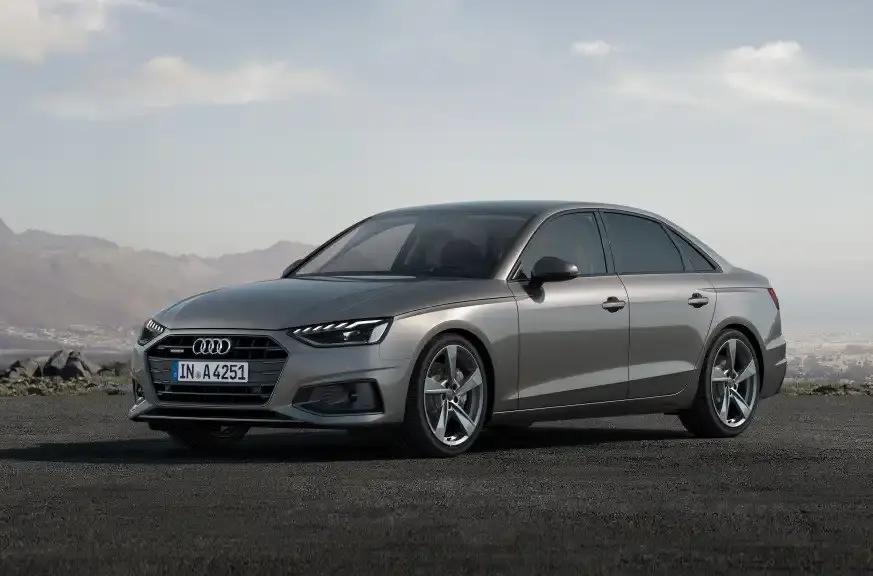
The Audi A4 40 TFSI Mild Hybrid S tronic, produced from 2019 to 2020, represents a significant iteration of the B9 (8W) generation A4, following the model’s facelift. Positioned as a mid-range offering within the A4 lineup, this variant blended performance, efficiency, and technology, catering to buyers seeking a refined and modern executive sedan. It was a key model in Audi’s push towards electrification, incorporating a 12V mild-hybrid system to enhance fuel economy and reduce emissions. The 40 TFSI designation, as per Audi’s naming convention, doesn’t directly correlate to engine displacement but rather indicates a specific power output level within the range.
Technical Specifications
| Brand | Audi |
| Model | A4 |
| Generation | A4 (B9 8W, facelift 2019) |
| Type (Engine) | 40 TFSI (190 Hp) Mild Hybrid S tronic |
| Start of production | 2019 |
| End of production | 2020 |
| Powertrain Architecture | MHEV (Mild Hybrid Electric Vehicle) |
| Body type | Sedan |
| Seats | 5 |
| Doors | 4 |
| Combined fuel consumption (WLTP) | 7.0-7.3 l/100 km (33.6 – 32.2 US mpg) |
| CO2 emissions (WLTP) | 152-166 g/km |
| Fuel consumption (urban) | 7.4-7.7 l/100 km (31.8 – 30.5 US mpg) |
| Fuel consumption (extra urban) | 4.7-5.2 l/100 km (50 – 45.2 US mpg) |
| Fuel consumption (combined) | 5.8-6.0 l/100 km (40.6 – 39.2 US mpg) |
| CO2 emissions | 132-137 g/km |
| Fuel Type | Petrol (Gasoline) |
| Acceleration 0 – 100 km/h | 7.3 sec |
| Acceleration 0 – 62 mph | 7.3 sec |
| Acceleration 0 – 60 mph | 6.9 sec |
| Maximum speed | 241 km/h (149.75 mph) |
| Emission standard | Euro 6d – TEMP – EVAP – ISC |
| Weight-to-power ratio | 7.7 kg/Hp |
| Weight-to-torque ratio | 4.5 kg/Nm |
| Power | 190 Hp @ 4200-6000 rpm |
| Torque | 320 Nm @ 1450-4200 rpm (236.02 lb.-ft.) |
| Engine layout | Front, Longitudinal |
| Engine Model/Code | DKYA, DLVA |
| Engine displacement | 1984 cm3 (121.07 cu. in.) |
| Number of cylinders | 4 |
| Engine configuration | Inline |
| Number of valves per cylinder | 4 |
| Fuel injection system | Direct injection |
| Engine aspiration | Turbocharger, Intercooler |
| Engine oil capacity | 5.2 l (5.49 US qt | 4.58 UK qt) |
| Kerb Weight | 1455 kg (3207.73 lbs.) |
| Max. weight | 2040 kg (4497.43 lbs.) |
| Max load | 585 kg (1289.7 lbs.) |
| Fuel tank capacity | 54 l (14.27 US gal | 11.88 UK gal) |
| Max. roof load | 90 kg (198.42 lbs.) |
| Permitted trailer load with brakes (8%) | 1700 kg (3747.86 lbs.) |
| Permitted trailer load with brakes (12%) | 1500 kg (3306.93 lbs.) |
| Permitted trailer load without brakes | 750 kg (1653.47 lbs.) |
| Permitted towbar download | 80 kg (176.37 lbs.) |
| Length | 4762 mm (187.48 in.) |
| Width | 1847 mm (72.72 in.) |
| Width including mirrors | 2022 mm (79.61 in.) |
| Height | 1428 mm (56.22 in.) |
| Wheelbase | 2820 mm (111.02 in.) |
| Front track | 1572 mm (61.89 in.) |
| Rear track | 1555 mm (61.22 in.) |
| Front overhang | 899 mm (35.39 in.) |
| Rear overhang | 1043 mm (41.06 in.) |
| Minimum turning circle | 11.6 m (38.06 ft.) |
| Drivetrain Architecture | Front wheel drive, MHEV |
| Number of gears | 7 |
| Gearbox type | Automatic transmission S tronic |
| Front suspension | Independent multi-link suspension |
| Rear suspension | Independent multi-link suspension |
| Front brakes | Ventilated discs |
| Rear brakes | Disc |
INTRODUCTION
The Audi A4 40 TFSI Mild Hybrid S tronic, launched as part of the B9 facelift in 2019, represented a refinement of Audi’s popular executive sedan. Built on the 1HX0/A3 platform, this variant aimed to deliver a balance of performance and efficiency, appealing to a broad range of buyers. The introduction of the 12V mild-hybrid system was a key feature, contributing to reduced fuel consumption and emissions without significantly impacting driving dynamics. This model occupied a central position in the A4 range, offering a step up from the entry-level models while remaining more accessible than the higher-performance variants like the S4.
Powertrain & Engine Architecture
At the heart of the A4 40 TFSI lies the 1.984-liter (121.07 cu. in.) turbocharged inline-four cylinder engine, designated as the DKYA or DLVA engine code. This engine utilizes direct fuel injection and an intercooled turbocharger to produce 190 horsepower at 4200-6000 rpm and 320 Nm (236.02 lb.-ft.) of torque between 1450-4200 rpm. The engine’s architecture incorporates Audi’s Valvelift system, which adjusts valve lift on the intake side to optimize performance and efficiency. The mild-hybrid system consists of a belt-driven starter-generator (BSG) and a small 12V lithium-ion battery. The BSG allows for extended start-stop operation, regenerative braking, and a slight power boost during acceleration. The engine is paired with Audi’s seven-speed S tronic dual-clutch transmission, known for its quick and smooth gear changes. This transmission features a wet clutch design for enhanced durability and heat dissipation.
Driving Characteristics
The A4 40 TFSI S tronic delivers a refined and comfortable driving experience. The 190 hp engine provides ample power for everyday driving and highway cruising, with the turbocharger providing a noticeable boost in acceleration. The S tronic transmission contributes to brisk performance, with quick and seamless gear changes. Compared to the manual transmission versions, the S tronic offers greater convenience, particularly in urban traffic. While not as overtly sporty as the higher-output variants, the 40 TFSI still provides a responsive and engaging driving experience. The mild-hybrid system is largely imperceptible to the driver, operating seamlessly in the background to improve fuel economy. The gear ratios are tuned for a balance of acceleration and fuel efficiency, with a relatively tall final drive contributing to lower engine speeds at highway speeds.
Equipment & Trim Levels
The A4 40 TFSI typically came well-equipped as standard. Common features included Audi’s MMI infotainment system with a 7-inch touchscreen display, Audi Virtual Cockpit (digital instrument cluster), three-zone automatic climate control, leather upholstery, and LED headlights. Optional extras included a larger 10.1-inch MMI touchscreen, a Bang & Olufsen sound system, a head-up display, and various driver-assistance systems such as adaptive cruise control and lane-keeping assist. Trim levels varied depending on the market, but generally included ‘Premium’ and ‘Premium Plus’ options, with the latter adding more luxury features and technology.
Chassis & Braking
The A4 40 TFSI utilizes a sophisticated chassis design featuring independent multi-link suspension at both the front and rear. This suspension setup provides a comfortable ride while maintaining good handling characteristics. The front suspension incorporates aluminum subframes and control arms to reduce weight. The braking system consists of ventilated discs at the front and solid discs at the rear. Anti-lock braking system (ABS) and electronic stability control (ESC) are standard features. The steering system is an electromechanical power steering system, providing precise and responsive steering feel.
Market Reception & Comparison
The Audi A4 40 TFSI Mild Hybrid S tronic was generally well-received by automotive critics. It was praised for its refined driving experience, comfortable interior, and efficient powertrain. Compared to the 2.0 TDI diesel variants, the 40 TFSI offered a more responsive and engaging driving experience, albeit with slightly higher fuel consumption. Against the higher-output 45 TFSI models, the 40 TFSI provided a more affordable entry point into the A4 range, while still delivering a respectable level of performance. Fuel economy figures of 7.0-7.3 l/100 km (33.6 – 32.2 US mpg) were competitive within its segment.
Legacy
The Audi A4 40 TFSI Mild Hybrid S tronic represents an important step in Audi’s transition towards electrification. The 12V mild-hybrid system paved the way for more advanced hybrid and electric powertrains in subsequent models. These engines, when properly maintained, have proven to be relatively reliable. Common issues include occasional turbocharger problems and oil consumption, but these are not widespread. On the used car market, the A4 40 TFSI remains a popular choice, offering a good balance of performance, efficiency, and luxury. Its relatively modern technology and refined driving experience continue to appeal to buyers seeking a premium executive sedan.