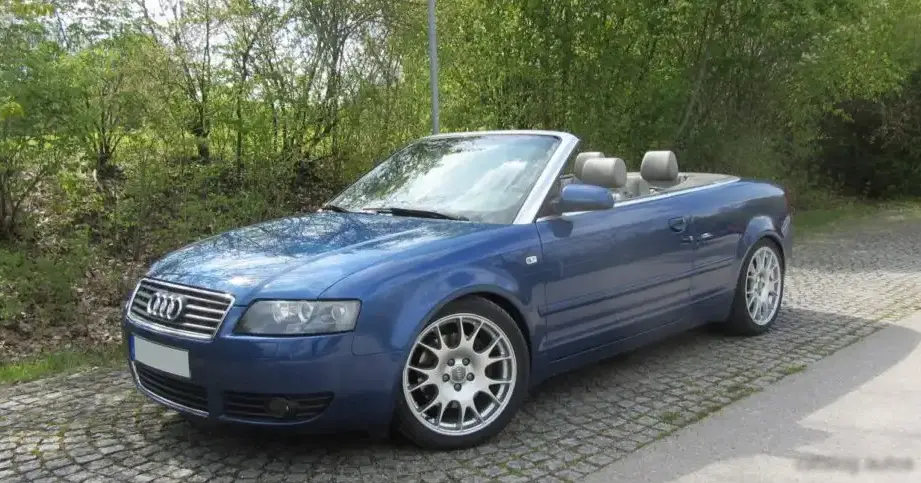
The Audi A4 Cabriolet (B6 8H) 2.0, producing 131 horsepower, was a key variant in Audi’s lineup from 2002 to 2005. Positioned as an entry-level offering within the B6 Cabriolet range, it provided an accessible pathway to Audi’s premium open-top experience. This model occupied a space between the more affordable, yet less powerful, 1.8T engines and the higher-performance 3.0 V6 options. Built on the Audi-specific version of the Volkswagen Group’s PL45 platform (internally designated 8H), the A4 Cabriolet aimed to blend sporty handling with comfortable open-air motoring. It was primarily marketed towards European and North American consumers seeking a stylish and relatively affordable luxury convertible.
Technical Specifications
| Brand | Audi |
| Model | A4 |
| Generation | A4 Cabriolet (B6 8H) |
| Type (Engine) | 2.0 (131 Hp) |
| Start of production | 2002 |
| End of production | 2005 |
| Powertrain Architecture | Internal Combustion engine |
| Body type | Cabriolet |
| Seats | 4 |
| Doors | 2 |
| Fuel consumption (urban) | 12.1 l/100 km (19.4 US mpg, 23.3 UK mpg, 8.3 km/l) |
| Fuel consumption (extra urban) | 6.6 l/100 km (35.6 US mpg, 42.8 UK mpg, 15.2 km/l) |
| Fuel consumption (combined) | 8.6 l/100 km (27.4 US mpg, 32.8 UK mpg, 11.6 km/l) |
| CO2 emissions | 206 g/km |
| Fuel Type | Petrol (Gasoline) |
| Acceleration 0 – 100 km/h | 10.9 sec |
| Acceleration 0 – 62 mph | 10.9 sec |
| Acceleration 0 – 60 mph | 10.4 sec |
| Maximum speed | 208 km/h (129.25 mph) |
| Emission standard | Euro 4 |
| Weight-to-power ratio | 11.6 kg/Hp, 86.2 Hp/tonne |
| Weight-to-torque ratio | 7.8 kg/Nm, 128.3 Nm/tonne |
| Power | 131 Hp @ 5700 rpm |
| Power per litre | 66 Hp/l |
| Torque | 195 Nm @ 3300 rpm (143.82 lb.-ft. @ 3300 rpm) |
| Engine layout | Front, Longitudinal |
| Engine Model/Code | ALT |
| Engine displacement | 1984 cm3 (121.07 cu. in.) |
| Number of cylinders | 4 |
| Engine configuration | Inline |
| Cylinder Bore | 82.5 mm (3.25 in.) |
| Piston Stroke | 92.8 mm (3.65 in.) |
| Compression ratio | 10.3:1 |
| Number of valves per cylinder | 5 |
| Fuel injection system | Multi-port manifold injection |
| Engine aspiration | Naturally aspirated engine |
| Valvetrain | DOHC |
| Engine oil capacity | 4.2 l (4.44 US qt | 3.7 UK qt) |
| Coolant | 7 l (7.4 US qt | 6.16 UK qt) |
| Kerb Weight | 1520 kg (3351.03 lbs.) |
| Max. weight | 2000 kg (4409.25 lbs.) |
| Max load | 480 kg (1058.22 lbs.) |
| Trunk (boot) space – minimum | 246 l (8.69 cu. ft.) |
| Trunk (boot) space – maximum | 315 l (11.12 cu. ft.) |
| Fuel tank capacity | 70 l (18.49 US gal | 15.4 UK gal) |
| Permitted trailer load with brakes (8%) | 1500 kg (3306.93 lbs.) |
| Permitted trailer load with brakes (12%) | 1300 kg (2866.01 lbs.) |
| Permitted trailer load without brakes | 750 kg (1653.47 lbs.) |
| Permitted towbar download | 80 kg (176.37 lbs.) |
| Length | 4573 mm (180.04 in.) |
| Width | 1777 mm (69.96 in.) |
| Height | 1391 mm (54.76 in.) |
| Wheelbase | 2654 mm (104.49 in.) |
| Front track | 1523 mm (59.96 in.) |
| Rear (Back) track | 1523 mm (59.96 in.) |
| Drag coefficient (Cd) | 0.30 |
| Minimum turning circle (turning diameter) | 11.1 m (36.42 ft.) |
| Drivetrain Architecture | The Internal combustion engine (ICE) drives the front wheels of the vehicle. |
| Drive wheel | Front wheel drive |
| Number of gears and type of gearbox | 5 gears, manual transmission |
| Front suspension | Independent multi-link suspension |
| Rear suspension | Independent multi-link suspension |
| Front brakes | Ventilated discs |
| Rear brakes | Disc |
| Assisting systems | ABS (Anti-lock braking system) |
| Steering type | Steering rack and pinion |
| Power steering | Hydraulic Steering |
| Tires size | 205/55 R16 |
| Wheel rims size | 7J x 16 |
Powertrain & Engine Architecture
The 2.0-liter inline-four engine, designated ALT, was a naturally aspirated unit. It featured multi-port fuel injection and a double overhead camshaft (DOHC) valvetrain with five valves per cylinder. This configuration aimed to provide a balance between power and fuel efficiency. The engine produced 131 horsepower at 5700 rpm and 195 Nm (143.82 lb-ft) of torque at 3300 rpm. The engine’s longitudinal mounting allowed for a front-wheel-drive configuration with a transaxle gearbox. The standard transmission for this variant was a five-speed manual, though a four-speed automatic transmission was also available, impacting acceleration and fuel economy. The automatic transmission, while offering convenience, generally resulted in slightly slower 0-60 mph times and increased fuel consumption compared to the manual counterpart.
Driving Characteristics
The A4 Cabriolet 2.0 offered a comfortable, rather than overtly sporty, driving experience. The 131 hp engine provided adequate power for everyday driving, but acceleration was not particularly brisk. The 0-60 mph time of around 10.4 seconds (with the manual transmission) reflects this. The automatic transmission, while smooth, further dulled acceleration. The chassis, benefiting from Audi’s multi-link suspension, delivered a composed ride, absorbing bumps effectively. Steering was precise, but lacked the feedback preferred by driving enthusiasts. Compared to the more powerful 3.0 V6 models, the 2.0 felt noticeably less responsive, particularly during overtaking maneuvers. However, it offered a more economical and accessible entry point into the A4 Cabriolet range.
Equipment & Trim Levels
The 2.0-liter A4 Cabriolet typically came equipped with standard features such as power windows, power locks, and air conditioning. Interior upholstery was generally cloth, though leather options were available. Standard dashboard trim was typically a brushed aluminum finish. Optional extras included a premium sound system, heated front seats, and automatic climate control. The SE trim level, popular in the UK market, added features like alloy wheels and upgraded interior trim. The S-line package offered a more aggressive exterior styling and sportier interior appointments.
Chassis & Braking
The B6 A4 Cabriolet utilized an independent multi-link suspension system at both the front and rear axles, providing a good balance of ride comfort and handling. Front brakes were ventilated discs, while rear brakes were solid discs. Anti-lock Braking System (ABS) was standard. The chassis was reinforced to compensate for the lack of a fixed roof, enhancing structural rigidity. Stabilizer bars were fitted front and rear to reduce body roll during cornering. The weight distribution was reasonably balanced, contributing to predictable handling characteristics.
Market Reception & Comparison
The A4 Cabriolet 2.0 was generally well-received by automotive critics as an affordable and stylish convertible. However, some reviewers noted that the engine lacked the punch to fully exploit the chassis’ capabilities. Compared to the 1.8T models, the 2.0 offered a modest power increase, but at a higher price point. The 3.0 V6 models provided significantly more performance, but came with a substantial premium. Fuel economy was respectable for a convertible, averaging around 27.4 US mpg in combined driving. Reliability was generally good, although some owners reported issues with the electronic convertible top mechanism.
Legacy
The Audi A4 Cabriolet (B6 8H) 2.0 remains a popular choice in the used car market, particularly for those seeking an affordable and stylish open-top experience. The 2.0-liter engine, while not the most powerful, has proven to be relatively reliable with proper maintenance. The availability of both manual and automatic transmissions caters to a wider range of drivers. While the convertible top mechanism can require occasional attention, the overall build quality and driving experience continue to appeal to enthusiasts. The B6 A4 Cabriolet represents a significant step forward in Audi’s convertible offerings, blending luxury, style, and practicality.