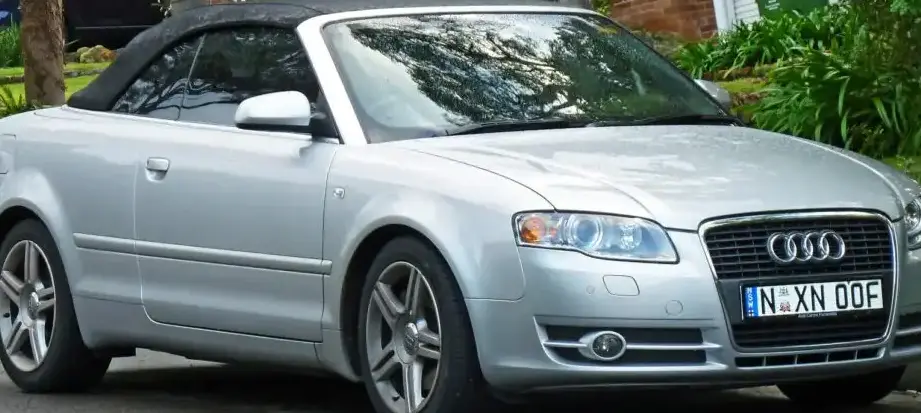
The Audi A4 Cabriolet (B7 8H) 2.0 TFSI Multitronic, produced between 2005 and 2008, represented a compelling blend of open-air motoring and modern technology within the Audi lineup. Positioned as a mid-range offering in the B7 Cabriolet series, it slotted between the more economical 1.8T models and the performance-oriented 3.2 FSI variants. This model capitalized on Audi’s reputation for build quality and sophisticated engineering, offering a comfortable and relatively sporty driving experience in a stylish package. It was primarily marketed towards buyers seeking a premium convertible experience with a balance of performance and fuel efficiency, particularly in European markets where convertibles were highly popular.
Technical Specifications
| Brand | Audi |
| Model | A4 |
| Generation | A4 Cabriolet (B7 8H) |
| Type (Engine) | 2.0 TFSI (200 Hp) Multitronic |
| Start of production | 2005 |
| End of production | 2008 |
| Powertrain Architecture | Internal Combustion engine |
| Body type | Cabriolet |
| Seats | 4 |
| Doors | 2 |
| Fuel consumption (urban) | 11.5 l/100 km (20.5 US mpg, 24.6 UK mpg, 8.7 km/l) |
| Fuel consumption (extra urban) | 6.6 l/100 km (35.6 US mpg, 42.8 UK mpg, 15.2 km/l) |
| Fuel consumption (combined) | 8.4 l/100 km (28 US mpg, 33.6 UK mpg, 11.9 km/l) |
| CO2 emissions | 199 g/km |
| Fuel Type | Petrol (Gasoline) |
| Acceleration 0 – 100 km/h | 8.1 sec |
| Acceleration 0 – 62 mph | 8.1 sec |
| Acceleration 0 – 60 mph | 7.7 sec |
| Maximum speed | 233 km/h (144.78 mph) |
| Emission standard | Euro 4 |
| Weight-to-power ratio | 8.2 kg/Hp, 122.7 Hp/tonne |
| Weight-to-torque ratio | 5.8 kg/Nm, 171.8 Nm/tonne |
| Power | 200 Hp @ 5100-6000 rpm |
| Power per litre | 100.8 Hp/l |
| Torque | 280 Nm @ 1800-5000 rpm (206.52 lb.-ft. @ 1800-5000 rpm) |
| Engine layout | Front, Longitudinal |
| Engine Model/Code | BGB, BPG, BWE, BWT |
| Engine displacement | 1984 cm3 (121.07 cu. in.) |
| Number of cylinders | 4 |
| Engine configuration | Inline |
| Cylinder Bore | 82.5 mm (3.25 in.) |
| Piston Stroke | 92.8 mm (3.65 in.) |
| Compression ratio | 10.5:1 |
| Number of valves per cylinder | 4 |
| Fuel injection system | Direct injection |
| Engine aspiration | Turbocharger, Intercooler |
| Valvetrain | DOHC |
| Engine oil capacity | 4.5 l (4.76 US qt | 3.96 UK qt) |
| Coolant | 8 l (8.45 US qt | 7.04 UK qt) |
| Kerb Weight | 1630 kg (3593.53 lbs.) |
| Max. weight | 2110 kg (4651.75 lbs.) |
| Max load | 480 kg (1058.22 lbs.) |
| Trunk (boot) space – minimum | 246 l (8.69 cu. ft.) |
| Trunk (boot) space – maximum | 315 l (11.12 cu. ft.) |
| Fuel tank capacity | 70 l (18.49 US gal | 15.4 UK gal) |
| Permitted trailer load with brakes (8%) | 1700 kg (3747.86 lbs.) |
| Permitted trailer load with brakes (12%) | 1500 kg (3306.93 lbs.) |
| Permitted trailer load without brakes | 750 kg (1653.47 lbs.) |
| Permitted towbar download | 80 kg (176.37 lbs.) |
| Length | 4573 mm (180.04 in.) |
| Width | 1777 mm (69.96 in.) |
| Height | 1391 mm (54.76 in.) |
| Wheelbase | 2650 mm (104.33 in.) |
| Front track | 1522 mm (59.92 in.) |
| Rear (Back) track | 1518 mm (59.76 in.) |
| Drag coefficient (Cd) | 0.31 |
| Minimum turning circle (turning diameter) | 11.1 m (36.42 ft.) |
| Drivetrain Architecture | The Internal combustion engine (ICE) drives the front wheels of the vehicle. |
| Drive wheel | Front wheel drive |
| Number of gears and type of gearbox | automatic transmission Multitronic |
| Front suspension | Independent multi-link suspension |
| Rear suspension | Independent multi-link suspension |
| Front brakes | Ventilated discs |
| Rear brakes | Disc |
| Assisting systems | ABS (Anti-lock braking system) |
| Steering type | Steering rack and pinion |
| Power steering | Hydraulic Steering |
| Tires size | 215/55 R16 |
| Wheel rims size | 7J x 16 |
Powertrain & Engine Architecture
At the heart of the A4 Cabriolet 2.0 TFSI Multitronic lies the 1.984-liter inline-four cylinder engine, identifiable by engine codes BGB, BPG, BWE, or BWT. This engine is a key member of Audi’s TFSI (Turbocharged Fuel Stratified Injection) family. It utilizes direct fuel injection, delivering fuel directly into the combustion chamber for improved efficiency and power. A single turbocharger, coupled with an intercooler, provides forced induction, boosting output to 200 horsepower and 280 Nm (206.52 lb-ft) of torque. The engine features a dual overhead camshaft (DOHC) valvetrain with four valves per cylinder, optimizing gas flow for enhanced performance. The Multitronic transmission is a continuously variable transmission (CVT) offering smooth, stepless gear changes. Unlike traditional automatic transmissions with fixed gear ratios, the Multitronic uses a chain-driven system to provide an infinite number of ratios within its operating range, optimizing engine efficiency and responsiveness.
Driving Characteristics
The 2.0 TFSI Multitronic powertrain delivers a refined and capable driving experience. Acceleration from 0 to 60 mph takes approximately 7.7 seconds, and the car reaches a top speed of 144.78 mph. The Multitronic transmission contributes to smooth acceleration and a lack of noticeable gear shifts. While not as overtly sporty as the manual transmission or the higher-output 3.2 FSI models, the 2.0 TFSI provides ample power for everyday driving and comfortable highway cruising. The CVT’s programming prioritizes fuel efficiency, which can sometimes result in a slightly less engaging driving experience compared to a traditional automatic or manual. The gear ratios are continuously adjusted to keep the engine within its optimal power band, providing good responsiveness in most situations.
Equipment & Trim Levels
The 2.0 TFSI Multitronic Cabriolet typically came equipped with a generous array of standard features. These included leather upholstery, automatic climate control, a multi-function steering wheel, and an Audi Concert audio system. Optional extras included features like navigation system, heated front seats, parking sensors, and upgraded alloy wheels. Trim levels were relatively streamlined, with most customization options available as individual add-ons rather than distinct packages. The interior design was typical of Audi at the time, characterized by a clean, functional layout and high-quality materials.
Chassis & Braking
The B7 A4 Cabriolet utilizes an independent multi-link suspension system at both the front and rear axles, providing a comfortable ride and good handling characteristics. The front suspension features coil springs and shock absorbers, while the rear suspension incorporates a more complex setup designed to minimize body roll and enhance stability. Brakes consist of ventilated discs at the front and solid discs at the rear, providing adequate stopping power for the vehicle’s weight and performance. Anti-lock braking system (ABS) is standard, enhancing safety and control during emergency braking situations.
Market Reception & Comparison
The A4 Cabriolet 2.0 TFSI Multitronic was generally well-received by automotive critics. It was praised for its refined engine, comfortable ride, and sophisticated interior. However, some reviewers noted that the Multitronic transmission could feel somewhat detached compared to a traditional automatic or manual gearbox. Compared to the 1.8T models, the 2.0 TFSI offered a significant performance upgrade, while remaining more fuel-efficient than the 3.2 FSI. The 1.8T was often seen as the entry-level choice, while the 3.2 FSI catered to buyers prioritizing outright performance. The 2.0 TFSI struck a balance between the two, appealing to a broader range of customers.
Legacy
The 2.0 TFSI engine, in various iterations, proved to be a reliable and durable powerplant. The Multitronic transmission, however, has a more mixed reputation. While offering smooth operation, it can be prone to issues if not properly maintained, particularly regarding fluid changes. Today, well-maintained examples of the A4 Cabriolet 2.0 TFSI Multitronic are sought after by enthusiasts who appreciate its blend of style, comfort, and performance. The car represents a significant step forward in Audi’s convertible offerings, showcasing the brand’s commitment to innovation and quality. Finding a car with a documented service history, especially regarding the Multitronic transmission, is crucial for potential buyers in the used car market.