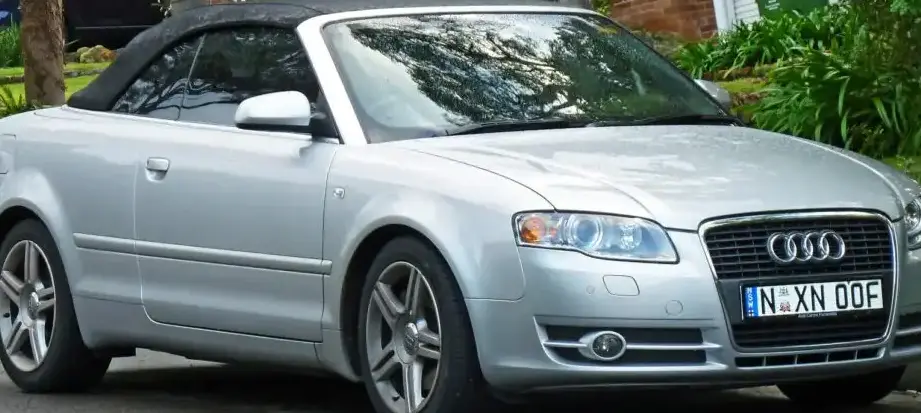
The Audi A4 Cabriolet (B7 8H) 2.0i 20V, produced between 2005 and 2008, represented a compelling entry point into Audi’s premium open-top market. Positioned within the B7 generation of the A4 Cabriolet – itself based on the Volkswagen Group’s PL45 (or 1HX0/A3) platform – this variant offered a balance of style, comfort, and reasonable performance. It served as a more accessible alternative to the higher-performance models like the 3.0 V6, appealing to buyers prioritizing fuel efficiency and a relaxed driving experience. This model was primarily sold in the European market, where convertibles enjoyed significant popularity.
Technical Specifications
| Brand | Audi |
| Model | A4 |
| Generation | A4 Cabriolet (B7 8H) |
| Type (Engine) | 2.0i 20V (131 Hp) |
| Start of production | 2005 |
| End of production | 2008 |
| Powertrain Architecture | Internal Combustion engine |
| Body type | Cabriolet |
| Seats | 4 |
| Doors | 2 |
| Fuel consumption (urban) | 12.1 l/100 km (19.4 US mpg, 23.3 UK mpg, 8.3 km/l) |
| Fuel consumption (extra urban) | 6.6 l/100 km (35.6 US mpg, 42.8 UK mpg, 15.2 km/l) |
| Fuel consumption (combined) | 8.6 l/100 km (27.4 US mpg, 32.8 UK mpg, 11.6 km/l) |
| CO2 emissions | 206 g/km |
| Fuel Type | Petrol (Gasoline) |
| Acceleration 0 – 100 km/h | 10.9 sec |
| Acceleration 0 – 62 mph | 10.9 sec |
| Acceleration 0 – 60 mph | 10.4 sec |
| Maximum speed | 208 km/h (129.25 mph) |
| Emission standard | Euro 4 |
| Weight-to-power ratio | 11.6 kg/Hp, 86.2 Hp/tonne |
| Weight-to-torque ratio | 7.8 kg/Nm, 128.3 Nm/tonne |
| Power | 131 Hp @ 5700 rpm |
| Power per litre | 66 Hp/l |
| Torque | 195 Nm @ 3300 rpm (143.82 lb.-ft. @ 3300 rpm) |
| Engine layout | Front, Longitudinal |
| Engine Model/Code | ALT |
| Engine displacement | 1984 cm3 (121.07 cu. in.) |
| Number of cylinders | 4 |
| Engine configuration | Inline |
| Cylinder Bore | 82.5 mm (3.25 in.) |
| Piston Stroke | 92.8 mm (3.65 in.) |
| Compression ratio | 10.3:1 |
| Number of valves per cylinder | 5 |
| Fuel injection system | Multi-port manifold injection |
| Engine aspiration | Naturally aspirated engine |
| Valvetrain | DOHC |
| Engine oil capacity | 4.2 l (4.44 US qt | 3.7 UK qt) |
| Coolant | 8 l (8.45 US qt | 7.04 UK qt) |
| Kerb Weight | 1520 kg (3351.03 lbs.) |
| Max. weight | 2000 kg (4409.25 lbs.) |
| Max load | 480 kg (1058.22 lbs.) |
| Trunk (boot) space – minimum | 246 l (8.69 cu. ft.) |
| Trunk (boot) space – maximum | 315 l (11.12 cu. ft.) |
| Fuel tank capacity | 70 l (18.49 US gal | 15.4 UK gal) |
| Permitted trailer load with brakes (8%) | 1500 kg (3306.93 lbs.) |
| Permitted trailer load with brakes (12%) | 1300 kg (2866.01 lbs.) |
| Permitted trailer load without brakes | 750 kg (1653.47 lbs.) |
| Permitted towbar download | 80 kg (176.37 lbs.) |
| Length | 4573 mm (180.04 in.) |
| Width | 1777 mm (69.96 in.) |
| Height | 1391 mm (54.76 in.) |
| Wheelbase | 2654 mm (104.49 in.) |
| Front track | 1523 mm (59.96 in.) |
| Rear (Back) track | 1523 mm (59.96 in.) |
| Drag coefficient (Cd) | 0.30 |
| Minimum turning circle (turning diameter) | 11.1 m (36.42 ft.) |
| Drivetrain Architecture | The Internal combustion engine (ICE) drives the front wheels of the vehicle. |
| Drive wheel | Front wheel drive |
| Number of gears and type of gearbox | 5 gears, manual transmission |
| Front suspension | Independent multi-link suspension |
| Rear suspension | Independent multi-link suspension |
| Front brakes | Ventilated discs |
| Rear brakes | Disc |
| Assisting systems | ABS (Anti-lock braking system) |
| Steering type | Steering rack and pinion |
| Power steering | Hydraulic Steering |
| Tires size | 205/55 R16 |
| Wheel rims size | 7J x 16 |
Powertrain & Engine Architecture
The heart of the A4 Cabriolet 2.0i 20V is the Audi ALT engine, a 1.984-liter (121.07 cubic inches) inline-four cylinder gasoline engine. This engine, part of the Volkswagen Group’s EA888 family, utilizes a five-valve-per-cylinder (20V) dual overhead camshaft (DOHC) configuration. The ALT engine employs multi-port fuel injection, delivering fuel directly into the intake ports. This system, while not as advanced as direct injection found in later engines, provided reliable and efficient fuel delivery for its time. The engine’s 131 horsepower peak is achieved at 5700 rpm, while its 195 Nm (143.82 lb-ft) of torque is available at 3300 rpm. The engine is longitudinally mounted, driving the front wheels. The transmission is a five-speed manual gearbox, offering a relatively conventional gear ratio spread.
Driving Characteristics
The 2.0i 20V Cabriolet offered a comfortable and refined driving experience, prioritizing ease of use over outright performance. Acceleration from 0-60 mph took approximately 10.4 seconds, and the top speed was around 129.25 mph. Compared to the more powerful 3.0 V6 models, the 2.0i felt noticeably less responsive, particularly during overtaking maneuvers. The five-speed manual transmission, while precise, lacked the closer ratios found in sportier variants. However, the engine’s torque delivery was adequate for everyday driving, providing sufficient power for cruising and navigating city streets. The front-wheel-drive configuration offered predictable handling, although it could exhibit some understeer when pushed hard.
Equipment & Trim Levels
The A4 Cabriolet 2.0i 20V typically came equipped with a respectable level of standard features. These included power windows, central locking, air conditioning, and an integrated audio system. Interior upholstery was generally cloth, although leather options were available as upgrades. Dashboard trim was typically finished in a brushed aluminum or wood effect. Common optional extras included a sunroof, upgraded audio systems, heated seats, and parking sensors. The trim level often dictated the availability of these options, with higher trims offering more standard features and a wider range of customization possibilities.
Chassis & Braking
The B7 A4 Cabriolet utilized an independent multi-link suspension system at both the front and rear axles. This setup provided a good balance of ride comfort and handling precision. The front suspension featured ventilated disc brakes, while the rear brakes were solid discs. Anti-lock Braking System (ABS) was standard, enhancing braking performance and stability. The chassis was reinforced to compensate for the lack of a fixed roof, providing adequate torsional rigidity. Stabilizer bars were fitted to both axles to reduce body roll during cornering.
Market Reception & Comparison
The A4 Cabriolet 2.0i 20V was generally well-received by automotive critics as a stylish and affordable entry into the premium convertible segment. It was praised for its comfortable ride, refined interior, and relatively fuel-efficient engine. However, some critics noted its lack of outright performance compared to its more powerful siblings. In terms of fuel economy, the 2.0i offered a significant improvement over the 3.0 V6, achieving around 27.4 US mpg in combined driving. Reliability was generally good, although regular maintenance was essential to prevent issues with the engine’s timing belt and cooling system.
Legacy
Today, the Audi A4 Cabriolet (B7 8H) 2.0i 20V remains a popular choice among used car buyers seeking a stylish and affordable convertible. The ALT engine, while not known for its exceptional power, is generally considered reliable if properly maintained. Common issues include oil leaks, coolant system failures, and timing belt wear. The availability of spare parts is good, and the car’s relatively simple mechanical design makes it accessible to independent mechanics. The 2.0i variant offers a good balance of cost, comfort, and reliability, making it a compelling option for those looking to experience open-top motoring without breaking the bank.