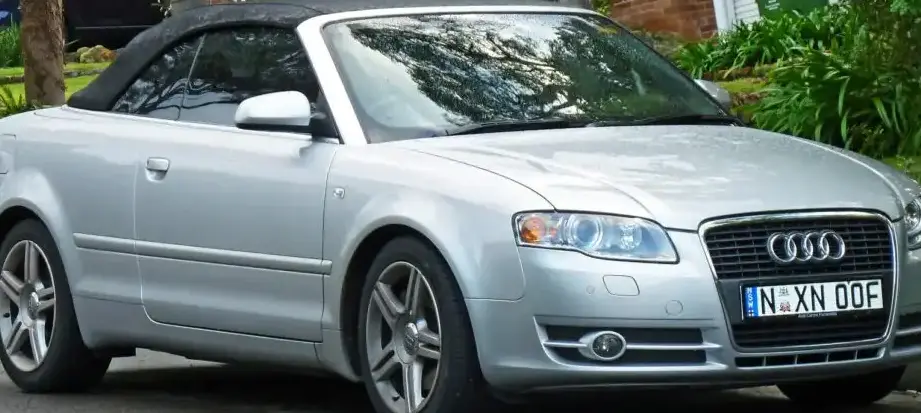
The Audi A4 Cabriolet (B7 8H) 3.0 TDI V6 quattro DPF, produced between 2005 and 2008, represented a sophisticated blend of performance and open-air motoring within the Audi A4 range. This variant occupied the upper echelon of the B7 Cabriolet lineup, offering a significant step up in power and refinement compared to the four-cylinder options. It was positioned as a premium offering, appealing to buyers seeking a sporty yet comfortable convertible experience with the added security of Audi’s quattro all-wheel-drive system. The B7 generation A4 Cabriolet, built on the Volkswagen Group’s PL45 platform (also known as the 1HX0 platform for the A4), aimed to improve upon its predecessor with enhanced rigidity, updated styling, and more advanced technology.
Technical Specifications
| Brand | Audi |
| Model | A4 |
| Generation | A4 Cabriolet (B7 8H) |
| Type (Engine) | 3.0 TDI V6 (233 Hp) quattro DPF |
| Start of production | 2005 |
| End of production | 2008 |
| Powertrain Architecture | Internal Combustion engine |
| Body type | Cabriolet |
| Seats | 4 |
| Doors | 2 |
| Fuel consumption (urban) | 11.1 l/100 km (21.2 US mpg, 25.4 UK mpg, 9 km/l) |
| Fuel consumption (extra urban) | 6 l/100 km (39.2 US mpg, 47.1 UK mpg, 16.7 km/l) |
| Fuel consumption (combined) | 7.9 l/100 km (29.8 US mpg, 35.8 UK mpg, 12.7 km/l) |
| CO2 emissions | 209 g/km |
| Fuel Type | Diesel |
| Acceleration 0 – 100 km/h | 7.3 sec |
| Acceleration 0 – 62 mph | 7.3 sec |
| Acceleration 0 – 60 mph | 6.9 sec |
| Maximum speed | 242 km/h (150.37 mph) |
| Emission standard | Euro 4 |
| Weight-to-power ratio | 7.7 kg/Hp, 130.2 Hp/tonne |
| Weight-to-torque ratio | 4 kg/Nm, 251.4 Nm/tonne |
| Power | 233 Hp @ 4000 rpm |
| Power per litre | 78.5 Hp/l |
| Torque | 450 Nm @ 1400-3250 rpm (331.9 lb.-ft. @ 1400-3250 rpm) |
| Engine layout | Front, Longitudinal |
| Engine Model/Code | ASB |
| Engine displacement | 2967 cm3 (181.06 cu. in.) |
| Number of cylinders | 6 |
| Engine configuration | V-engine |
| Cylinder Bore | 83 mm (3.27 in.) |
| Piston Stroke | 91.4 mm (3.6 in.) |
| Compression ratio | 17:1 |
| Number of valves per cylinder | 4 |
| Fuel injection system | Diesel Commonrail |
| Engine aspiration | Turbocharger, Intercooler |
| Valvetrain | DOHC |
| Engine oil capacity | 8 l (8.45 US qt | 7.04 UK qt) |
| Coolant | 12 l (12.68 US qt | 10.56 UK qt) |
| Kerb Weight | 1790 kg (3946.27 lbs.) |
| Max. weight | 2270 kg (5004.49 lbs.) |
| Max load | 480 kg (1058.22 lbs.) |
| Trunk (boot) space – minimum | 246 l (8.69 cu. ft.) |
| Trunk (boot) space – maximum | 315 l (11.12 cu. ft.) |
| Fuel tank capacity | 63 l (16.64 US gal | 13.86 UK gal) |
| Permitted trailer load with brakes (8%) | 1800 kg (3968.32 lbs.) |
| Permitted trailer load with brakes (12%) | 1800 kg (3968.32 lbs.) |
| Permitted trailer load without brakes | 750 kg (1653.47 lbs.) |
| Permitted towbar download | 80 kg (176.37 lbs.) |
| Length | 4573 mm (180.04 in.) |
| Width | 1777 mm (69.96 in.) |
| Height | 1391 mm (54.76 in.) |
| Wheelbase | 2650 mm (104.33 in.) |
| Front track | 1522 mm (59.92 in.) |
| Rear (Back) track | 1518 mm (59.76 in.) |
| Drag coefficient (Cd) | 0.32 |
| Minimum turning circle (turning diameter) | 11.1 m (36.42 ft.) |
| Drivetrain Architecture | The Internal combustion engine (ICE) drives permanently the four wheels of the vehicle. |
| Drive wheel | All wheel drive (4×4) |
| Number of gears and type of gearbox | 6 gears, manual transmission |
| Front suspension | Independent multi-link suspension |
| Rear suspension | Independent multi-link suspension |
| Front brakes | Ventilated discs |
| Rear brakes | Disc |
| Assisting systems | ABS (Anti-lock braking system) |
| Steering type | Steering rack and pinion |
| Power steering | Hydraulic Steering |
| Tires size | 205/55 R16 |
| Wheel rims size | 7J x 16 |
Powertrain & Engine Architecture
The heart of the A4 Cabriolet 3.0 TDI quattro was the ASB engine code, a 2,967 cc (181.06 cu. in.) V6 diesel engine. This engine utilized a common rail direct injection system, delivering fuel at extremely high pressures for optimized combustion. The engine featured a single turbocharger with an intercooler, boosting power and torque output. The valvetrain employed a double overhead camshaft (DOHC) design with four valves per cylinder, enhancing breathing and overall efficiency. The engine produced 233 horsepower at 4,000 rpm and a substantial 450 Nm (331.9 lb.-ft.) of torque between 1,400 and 3,250 rpm. This broad torque curve provided strong acceleration across a wide range of engine speeds. The engine was longitudinally mounted, directing power to Audi’s renowned quattro all-wheel-drive system through a six-speed manual transmission.
Driving Characteristics
The 3.0 TDI quattro variant offered a compelling driving experience. The high torque output of the V6 diesel engine meant brisk acceleration, with 0-60 mph times around 6.9 seconds. The quattro system provided excellent traction, particularly in adverse weather conditions, enhancing stability and confidence. While not as overtly sporty as some of its gasoline-powered counterparts, the 3.0 TDI offered a refined and effortless cruising experience. The six-speed manual transmission provided precise gear changes, allowing drivers to fully exploit the engine’s powerband. Compared to the 1.8T or 2.0T models, the 3.0 TDI offered significantly more torque and a more relaxed driving style, sacrificing some of the high-revving excitement for strong, usable power.
Equipment & Trim Levels
The A4 Cabriolet 3.0 TDI quattro typically came well-equipped, reflecting its position as a premium model. Standard features included leather upholstery, automatic climate control, a multi-function steering wheel, and an upgraded audio system. Optional extras included navigation system, heated seats, parking sensors, and a wind deflector to reduce turbulence in the cabin with the top down. Trim levels varied slightly depending on the market, but generally offered a range of interior finishes and exterior styling options. The focus was on providing a luxurious and comfortable open-top driving experience.
Chassis & Braking
The B7 A4 Cabriolet featured an independent multi-link suspension system at both the front and rear, providing a comfortable ride and precise handling. The quattro all-wheel-drive system distributed power between the front and rear axles as needed, optimizing traction and stability. Braking duties were handled by ventilated discs at the front and solid discs at the rear, equipped with ABS (Anti-lock Braking System) for enhanced safety. The chassis was reinforced compared to the previous generation to improve rigidity and reduce scuttle shake, a common issue in convertibles.
Market Reception & Comparison
The Audi A4 Cabriolet 3.0 TDI quattro was generally well-received by automotive critics. It was praised for its refined engine, comfortable ride, and the added security of the quattro all-wheel-drive system. Fuel economy was a strong point, offering a good balance between performance and efficiency. Compared to the gasoline-powered A4 Cabriolet models, the 3.0 TDI offered superior torque and fuel economy, making it a popular choice for long-distance drivers. However, some critics noted that the diesel engine lacked the sporty character of the gasoline engines. Reliability was generally good, although diesel particulate filter (DPF) issues could occur with infrequent long journeys.
Legacy
The ASB engine, while robust, requires regular maintenance, particularly concerning the diesel particulate filter. Proper servicing and the use of high-quality diesel fuel are crucial for long-term reliability. Today, the A4 Cabriolet 3.0 TDI quattro represents a desirable used car option for those seeking a stylish and capable convertible. Its combination of performance, refinement, and all-weather capability continues to appeal to enthusiasts. Values have remained relatively stable, reflecting the car’s enduring appeal and the reputation of the Audi brand. Finding well-maintained examples is key, as neglected vehicles may require significant investment to address deferred maintenance.