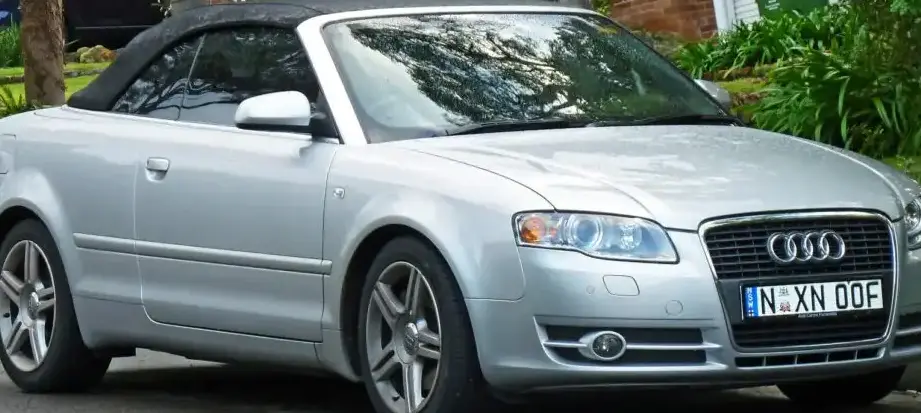
The Audi A4 Cabriolet (B7 8H) 3.2 FSI V6, produced from 2005 to 2008, represented a compelling blend of open-air motoring and sophisticated German engineering. Positioned as the flagship engine option within the B7 A4 Cabriolet range, it offered a significant performance upgrade over the more common 1.8T and 2.0T models. This variant was built on the Audi-specific version of the Volkswagen Group’s PL45 platform (internally designated as the B7), sharing its underpinnings with the A4 sedan and Avant (wagon). The 3.2 FSI aimed at buyers seeking a premium, high-performance convertible experience, often appealing to those who desired the prestige of the V6 engine and its associated refinement.
Technical Specifications
| Brand | Audi |
| Model | A4 |
| Generation | A4 Cabriolet (B7 8H) |
| Type (Engine) | 3.2 FSI V6 (255 Hp) |
| Start of production | 2005 |
| End of production | 2008 |
| Powertrain Architecture | Internal Combustion engine |
| Body type | Cabriolet |
| Seats | 4 |
| Doors | 2 |
| Fuel consumption (urban) | 13.8 l/100 km (17 US mpg, 20.5 UK mpg, 7.2 km/l) |
| Fuel consumption (extra urban) | 7.2 l/100 km (32.7 US mpg, 39.2 UK mpg, 13.9 km/l) |
| Fuel consumption (combined) | 9.6 l/100 km (24.5 US mpg, 29.4 UK mpg, 10.4 km/l) |
| CO2 emissions | 230 g/km |
| Fuel Type | Petrol (Gasoline) |
| Acceleration 0 – 100 km/h | 7.2 sec |
| Acceleration 0 – 62 mph | 7.2 sec |
| Acceleration 0 – 60 mph | 6.8 sec |
| Maximum speed | 250 km/h (155.34 mph) |
| Emission standard | Euro 4 |
| Weight-to-power ratio | 6.5 kg/Hp, 153.6 Hp/tonne |
| Weight-to-torque ratio | 5 kg/Nm, 198.8 Nm/tonne |
| Power | 255 Hp @ 6500 rpm |
| Power per litre | 81.7 Hp/l |
| Torque | 330 Nm @ 3250 rpm (243.4 lb.-ft. @ 3250 rpm) |
| Engine layout | Front, Longitudinal |
| Engine Model/Code | AUK, BKH |
| Engine displacement | 3123 cm3 (190.58 cu. in.) |
| Number of cylinders | 6 |
| Engine configuration | V-engine |
| Cylinder Bore | 84.5 mm (3.33 in.) |
| Piston Stroke | 92.8 mm (3.65 in.) |
| Compression ratio | 12.5:1 |
| Number of valves per cylinder | 4 |
| Fuel injection system | Direct injection |
| Engine aspiration | Naturally aspirated engine |
| Valvetrain | DOHC |
| Engine oil capacity | 6.2 l (6.55 US qt | 5.46 UK qt) |
| Coolant | 12 l (12.68 US qt | 10.56 UK qt) |
| Kerb Weight | 1660 kg (3659.67 lbs.) |
| Max. weight | 2140 kg (4717.89 lbs.) |
| Max load | 480 kg (1058.22 lbs.) |
| Trunk (boot) space – minimum | 246 l (8.69 cu. ft.) |
| Trunk (boot) space – maximum | 315 l (11.12 cu. ft.) |
| Fuel tank capacity | 70 l (18.49 US gal | 15.4 UK gal) |
| Permitted trailer load with brakes (8%) | 1800 kg (3968.32 lbs.) |
| Permitted trailer load with brakes (12%) | 1700 kg (3747.86 lbs.) |
| Permitted trailer load without brakes | 750 kg (1653.47 lbs.) |
| Permitted towbar download | 80 kg (176.37 lbs.) |
| Length | 4573 mm (180.04 in.) |
| Width | 1777 mm (69.96 in.) |
| Height | 1391 mm (54.76 in.) |
| Wheelbase | 2650 mm (104.33 in.) |
| Front track | 1522 mm (59.92 in.) |
| Rear (Back) track | 1518 mm (59.76 in.) |
| Drag coefficient (Cd) | 0.31 |
| Minimum turning circle (turning diameter) | 11.1 m (36.42 ft.) |
| Drivetrain Architecture | The Internal combustion engine (ICE) drives the front wheels of the vehicle. |
| Drive wheel | Front wheel drive |
| Number of gears and type of gearbox | 6 gears, manual transmission |
| Front suspension | Independent multi-link suspension |
| Rear suspension | Independent multi-link suspension |
| Front brakes | Ventilated discs |
| Rear brakes | Disc |
| Assisting systems | ABS (Anti-lock braking system) |
| Steering type | Steering rack and pinion |
| Power steering | Hydraulic Steering |
| Tires size | 215/55 R16 |
| Wheel rims size | 7J x 16 |
Powertrain & Engine Architecture
The heart of the A4 Cabriolet 3.2 FSI was the AUK or BKH engine code, a 3.2-liter naturally aspirated V6. This engine utilized Audi’s FSI (Fuel Stratified Injection) direct injection technology, which allowed for precise fuel delivery and improved combustion efficiency. The engine featured a double overhead camshaft (DOHC) valvetrain with four valves per cylinder, contributing to its high power output. The 3.2 FSI produced 255 horsepower at 6500 rpm and 243 lb-ft of torque at 3250 rpm. The engine’s longitudinal mounting and front-wheel drive configuration were standard for Audi’s at the time. The standard transmission was a 6-speed manual, although a 6-speed Tiptronic automatic transmission was also available. The automatic transmission featured adaptive shift programs, adjusting to the driver’s style for smoother or more aggressive gear changes.
Driving Characteristics
The 3.2 FSI Cabriolet offered a noticeably more engaging driving experience than its four-cylinder counterparts. Acceleration from 0-60 mph took approximately 6.8 seconds, making it one of the quicker convertibles in its class. The engine’s broad torque curve provided strong pull throughout the rev range, making overtaking maneuvers effortless. The manual transmission offered precise shifts, while the Tiptronic automatic provided convenience without sacrificing too much control. Compared to the 1.8T, the 3.2 FSI felt significantly more responsive and refined. While the 1.8T offered good fuel economy, the 3.2 FSI prioritized performance, resulting in higher fuel consumption. The added weight of the V6 engine did slightly impact handling compared to the lighter models, but the well-tuned suspension minimized body roll and provided a comfortable ride.
Equipment & Trim Levels
The 3.2 FSI Cabriolet typically came well-equipped, reflecting its position as the range-topping model. Standard features included leather upholstery, automatic climate control, a premium sound system, and alloy wheels. Optional extras included navigation system, heated seats, and a wind deflector to reduce turbulence in the cabin with the top down. Interior trim options typically included wood or aluminum accents. The dashboard layout was typical of the B7 A4, with a focus on ergonomics and a clean, functional design.
Chassis & Braking
The A4 Cabriolet 3.2 FSI utilized an independent multi-link suspension system at both the front and rear, providing a comfortable and controlled ride. The front brakes were ventilated discs, while the rear brakes were solid discs. Anti-lock braking system (ABS) was standard. The chassis was reinforced to compensate for the lack of a fixed roof, ensuring adequate torsional rigidity. Stabilizer bars were fitted front and rear to reduce body roll during cornering.
Market Reception & Comparison
The Audi A4 Cabriolet 3.2 FSI was generally well-received by automotive critics. It was praised for its powerful engine, refined ride, and luxurious interior. However, some reviewers noted the relatively high fuel consumption and the premium price tag. Compared to competitors like the BMW 3 Series Convertible and Mercedes-Benz CLK Cabriolet, the A4 offered a compelling combination of performance, comfort, and value. The 1.8T Cabriolet was a more affordable option, appealing to buyers prioritizing fuel economy and lower running costs. The 2.0T offered a middle ground, providing a balance of performance and efficiency.
Legacy
The 3.2 FSI engine, while not without its quirks, proved to be relatively reliable when properly maintained. The direct injection system required regular servicing to prevent carbon buildup, and the timing chain was a potential wear item. Today, the A4 Cabriolet 3.2 FSI remains a desirable used car, particularly for enthusiasts seeking a stylish and capable open-top experience. Values have remained relatively stable, reflecting the car’s enduring appeal and the reputation of the Audi brand. Finding well-maintained examples can be challenging, but the reward is a rewarding and enjoyable driving experience.