Technical Specifications
| Brand | Audi |
| Model | A5 |
| Generation | A5 Cabriolet (8F7) |
| Type (Engine) | 2.0 TFSI (211 Hp) quattro Tiptronic |
| Start of production | September, 2009 |
| End of production | 2011 |
| Powertrain Architecture | Internal Combustion engine |
| Body type | Cabriolet |
| Seats | 4 |
| Doors | 2 |
| Fuel consumption (economy) – urban (EPA) | 11.8 l/100 km (19.9 US mpg, 23.9 UK mpg, 8.5 km/l) |
| Fuel consumption (economy) – extra urban (EPA) | 9 l/100 km (26.1 US mpg, 31.4 UK mpg, 11.1 km/l) |
| Fuel consumption (economy) – combined (EPA) | 10.2 l/100 km (23.1 US mpg, 27.7 UK mpg, 9.8 km/l) |
| Fuel Type | Petrol (Gasoline) |
| Acceleration 0 – 60 mph | 7.2 sec |
| Maximum speed | 210 km/h (130.49 mph), Electronically limited |
| Emission standard | ULEV II |
| Weight-to-power ratio | 8.7 kg/Hp, 115.3 Hp/tonne |
| Weight-to-torque ratio | 5.2 kg/Nm, 191.3 Nm/tonne |
| Power | 211 Hp @ 4300-6000 rpm |
| Power per litre | 106.4 Hp/l |
| Torque | 350 Nm @ 1500-4200 rpm (258.15 lb.-ft. @ 1500-4200 rpm) |
| Engine layout | Front, Longitudinal |
| Engine Model/Code | CAEB, CPMA |
| Engine displacement | 1984 cm3 (121.07 cu. in.) |
| Number of cylinders | 4 |
| Engine configuration | Inline |
| Cylinder Bore | 82.5 mm (3.25 in.) |
| Piston Stroke | 92.8 mm (3.65 in.) |
| Compression ratio | 9.6:1 |
| Number of valves per cylinder | 4 |
| Fuel injection system | Direct injection |
| Engine aspiration | Turbocharger, Intercooler |
| Valvetrain | DOHC |
| Engine oil capacity | 4.6 l (4.86 US qt | 4.05 UK qt) |
| Coolant | 7 l (7.4 US qt | 6.16 UK qt) |
| Kerb Weight | 1830 kg (4034.46 lbs.) |
| Trunk (boot) space – minimum | 320 l (11.3 cu. ft.) |
| Trunk (boot) space – maximum | 750 l (26.49 cu. ft.) |
| Fuel tank capacity | 65 l (17.17 US gal | 14.3 UK gal) |
| Length | 4625 mm (182.09 in.) |
| Width | 1854 mm (72.99 in.) |
| Width including mirrors | 2020 mm (79.53 in.) |
| Height | 1383 mm (54.45 in.) |
| Wheelbase | 2751 mm (108.31 in.) |
| Front track | 1590 mm (62.6 in.) |
| Rear (Back) track | 1577 mm (62.09 in.) |
| Front overhang | 860 mm (33.86 in.) |
| Rear overhang | 1014 mm (39.92 in.) |
| Drag coefficient (Cd) | 0.31 |
| Minimum turning circle (turning diameter) | 11.4 m (37.4 ft.) |
| Drivetrain Architecture | The Internal combustion engine (ICE) drives permanently the four wheels of the vehicle. |
| Drive wheel | All wheel drive (4×4) |
| Number of gears and type of gearbox | 6 gears, automatic transmission Tiptronic |
| Front suspension | Coil spring, Independent multi-link suspension, Transverse stabilizer |
| Rear suspension | Independent on trapezoidal lever, Transverse stabilizer |
| Front brakes | Ventilated discs, 320 mm |
| Rear brakes | Disc, 300 mm |
| Assisting systems | ABS (Anti-lock braking system) |
| Steering type | Steering rack and pinion |
| Power steering | Hydraulic Steering |
| Tires size | 245/40 R18; 255/35 R19 |
| Wheel rims size | 8.5J x 18; 8.5J x 19; 9J x 19 |
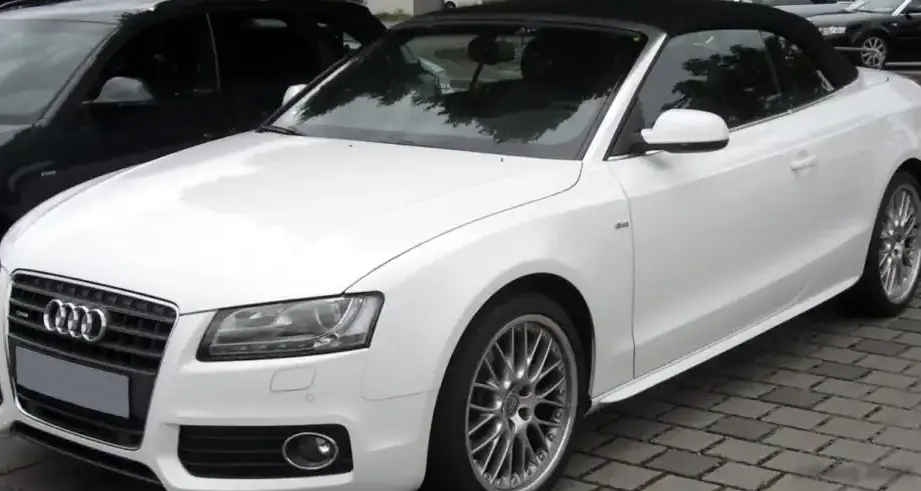
The Audi A5 Cabriolet (8F7) 2.0 TFSI quattro Tiptronic, produced from 2009 to 2011, represented a compelling blend of open-air motoring, performance, and Audi’s signature refinement. Positioned as a mid-range offering within the A5 Cabriolet lineup, it slotted between the more economical 1.8 TFSI models and the higher-performance 3.2 FSI variants. This particular configuration, combining a 2.0-liter turbocharged four-cylinder engine with Audi’s quattro all-wheel-drive system and a six-speed Tiptronic automatic transmission, aimed to deliver a balanced driving experience suitable for both daily commutes and spirited weekend drives. It was part of the broader A5/S5/RS5 family built on the Audi B8 platform, sharing its underpinnings with the A4 sedan and Avant.
Powertrain & Engine Architecture
At the heart of the A5 Cabriolet 2.0 TFSI quattro Tiptronic lies the EA888 2.0-liter inline-four cylinder engine. Specifically, models produced during this period utilized either the CAEB or CPMA engine code, both representing variations of this powerplant. This engine featured direct fuel injection (FSI) and a single turbocharger with an intercooler, enabling a respectable 211 horsepower and 258 lb-ft of torque. The direct injection system allowed for precise fuel delivery, improving efficiency and reducing emissions. The turbocharger boosted power output, providing a noticeable increase in performance over naturally aspirated engines. The six-speed Tiptronic automatic transmission offered both fully automatic operation and the ability for the driver to manually select gears, providing a degree of control. The Tiptronic system, while not as sporty as a dual-clutch transmission, offered smooth and relatively quick shifts.
Driving Characteristics
The 2.0 TFSI quattro Tiptronic A5 Cabriolet delivered a comfortable and capable driving experience. Acceleration from 0 to 60 mph took approximately 7.2 seconds, making it reasonably quick for its class. The quattro all-wheel-drive system provided excellent traction, particularly in inclement weather, enhancing stability and confidence. The Tiptronic transmission, while smooth, wasn’t as responsive as the six-speed manual available on other A5 models. Gear ratios were tuned for a balance of fuel economy and performance, with a focus on providing adequate power for everyday driving. Compared to the more powerful 3.2 FSI variant, the 2.0 TFSI felt less urgent in its acceleration, but it offered a more fuel-efficient and accessible driving experience.
Equipment & Trim Levels
The 2.0 TFSI quattro Tiptronic typically came standard with a generous array of features. Interior appointments included leather upholstery, power-adjustable front seats, and a multi-function steering wheel. Standard technology included Audi’s Multi Media Interface (MMI) infotainment system, a premium sound system, and automatic climate control. Optional extras included navigation, heated seats, and a wind deflector to reduce turbulence in the cabin when the top was down. Trim levels varied slightly by market, but generally offered options for upgraded interior materials and exterior styling cues.
Chassis & Braking
The A5 Cabriolet’s chassis was designed to provide a balance of comfort and handling. The front suspension utilized a multi-link setup with coil springs and a transverse stabilizer bar, while the rear suspension employed an independent trapezoidal lever design with a similar stabilizer bar. This configuration minimized body roll and provided a relatively smooth ride. Braking duties were handled by ventilated discs at the front and solid discs at the rear, equipped with ABS (Anti-lock Braking System) for enhanced safety. The braking system was generally considered adequate for the car’s performance, providing confident stopping power.
Market Reception & Comparison
The Audi A5 Cabriolet 2.0 TFSI quattro Tiptronic was generally well-received by automotive critics. It was praised for its stylish design, comfortable interior, and capable performance. However, some reviewers noted that the Tiptronic transmission wasn’t as engaging as a manual gearbox. Compared to the 1.8 TFSI models, the 2.0 TFSI offered a significant performance boost, while maintaining reasonable fuel economy. Against the 3.2 FSI, it represented a more affordable and fuel-efficient option, albeit with slightly less power. Fuel economy figures averaged around 23.1 US mpg combined, making it a relatively efficient choice for a luxury convertible.
Legacy
The EA888 2.0 TFSI engine, in its various iterations, has proven to be a remarkably durable and reliable powerplant. While early versions were prone to some oil consumption issues, these were largely addressed in later revisions. The Tiptronic transmission, when properly maintained, is also generally reliable. Today, the A5 Cabriolet 2.0 TFSI quattro Tiptronic remains a desirable used car, offering a blend of style, performance, and practicality. Its quattro all-wheel-drive system and relatively simple mechanicals make it a relatively easy car to live with, and parts availability is generally good. Well-maintained examples continue to command reasonable prices in the used car market.