Technical Specifications
| Brand | Audi |
| Model | A5 |
| Generation | A5 Cabriolet (8F7, facelift 2011) |
| Type (Engine) | 1.8 TFSI (170 Hp) |
| Start of production | 2011 |
| End of production | 2015 |
| Powertrain Architecture | Internal Combustion engine |
| Body type | Cabriolet |
| Seats | 4 |
| Doors | 2 |
| Fuel consumption (urban) | 7.9 l/100 km (29.8 US mpg, 35.8 UK mpg, 12.7 km/l) |
| Fuel consumption (extra urban) | 5.1 l/100 km (46.1 US mpg, 55.4 UK mpg, 19.6 km/l) |
| Fuel consumption (combined) | 6.2 l/100 km (37.9 US mpg, 45.6 UK mpg, 16.1 km/l) |
| CO2 emissions | 143 g/km |
| Fuel Type | Petrol (Gasoline) |
| Acceleration 0 – 100 km/h | 8.7 sec |
| Acceleration 0 – 62 mph | 8.7 sec |
| Acceleration 0 – 60 mph | 8.3 sec |
| Maximum speed | 222 km/h (137.94 mph) |
| Emission standard | Euro 6 |
| Weight-to-power ratio | 9.5 kg/Hp, 104.9 Hp/tonne |
| Weight-to-torque ratio | 5.1 kg/Nm, 197.5 Nm/tonne |
| Power | 170 Hp @ 3800-6200 rpm |
| Power per litre | 94.5 Hp/l |
| Torque | 320 Nm @ 1400-3700 rpm (236.02 lb.-ft. @ 1400-3700 rpm) |
| Engine layout | Front, Longitudinal |
| Engine Model/Code | EA888 / CJEB |
| Engine displacement | 1798 cm3 (109.72 cu. in.) |
| Number of cylinders | 4 |
| Engine configuration | Inline |
| Cylinder Bore | 82.5 mm (3.25 in.) |
| Piston Stroke | 84.1 mm (3.31 in.) |
| Compression ratio | 9.6:1 |
| Number of valves per cylinder | 4 |
| Fuel injection system | Direct injection and Multi-port manifold injection |
| Engine aspiration | Turbocharger, Intercooler |
| Valvetrain | DOHC |
| Engine oil capacity | 4.6 l (4.86 US qt | 4.05 UK qt) |
| Kerb Weight | 1620 kg (3571.49 lbs.) |
| Max. weight | 2120 kg (4673.8 lbs.) |
| Max load | 500 kg (1102.31 lbs.) |
| Trunk (boot) space – minimum | 320 l (11.3 cu. ft.) |
| Trunk (boot) space – maximum | 750 l (26.49 cu. ft.) |
| Fuel tank capacity | 63 l (16.64 US gal | 13.86 UK gal) |
| Permitted trailer load with brakes (8%) | 1700 kg (3747.86 lbs.) |
| Permitted trailer load with brakes (12%) | 1500 kg (3306.93 lbs.) |
| Permitted trailer load without brakes | 750 kg (1653.47 lbs.) |
| Permitted towbar download | 80 kg (176.37 lbs.) |
| Length | 4626 mm (182.13 in.) |
| Width | 1854 mm (72.99 in.) |
| Width including mirrors | 2020 mm (79.53 in.) |
| Height | 1383 mm (54.45 in.) |
| Wheelbase | 2751 mm (108.31 in.) |
| Front track | 1590 mm (62.6 in.) |
| Rear (Back) track | 1577 mm (62.09 in.) |
| Front overhang | 861 mm (33.9 in.) |
| Rear overhang | 1014 mm (39.92 in.) |
| Minimum turning circle | 11.4 m (37.4 ft.) |
| Drivetrain Architecture | The Internal combustion engine (ICE) drives the front wheels of the vehicle. |
| Drive wheel | Front wheel drive |
| Number of gears and type of gearbox | 6 gears, manual transmission |
| Front suspension | Independent multi-link suspension, Transverse stabilizer |
| Rear suspension | Independent on trapezoidal lever, Transverse stabilizer |
| Front brakes | Ventilated discs |
| Rear brakes | Disc |
| Assisting systems | ABS (Anti-lock braking system) |
| Steering type | Steering rack and pinion |
| Power steering | Electric Steering |
| Tires size | 225/50 R17 |
| Wheel rims size | 7.5J x 17 |
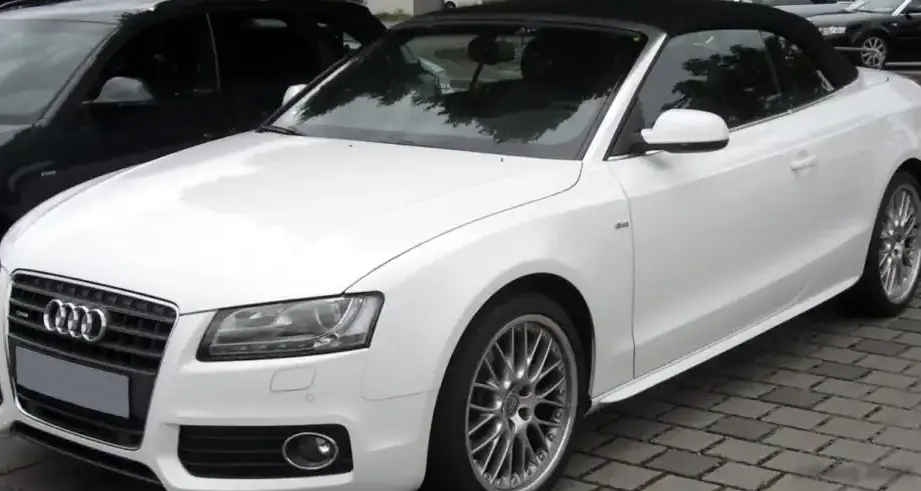
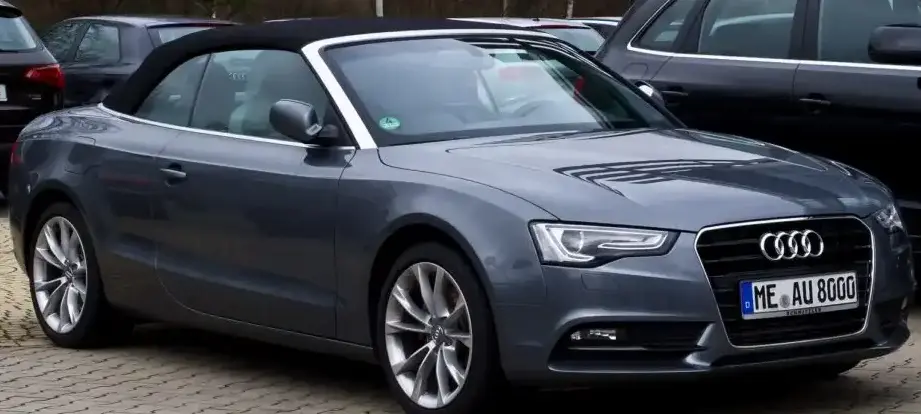
The Audi A5 Cabriolet 8F7, particularly the facelifted model produced from 2011 to 2015, represented Audi’s entry into the premium mid-size convertible market. The 1.8 TFSI variant, producing 170 horsepower, occupied a crucial position in the A5 Cabriolet lineup, offering a balance between performance, fuel efficiency, and affordability. Positioned as a more accessible alternative to the higher-performance 2.0 TFSI and 3.2 FSI models, it aimed to attract buyers seeking a stylish open-top experience without the associated premium price tag. This generation A5 Cabriolet built upon the success of the original 8F platform, introducing updated styling cues and enhanced technology.
Powertrain & Engine Architecture
The heart of the A5 Cabriolet 1.8 TFSI is the EA888 engine, specifically the CJEB variant. This 1.8-liter, inline-four cylinder engine utilizes direct fuel injection (FSI) combined with multi-point manifold injection, optimizing both power delivery and fuel efficiency. The engine is turbocharged, employing a single turbocharger with an intercooler to mitigate heat and increase air density. The valvetrain features a dual overhead camshaft (DOHC) design with four valves per cylinder, contributing to efficient cylinder filling and exhaust scavenging. The CJEB engine produces 170 horsepower at 3800-6200 rpm and 320 Nm (236 lb-ft) of torque between 1400-3700 rpm. The engine is longitudinally mounted, driving the front wheels. The transmission is a six-speed manual gearbox, offering precise control and a relatively engaging driving experience. While an automatic transmission (S tronic) was available, the manual was often preferred by enthusiasts for its responsiveness.
Driving Characteristics
The 1.8 TFSI-equipped A5 Cabriolet delivers a comfortable and refined driving experience. Acceleration from 0-60 mph takes approximately 8.3 seconds, making it adequately quick for everyday driving. The engine’s torque curve is relatively flat, providing good responsiveness across a wide range of engine speeds. Compared to the more powerful 2.0 TFSI, the 1.8 TFSI feels less urgent in its acceleration, but it offers a more relaxed and fuel-efficient driving experience. The six-speed manual transmission provides a good balance between gear ratios, allowing for efficient cruising and spirited acceleration when needed. The front-wheel-drive configuration provides predictable handling, although it lacks the all-weather capability of Audi’s quattro all-wheel-drive system.
Equipment & Trim Levels
The A5 Cabriolet 1.8 TFSI typically came standard with features such as leather upholstery, automatic climate control, a multi-function steering wheel, and an Audi Concert audio system. Optional extras included features like Audi’s navigation system, heated seats, a wind deflector (to reduce wind buffeting with the top down), and various driver assistance systems. Trim levels varied by market, but generally, the 1.8 TFSI represented a mid-range offering, positioned above the base models but below the more luxurious and performance-oriented trims. Interior trim options included a variety of wood, aluminum, and carbon fiber accents.
Chassis & Braking
The A5 Cabriolet features an independent suspension system at all four wheels. The front suspension utilizes a multi-link design with a transverse stabilizer bar, while the rear suspension employs an independent trapezoidal lever setup, also with a stabilizer bar. This configuration provides a comfortable ride and good handling characteristics. Braking duties are handled by ventilated discs at the front and solid discs at the rear. Anti-lock braking system (ABS) is standard. The chassis is reinforced to compensate for the lack of a fixed roof, ensuring structural rigidity and minimizing body flex.
Market Reception & Comparison
The Audi A5 Cabriolet 1.8 TFSI was generally well-received by automotive critics. It was praised for its stylish design, comfortable ride, and refined interior. The 1.8 TFSI engine was considered a good compromise between performance and fuel economy. Compared to the 2.0 TFSI, the 1.8 TFSI offered a lower price point and slightly better fuel efficiency, making it an attractive option for buyers who didn’t require the extra power. However, some critics noted that the 1.8 TFSI engine could feel strained when pushed hard, particularly when fully loaded. Reliability was generally good, although owners should be aware of potential issues with the turbocharger and fuel injectors.
Legacy
The Audi A5 Cabriolet 1.8 TFSI remains a popular choice in the used car market. The EA888 engine, in its various iterations, has proven to be a relatively reliable powerplant, although regular maintenance is crucial. The 1.8 TFSI variant offers a good balance of style, comfort, and affordability, making it an appealing option for buyers seeking a premium open-top experience. Its continued presence on the used car market is a testament to its enduring appeal and overall quality.