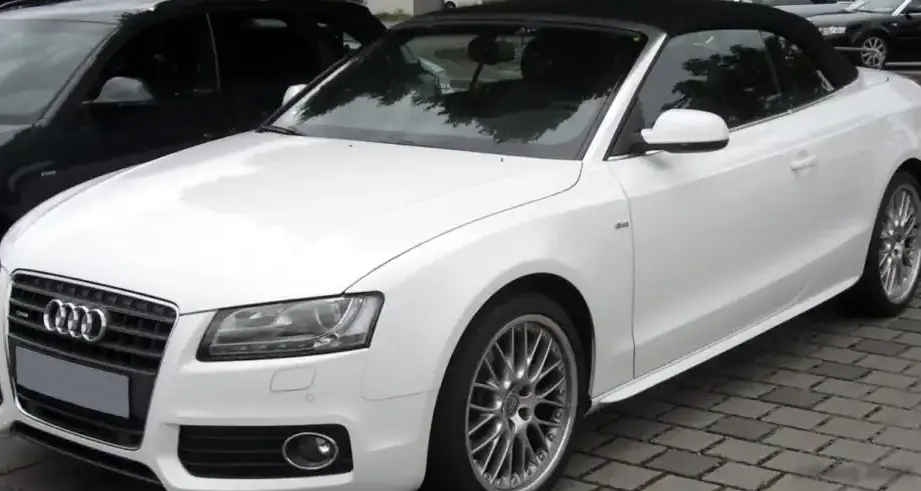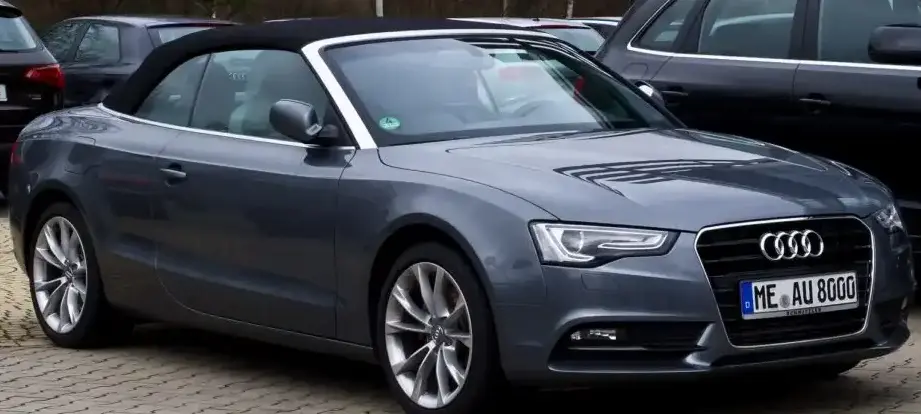
The Audi A5 Cabriolet 8F7, particularly the 2.0 TDI quattro variant produced from 2011 to 2015, represents a compelling blend of open-air motoring, diesel efficiency, and Audi’s renowned all-wheel-drive system. This facelifted version of the A5 Cabriolet (introduced in 2009) benefited from styling revisions, updated technology, and refined engine options. The 2.0 TDI quattro model occupied a middle ground in the A5 Cabriolet lineup, offering a balance between performance, fuel economy, and price, appealing to buyers seeking a sophisticated and practical convertible. It was positioned above the base 1.8 TFSI models and below the more powerful 3.0 TDI and S5 variants.
Technical Specifications
| Brand | Audi |
| Model | A5 |
| Generation | A5 Cabriolet (8F7, facelift 2011) |
| Type (Engine) | 2.0 TDI (177 Hp) quattro |
| Start of production | 2011 |
| End of production | 2015 |
| Powertrain Architecture | Internal Combustion engine |
| Body type | Cabriolet |
| Seats | 4 |
| Doors | 2 |
| Fuel consumption (urban) | 6.5 l/100 km (36.2 US mpg, 43.5 UK mpg, 15.4 km/l) |
| Fuel consumption (extra urban) | 4.9 l/100 km (48 US mpg, 57.6 UK mpg, 20.4 km/l) |
| Fuel consumption (combined) | 5.4 l/100 km (43.6 US mpg, 52.3 UK mpg, 18.5 km/l) |
| CO2 emissions | 142 g/km |
| Fuel Type | Diesel |
| Acceleration 0 – 100 km/h | 8.5 sec |
| Acceleration 0 – 62 mph | 8.5 sec |
| Acceleration 0 – 60 mph | 8.1 sec |
| Maximum speed | 221 km/h (137.32 mph) |
| Emission standard | Euro 5 |
| Weight-to-power ratio | 9.7 kg/Hp, 102.9 Hp/tonne |
| Weight-to-torque ratio | 4.5 kg/Nm, 220.9 Nm/tonne |
| Power | 177 Hp @ 4200 rpm |
| Power per litre | 89.9 Hp/l |
| Torque | 380 Nm @ 1750-2500 rpm (280.27 lb.-ft. @ 1750-2500 rpm) |
| Engine layout | Front, Longitudinal |
| Engine Model/Code | CGLC |
| Engine displacement | 1968 cm3 (120.09 cu. in.) |
| Number of cylinders | 4 |
| Engine configuration | Inline |
| Cylinder Bore | 81 mm (3.19 in.) |
| Piston Stroke | 95.5 mm (3.76 in.) |
| Compression ratio | 16.5:1 |
| Number of valves per cylinder | 4 |
| Fuel injection system | Diesel Commonrail |
| Engine aspiration | Turbocharger, Intercooler |
| Valvetrain | DOHC |
| Engine oil capacity | 5 l (5.28 US qt | 4.4 UK qt) |
| Kerb Weight | 1720 kg (3791.95 lbs.) |
| Max. weight | 2220 kg (4894.26 lbs.) |
| Max load | 500 kg (1102.31 lbs.) |
| Trunk (boot) space – minimum | 320 l (11.3 cu. ft.) |
| Trunk (boot) space – maximum | 750 l (26.49 cu. ft.) |
| Fuel tank capacity | 61 l (16.11 US gal | 13.42 UK gal) |
| Permitted trailer load with brakes (8%) | 1900 kg (4188.78 lbs.) |
| Permitted trailer load with brakes (12%) | 1700 kg (3747.86 lbs.) |
| Permitted trailer load without brakes | 750 kg (1653.47 lbs.) |
| Permitted towbar download | 80 kg (176.37 lbs.) |
| Length | 4626 mm (182.13 in.) |
| Width | 1854 mm (72.99 in.) |
| Width including mirrors | 2020 mm (79.53 in.) |
| Height | 1383 mm (54.45 in.) |
| Wheelbase | 2751 mm (108.31 in.) |
| Front track | 1590 mm (62.6 in.) |
| Rear (Back) track | 1577 mm (62.09 in.) |
| Front overhang | 861 mm (33.9 in.) |
| Rear overhang | 1014 mm (39.92 in.) |
| Drag coefficient (Cd) | 0.31 |
| Minimum turning circle (turning diameter) | 11.4 m (37.4 ft.) |
| Drivetrain Architecture | The Internal combustion engine (ICE) drives permanently the four wheels of the vehicle. |
| Drive wheel | All wheel drive (4×4) |
| Number of gears and type of gearbox | 6 gears, manual transmission |
| Front suspension | Independent multi-link suspension |
| Rear suspension | Independent on trapezoidal lever |
| Front brakes | Ventilated discs |
| Rear brakes | Disc |
| Assisting systems | ABS (Anti-lock braking system) |
| Steering type | Steering rack and pinion |
| Power steering | Electric Steering |
| Tires size | 225/50 R17 |
| Wheel rims size | 7.5J x 17 |
Powertrain & Engine Architecture
The heart of the A5 Cabriolet 2.0 TDI quattro is the CGLC engine, a 2.0-liter inline-four cylinder diesel engine. This engine is part of the Volkswagen Group’s modular engine family and features common-rail direct injection, a turbocharger with intercooling, and a double overhead camshaft (DOHC) valvetrain with four valves per cylinder. The high 16.5:1 compression ratio is typical for diesel engines, contributing to their efficiency. The engine produces 177 horsepower at 4200 rpm and a substantial 380 Nm (280 lb-ft) of torque between 1750 and 2500 rpm. This broad torque curve is a hallmark of diesel engines, providing strong pulling power across a wide range of engine speeds. The engine is longitudinally mounted in the front of the vehicle, directing power to all four wheels via Audi’s quattro all-wheel-drive system. The 6-speed manual transmission was standard, offering precise gear changes and driver engagement.
Driving Characteristics
The 2.0 TDI quattro offers a refined and capable driving experience. While not as overtly sporty as the higher-powered variants, the 177 hp engine provides ample power for everyday driving and comfortable cruising. The quattro all-wheel-drive system delivers excellent traction in all weather conditions, enhancing stability and confidence. The manual transmission, while requiring more driver involvement than an automatic, allows for precise control over gear selection. Acceleration from 0 to 100 km/h (0-62 mph) takes around 8.5 seconds, which is respectable for a relatively heavy convertible. The torque-rich engine makes overtaking maneuvers easy, and the well-tuned suspension provides a comfortable ride without sacrificing handling. Compared to the 1.8 TFSI models, the 2.0 TDI offers significantly more torque and better fuel economy, while the higher-powered 3.0 TDI provides more outright performance but at the cost of increased fuel consumption and emissions.
Equipment & Trim Levels
The A5 Cabriolet 2.0 TDI quattro typically came well-equipped, even in base trim. Standard features included leather upholstery, automatic climate control, a multi-function steering wheel, and an Audi Concert audio system. Optional extras included navigation, premium sound systems (Bang & Olufsen), heated seats, and advanced driver-assistance systems such as parking sensors and adaptive cruise control. The interior design is typically Audi – clean, modern, and built with high-quality materials. The Cabriolet’s soft top is electronically operated and provides good insulation from the elements when raised.
Chassis & Braking
The A5 Cabriolet features a sophisticated chassis design. The front suspension utilizes an independent multi-link setup, while the rear suspension employs an independent trapezoidal link design. This configuration provides a good balance between ride comfort and handling precision. The braking system consists of ventilated discs at the front and solid discs at the rear, providing ample stopping power. Anti-lock braking system (ABS) is standard, enhancing safety and control during emergency braking situations. The steering is a rack-and-pinion system with electric power assistance, offering precise and responsive steering feel.
Market Reception & Comparison
The Audi A5 Cabriolet 2.0 TDI quattro was generally well-received by automotive critics. It was praised for its stylish design, refined driving experience, and fuel efficiency. The combination of a diesel engine and all-wheel drive was seen as a practical and appealing choice for buyers in Europe, where diesel fuel is more common and winter driving conditions can be challenging. Compared to its rivals, such as the BMW 3 Series Convertible and Mercedes-Benz C-Class Cabriolet, the A5 offered a compelling blend of performance, luxury, and value. Fuel economy was a key strength, with combined fuel consumption figures around 5.4 l/100 km (43.6 US mpg).
Legacy
The 2.0 TDI engine, in various iterations, has proven to be a reliable and durable powertrain. However, like all diesel engines, it’s important to ensure regular maintenance, including oil changes and filter replacements. The CGLC engine is generally considered robust, but potential issues can include diesel particulate filter (DPF) clogging, particularly with frequent short trips. In the used car market, the A5 Cabriolet 2.0 TDI quattro remains a popular choice, offering a stylish and practical open-top driving experience at a relatively affordable price. Its combination of fuel efficiency, all-wheel-drive capability, and Audi’s reputation for quality make it a desirable option for buyers seeking a premium convertible.