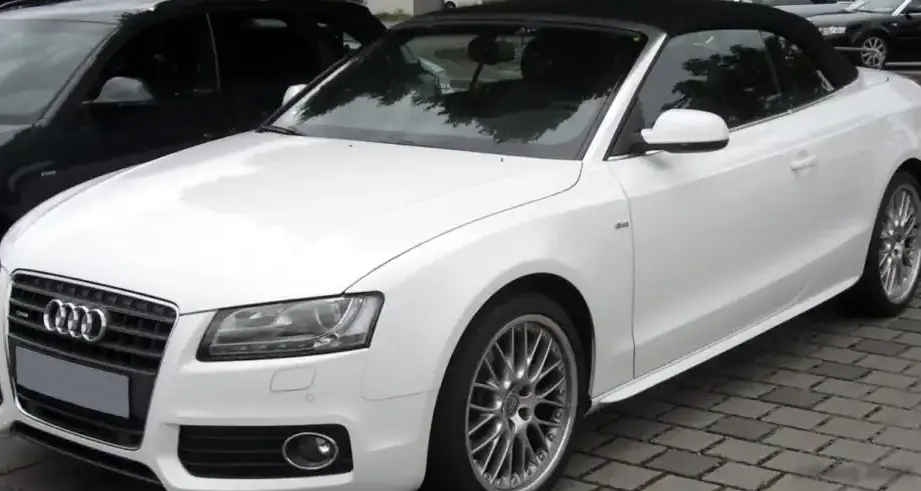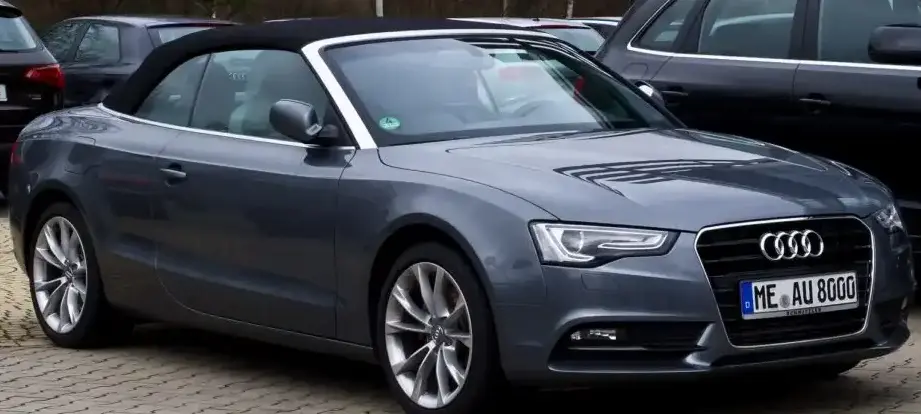
The Audi A5 Cabriolet 8F7, particularly the facelifted version introduced in 2011, represented Audi’s entry into the premium mid-size convertible market. Production of the 2.0 TDI clean diesel variant, producing 150 horsepower, spanned from May 2014 to 2015. This model occupied a key position in the A5 Cabriolet lineup, offering a balance between fuel efficiency, reasonable performance, and a more accessible price point compared to the higher-output gasoline engines and more expensive trim levels. It was designed to appeal to buyers seeking a stylish open-top experience without the significant running costs associated with larger displacement engines.
Technical Specifications
| Brand | Audi |
| Model | A5 |
| Generation | A5 Cabriolet (8F7, facelift 2011) |
| Type (Engine) | 2.0 TDI clean diesel (150 Hp) |
| Start of production | May, 2014 |
| End of production | 2015 |
| Powertrain Architecture | Internal Combustion engine |
| Body type | Cabriolet |
| Seats | 4 |
| Doors | 2 |
| Fuel consumption (urban) | 5.6 l/100 km (42 US mpg, 50.4 UK mpg, 17.9 km/l) |
| Fuel consumption (extra urban) | 4.2 l/100 km (56 US mpg, 67.3 UK mpg, 23.8 km/l) |
| Fuel consumption (combined) | 4.7 l/100 km (50 US mpg, 60.1 UK mpg, 21.3 km/l) |
| CO2 emissions | 123 g/km |
| Fuel Type | Diesel |
| Acceleration 0 – 100 km/h | 10.2 sec |
| Acceleration 0 – 62 mph | 10.2 sec |
| Acceleration 0 – 60 mph | 9.7 sec |
| Maximum speed | 210 km/h (130.49 mph) |
| Emission standard | Euro 6 |
| Weight-to-power ratio | 11.4 kg/Hp, 87.7 Hp/tonne |
| Weight-to-torque ratio | 5.3 kg/Nm, 187.1 Nm/tonne |
| Power | 150 Hp @ 3250-4200 rpm |
| Power per litre | 76.2 Hp/l |
| Torque | 320 Nm @ 1500-3250 rpm (236.02 lb.-ft. @ 1500-3250 rpm) |
| Engine layout | Front, Longitudinal |
| Engine Model/Code | CSUA |
| Engine displacement | 1968 cm3 (120.09 cu. in.) |
| Number of cylinders | 4 |
| Engine configuration | Inline |
| Cylinder Bore | 81 mm (3.19 in.) |
| Piston Stroke | 95.5 mm (3.76 in.) |
| Compression ratio | 16.5:1 |
| Number of valves per cylinder | 4 |
| Fuel injection system | Diesel Commonrail |
| Engine aspiration | Turbocharger, Intercooler |
| Valvetrain | DOHC |
| Engine oil capacity | 4.7 l (4.97 US qt | 4.14 UK qt) |
| Kerb Weight | 1710 kg (3769.9 lbs.) |
| Max. weight | 2210 kg (4872.22 lbs.) |
| Max load | 500 kg (1102.31 lbs.) |
| Trunk (boot) space – minimum | 320 l (11.3 cu. ft.) |
| Trunk (boot) space – maximum | 750 l (26.49 cu. ft.) |
| Fuel tank capacity | 63 l (16.64 US gal | 13.86 UK gal) |
| AdBlue tank | 20 l (5.28 US gal | 4.4 UK gal) |
| Permitted trailer load with brakes (8%) | 1800 kg (3968.32 lbs.) |
| Permitted trailer load with brakes (12%) | 1600 kg (3527.4 lbs.) |
| Permitted trailer load without brakes | 750 kg (1653.47 lbs.) |
| Permitted towbar download | 80 kg (176.37 lbs.) |
| Length | 4626 mm (182.13 in.) |
| Width | 1854 mm (72.99 in.) |
| Width including mirrors | 2020 mm (79.53 in.) |
| Height | 1383 mm (54.45 in.) |
| Wheelbase | 2751 mm (108.31 in.) |
| Front track | 1590 mm (62.6 in.) |
| Rear (Back) track | 1577 mm (62.09 in.) |
| Front overhang | 861 mm (33.9 in.) |
| Rear overhang | 1014 mm (39.92 in.) |
| Drag coefficient (Cd) | 0.31 |
| Minimum turning circle (turning diameter) | 11.4 m (37.4 ft.) |
| Drivetrain Architecture | The Internal combustion engine (ICE) drives the front wheels of the vehicle. |
| Drive wheel | Front wheel drive |
| Number of gears and type of gearbox | 6 gears, manual transmission |
| Front suspension | Independent multi-link suspension |
| Rear suspension | Independent on trapezoidal lever |
| Front brakes | Ventilated discs |
| Rear brakes | Disc |
| Assisting systems | ABS (Anti-lock braking system) |
| Steering type | Steering rack and pinion |
| Power steering | Electric Steering |
| Tires size | 225/50 R17 |
| Wheel rims size | 7.5J x 17 |
INTRODUCTION
The Audi A5 Cabriolet 8F7, facelifted in 2011, built upon the success of the original A5 coupe, offering open-top motoring with Audi’s signature blend of style, technology, and build quality. The 2.0 TDI clean diesel variant, introduced in 2014 and continuing through 2015, was a key component of the A5 Cabriolet range. It was positioned as a more economical alternative to the petrol-powered models, appealing to drivers prioritizing fuel efficiency and lower running costs. This variant utilized the well-regarded 2.0-liter TDI engine, known for its balance of power and economy, and was typically paired with a six-speed manual transmission, though automatic options were also available.
Powertrain & Engine Architecture
The heart of the A5 Cabriolet 2.0 TDI was the CSUA engine code, a 1968cc inline-four cylinder diesel engine. This engine featured a turbocharger with an intercooler to boost power and efficiency. It employed a common rail direct injection system, delivering fuel directly into the combustion chamber at extremely high pressure for optimized combustion. The engine boasted a relatively high compression ratio of 16.5:1, contributing to its thermal efficiency. The valvetrain utilized a double overhead camshaft (DOHC) configuration with four valves per cylinder, enhancing breathing and overall performance. The six-speed manual transmission was the standard offering, providing precise gear changes and contributing to the car’s engaging driving experience. An optional S tronic dual-clutch automatic transmission was also available, offering quicker shifts and enhanced convenience.
Driving Characteristics
The 150 horsepower and 320 Nm (236 lb-ft) of torque produced by the 2.0 TDI engine provided adequate, though not exhilarating, performance for the A5 Cabriolet. Acceleration from 0-60 mph took around 9.7 seconds, and the top speed was limited to 210 km/h (130 mph). The engine’s torque curve was relatively flat, providing good responsiveness across a wide rev range. Compared to the more powerful 2.0 TFSI petrol variants, the TDI offered less outright acceleration but significantly better fuel economy. The manual transmission provided a direct connection to the engine, allowing for precise control, while the optional S tronic automatic offered smooth and rapid gear changes. The front-wheel-drive configuration provided predictable handling, although it could exhibit some torque steer under hard acceleration.
Equipment & Trim Levels
The A5 Cabriolet 2.0 TDI typically came equipped with a respectable level of standard features. These included automatic climate control, a multi-function steering wheel, an infotainment system with a color display, and electric windows and mirrors. Upholstery was typically cloth, though leather options were available. Common optional extras included navigation system, parking sensors, upgraded sound system, and sport seats. Trim levels varied depending on the market, but generally followed a progression from SE (entry-level) to Sport and S-Line (higher-spec). The S-Line trim added more aggressive styling cues, sport suspension, and upgraded interior trim.
Chassis & Braking
The A5 Cabriolet 8F7 utilized an independent multi-link suspension at the front and an independent trapezoidal lever suspension at the rear, providing a comfortable and controlled ride. The suspension was tuned to balance handling and comfort, making it suitable for both everyday driving and longer journeys. Braking duties were handled by ventilated discs at the front and solid discs at the rear, equipped with ABS (Anti-lock Braking System) for enhanced safety. The steering was a rack and pinion system with electric power assistance, providing precise and responsive steering feel.
Market Reception & Comparison
The Audi A5 Cabriolet 2.0 TDI was generally well-received by automotive critics. It was praised for its stylish design, comfortable interior, and fuel-efficient engine. However, some reviewers noted that the 150 horsepower engine could feel underpowered, particularly when fully loaded or tackling steep hills. Compared to the 2.0 TFSI petrol variants, the TDI offered significantly better fuel economy – around 50 US mpg combined – but less outright performance. The TDI also tended to be slightly cheaper to insure and tax. Against competitors like the BMW 3 Series Convertible and Mercedes-Benz C-Class Cabriolet, the A5 Cabriolet 2.0 TDI offered a compelling combination of style, practicality, and efficiency.
Legacy
The 2.0 TDI engine in the A5 Cabriolet has proven to be relatively reliable, although, like all diesel engines, it is susceptible to issues related to the diesel particulate filter (DPF) if not properly maintained. Regular servicing and the use of high-quality diesel fuel are crucial for ensuring long-term reliability. On the used car market, the A5 Cabriolet 2.0 TDI remains a popular choice, offering a stylish and affordable way to enjoy open-top motoring. Its fuel efficiency and relatively low running costs continue to appeal to buyers seeking a practical and economical convertible.