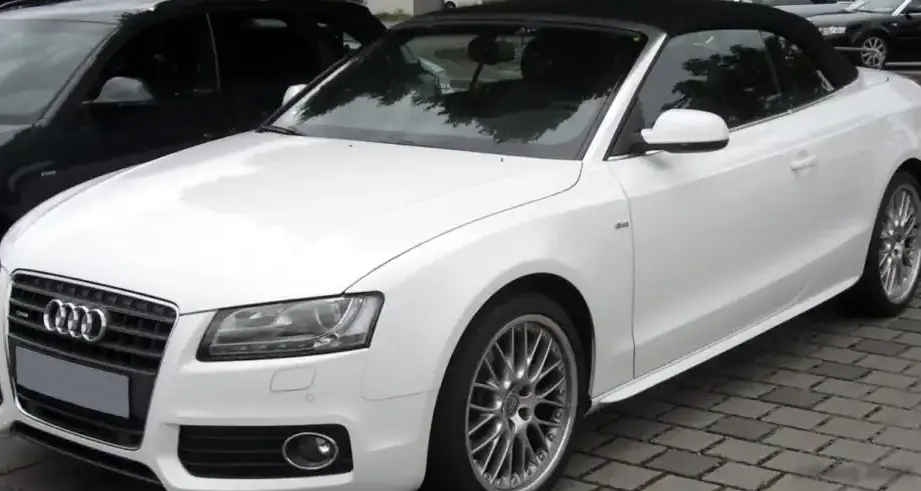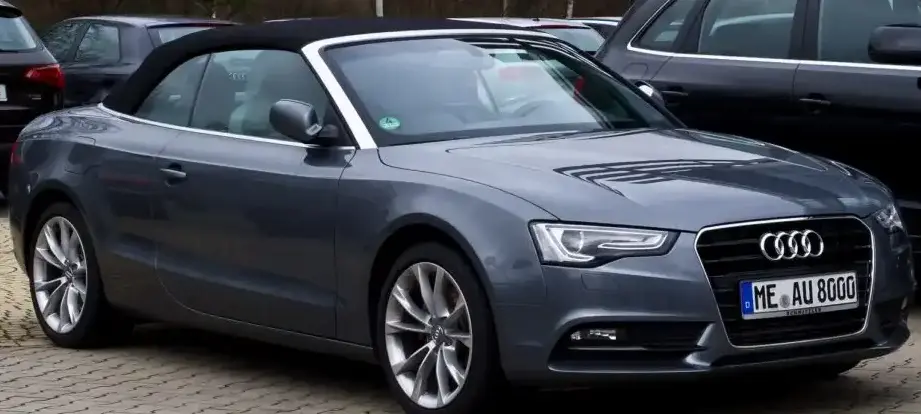
The Audi A5 Cabriolet, specifically the 8F7 facelift model produced from 2012 to 2013, represented Audi’s entry into the premium mid-size convertible market. This variant, equipped with the 2.0 TFSI engine producing 211 horsepower and paired with Audi’s Multitronic continuously variable transmission (CVT), occupied a middle ground within the A5 Cabriolet lineup, offering a balance between performance, fuel efficiency, and luxury. It built upon the foundation of the A5/A4 (B8) platform, known for its refined driving dynamics and sophisticated interior.
Technical Specifications
| Brand | Audi |
| Model | A5 |
| Generation | A5 Cabriolet (8F7, facelift 2011) |
| Type (Engine) | 2.0 TFSI (211 Hp) Multitronic |
| Start of production | June, 2012 |
| End of production | 2013 |
| Powertrain Architecture | Internal Combustion engine |
| Body type | Cabriolet |
| Seats | 4 |
| Doors | 2 |
| Fuel consumption (economy) – urban (EPA) | 9.8 l/100 km (24 US mpg, 28.8 UK mpg, 10.2 km/l) |
| Fuel consumption (economy) – extra urban (EPA) | 7.6 l/100 km (30.9 US mpg, 37.2 UK mpg, 13.2 km/l) |
| Fuel consumption (economy) – combined (EPA) | 9 l/100 km (26.1 US mpg, 31.4 UK mpg, 11.1 km/l) |
| Fuel Type | Petrol (Gasoline) |
| Acceleration 0 – 60 mph | 7.2 sec |
| Maximum speed | 210 km/h (130.49 mph), Electronically limited |
| Emission standard | ULEV II |
| Weight-to-power ratio | 8.3 kg/Hp, 119.9 Hp/tonne |
| Weight-to-torque ratio | 5 kg/Nm, 198.9 Nm/tonne |
| Power | 211 Hp @ 4300 rpm |
| Power per litre | 106.4 Hp/l |
| Torque | 350 Nm @ 1500 rpm (258.15 lb.-ft. @ 1500 rpm) |
| Engine layout | Front, Longitudinal |
| Engine Model/Code | CAEB, CPMA |
| Engine displacement | 1984 cm3 (121.07 cu. in.) |
| Number of cylinders | 4 |
| Engine configuration | Inline |
| Cylinder Bore | 82.5 mm (3.25 in.) |
| Piston Stroke | 92.8 mm (3.65 in.) |
| Compression ratio | 9.6:1 |
| Number of valves per cylinder | 4 |
| Fuel injection system | Direct injection |
| Engine aspiration | Turbocharger, Intercooler |
| Valvetrain | DOHC |
| Engine oil capacity | 4.6 l (4.86 US qt | 4.05 UK qt) |
| Coolant | 7 l (7.4 US qt | 6.16 UK qt) |
| Kerb Weight | 1760 kg (3880.14 lbs.) |
| Trunk (boot) space – minimum | 320 l (11.3 cu. ft.) |
| Trunk (boot) space – maximum | 750 l (26.49 cu. ft.) |
| Fuel tank capacity | 61 l (16.11 US gal | 13.42 UK gal) |
| Length | 4626 mm (182.13 in.) |
| Width | 1854 mm (72.99 in.) |
| Width including mirrors | 2020 mm (79.53 in.) |
| Height | 1383 mm (54.45 in.) |
| Wheelbase | 2751 mm (108.31 in.) |
| Front track | 1590 mm (62.6 in.) |
| Rear (Back) track | 1577 mm (62.09 in.) |
| Front overhang | 861 mm (33.9 in.) |
| Rear overhang | 1014 mm (39.92 in.) |
| Drag coefficient (Cd) | 0.34 |
| Minimum turning circle (turning diameter) | 11.4 m (37.4 ft.) |
| Drivetrain Architecture | The Internal combustion engine (ICE) drives the front wheels of the vehicle. |
| Drive wheel | Front wheel drive |
| Number of gears and type of gearbox | automatic transmission Multitronic |
| Front suspension | Coil spring, Independent multi-link suspension, Transverse stabilizer |
| Rear suspension | Independent on trapezoidal lever, Transverse stabilizer |
| Front brakes | Ventilated discs, 320 mm |
| Rear brakes | Disc, 300 mm |
| Assisting systems | ABS (Anti-lock braking system) |
| Steering type | Steering rack and pinion |
| Power steering | Electric Steering |
| Tires size | 245/40 R18; 235/35 R19 |
| Wheel rims size | 8.5J x 18; 8.5J x 19; 9J x 19 |
INTRODUCTION
The 2012-2013 Audi A5 Cabriolet 2.0 TFSI Multitronic was a key variant within the second-generation (8F) A5 range. The facelift introduced in 2011 brought styling updates, revised technology, and refinements to the engine lineup. This particular model aimed to provide a more accessible entry point into the A5 Cabriolet experience, appealing to buyers who prioritized fuel economy and a comfortable driving experience over outright performance. It sat below the more powerful 3.0 TFSI V6 models and offered a different character than the available manual transmission options.
Powertrain & Engine Architecture
At the heart of this A5 Cabriolet lies the 2.0 TFSI engine, specifically the CAEB or CPMA engine code depending on the exact production date and market. This is a turbocharged, direct-injection four-cylinder engine displacing 1984cc. The engine utilizes a single turbocharger with an intercooler to boost power and efficiency. Direct injection allows for precise fuel delivery, optimizing combustion and reducing emissions. The engine features a double overhead camshaft (DOHC) valvetrain with four valves per cylinder. The Multitronic transmission is a continuously variable transmission (CVT) offering seamless gear changes and contributing to improved fuel economy. Unlike traditional automatic transmissions with fixed gear ratios, the Multitronic uses a chain-driven system to provide an infinite number of ratios within its operating range.
Driving Characteristics
The 211 horsepower and 350 Nm (258 lb-ft) of torque delivered by the 2.0 TFSI engine, when coupled with the Multitronic transmission, resulted in a smooth and refined driving experience. Acceleration from 0 to 60 mph took approximately 7.2 seconds, and the car was electronically limited to a top speed of 210 km/h (130 mph). The Multitronic transmission prioritized fuel efficiency and comfort over aggressive shifting. While it didn’t offer the sporty feel of a traditional automatic or manual gearbox, it provided effortless cruising and responsive acceleration for everyday driving. The CVT’s ability to keep the engine in its optimal power band contributed to a feeling of readily available torque. Compared to the higher-output 3.0 TFSI models, this variant felt less urgent in its acceleration, but it offered a more relaxed and fuel-efficient driving experience.
Equipment & Trim Levels
The A5 Cabriolet 2.0 TFSI Multitronic typically came well-equipped as standard. Features included leather upholstery, automatic climate control, a multi-function steering wheel, and an Audi Concert audio system. Optional extras were plentiful, including Audi’s navigation system, premium sound systems (Bang & Olufsen), heated seats, and advanced driver-assistance systems like parking sensors and adaptive cruise control. Trim levels varied by market, but generally, this 2.0 TFSI model represented a mid-range offering, positioned above the base models but below the more luxurious and performance-oriented trims.
Chassis & Braking
The A5 Cabriolet featured a sophisticated chassis designed to balance comfort and handling. The front suspension utilized a coil spring, independent multi-link setup with a transverse stabilizer bar, while the rear suspension employed an independent trapezoidal lever design, also with a stabilizer bar. Braking duties were handled by ventilated discs at the front (320mm) and solid discs at the rear (300mm). Anti-lock braking system (ABS) was standard. The suspension tuning was geared towards providing a comfortable ride, but the A5 Cabriolet still offered respectable handling characteristics for a convertible.
Market Reception & Comparison
Critics generally praised the A5 Cabriolet for its stylish design, refined interior, and comfortable ride. The 2.0 TFSI Multitronic variant was often seen as a sensible choice for buyers who prioritized fuel economy and ease of use. Compared to the 3.0 TFSI models, it offered a lower price point and better fuel consumption, but at the expense of outright performance. Against competitors like the BMW 3 Series Convertible and Mercedes-Benz C-Class Cabriolet, the A5 Cabriolet was often lauded for its interior quality and sophisticated technology. The Multitronic transmission, while efficient, sometimes drew criticism for lacking the engagement of a traditional automatic or manual gearbox.
Legacy
The Audi A5 Cabriolet 2.0 TFSI Multitronic has proven to be a relatively reliable vehicle in the used car market. The 2.0 TFSI engine, while not without its potential issues (such as carbon buildup on the intake valves), is generally considered durable when properly maintained. The Multitronic transmission requires regular servicing, including fluid changes, to ensure longevity. Today, these A5 Cabriolets represent a good value for buyers seeking a stylish and comfortable convertible with a premium badge. Their combination of performance, fuel efficiency, and features continues to make them an appealing option in the used car market.