Technical Specifications
| Brand | Audi |
| Model | A5 |
| Generation | A5 Cabriolet (8F7, facelift 2011) |
| Type (Engine) | 2.0 TFSI (211 Hp) quattro Tiptronic |
| Start of production | June, 2012 |
| End of production | 2013 |
| Powertrain Architecture | Internal Combustion engine |
| Body type | Cabriolet |
| Seats | 4 |
| Doors | 2 |
| Fuel consumption (economy) – urban (EPA) | 11.8 l/100 km (19.9 US mpg, 23.9 UK mpg, 8.5 km/l) |
| Fuel consumption (economy) – extra urban (EPA) | 7.8 l/100 km (30.2 US mpg, 36.2 UK mpg, 12.8 km/l) |
| Fuel consumption (economy) – combined (EPA) | 9.8 l/100 km (24 US mpg, 28.8 UK mpg, 10.2 km/l) |
| Fuel Type | Petrol (Gasoline) |
| Acceleration 0 – 60 mph | 6.7 sec |
| Maximum speed | 210 km/h (130.49 mph), Electronically limited |
| Emission standard | ULEV II |
| Weight-to-power ratio | 8.7 kg/Hp, 115 Hp/tonne |
| Weight-to-torque ratio | 5.2 kg/Nm, 190.7 Nm/tonne |
| Power | 211 Hp @ 4300 rpm |
| Power per litre | 106.4 Hp/l |
| Torque | 350 Nm @ 1500 rpm (258.15 lb.-ft. @ 1500 rpm) |
| Engine layout | Front, Longitudinal |
| Engine Model/Code | CAEB, CPMA |
| Engine displacement | 1984 cm3 (121.07 cu. in.) |
| Number of cylinders | 4 |
| Engine configuration | Inline |
| Cylinder Bore | 82.5 mm (3.25 in.) |
| Piston Stroke | 92.8 mm (3.65 in.) |
| Compression ratio | 9.6:1 |
| Number of valves per cylinder | 4 |
| Fuel injection system | Direct injection |
| Engine aspiration | Turbocharger, Intercooler |
| Valvetrain | DOHC |
| Engine oil capacity | 4.6 l (4.86 US qt | 4.05 UK qt) |
| Coolant | 7 l (7.4 US qt | 6.16 UK qt) |
| Kerb Weight | 1835 kg (4045.48 lbs.) |
| Trunk (boot) space – minimum | 320 l (11.3 cu. ft.) |
| Trunk (boot) space – maximum | 750 l (26.49 cu. ft.) |
| Fuel tank capacity | 61 l (16.11 US gal | 13.42 UK gal) |
| Length | 4626 mm (182.13 in.) |
| Width | 1854 mm (72.99 in.) |
| Width including mirrors | 2020 mm (79.53 in.) |
| Height | 1383 mm (54.45 in.) |
| Wheelbase | 2751 mm (108.31 in.) |
| Front track | 1590 mm (62.6 in.) |
| Rear (Back) track | 1577 mm (62.09 in.) |
| Front overhang | 861 mm (33.9 in.) |
| Rear overhang | 1014 mm (39.92 in.) |
| Drag coefficient (Cd) | 0.34 |
| Minimum turning circle (turning diameter) | 11.4 m (37.4 ft.) |
| Drivetrain Architecture | The Internal combustion engine (ICE) drives permanently the four wheels of the vehicle. |
| Drive wheel | All wheel drive (4×4) |
| Number of gears and type of gearbox | 8 gears, automatic transmission Tiptronic |
| Front suspension | Coil spring, Independent multi-link suspension, Transverse stabilizer |
| Rear suspension | Independent on trapezoidal lever, Transverse stabilizer |
| Front brakes | Ventilated discs, 320 mm |
| Rear brakes | Disc, 300 mm |
| Assisting systems | ABS (Anti-lock braking system) |
| Steering type | Steering rack and pinion |
| Power steering | Electric Steering |
| Tires size | 245/40 R18; 235/35 R19 |
| Wheel rims size | 8.5J x 18; 8.5J x 19; 9J x 19 |
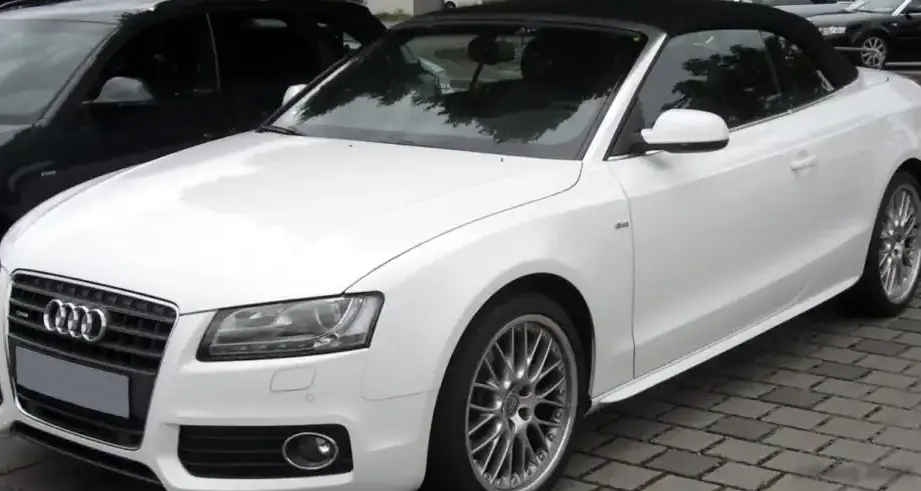
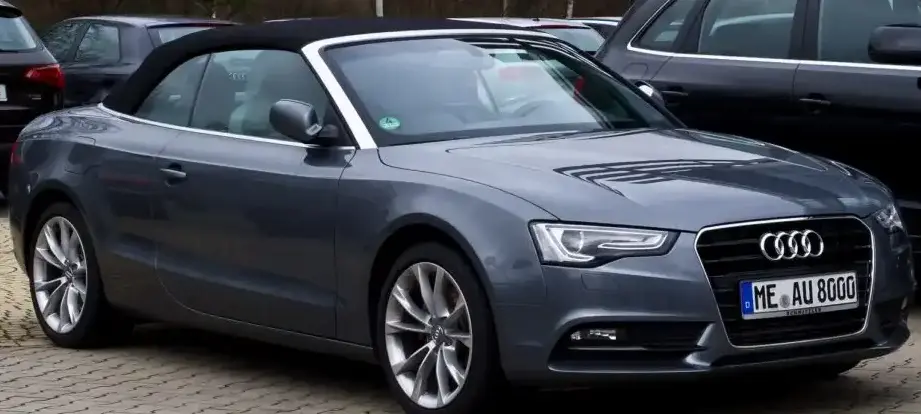
The Audi A5 Cabriolet 2.0 TFSI quattro Tiptronic (8F7 facelift) was introduced in June 2012 and continued through 2013. It built upon the success of the original A5 Cabriolet, launched in 2009, offering an open-top experience within the A5 family. The facelift brought revised styling cues, including redesigned headlights and grille, as well as updated technology and efficiency improvements. This particular variant, with its 211 horsepower engine, automatic transmission, and all-wheel drive, was positioned as a well-rounded option for drivers seeking a blend of performance and comfort. It sat comfortably between the more economical base models and the higher-performance S5 Cabriolet.
Powertrain & Engine Architecture
At the heart of this A5 Cabriolet lies the 2.0 TFSI engine, specifically the CAEB or CPMA engine code depending on the exact production date and market. This is a turbocharged, direct-injection four-cylinder engine displacing 1984cc. The direct injection system, coupled with the turbocharger and intercooler, allows for a high level of power and torque while maintaining reasonable fuel efficiency. The engine utilizes a double overhead camshaft (DOHC) valvetrain with four valves per cylinder, optimizing airflow for improved performance. The Tiptronic eight-speed automatic transmission is a torque converter type, offering smooth and responsive gear changes. It allows for both fully automatic operation and manual gear selection via steering wheel-mounted paddles or the gear selector. The quattro all-wheel drive system utilizes a Torsen center differential, distributing torque between the front and rear axles as needed to maximize traction.
Driving Characteristics
The 2.0 TFSI engine, producing 211 hp and 350 Nm (258 lb-ft) of torque, provides brisk acceleration. The 0-60 mph sprint takes approximately 6.7 seconds, and the car is electronically limited to a top speed of 130.49 mph. The Tiptronic transmission is well-matched to the engine’s characteristics, providing smooth upshifts and downshifts. While not as overtly sporty as the manual transmission or the higher-output engines, the automatic offers a more relaxed and convenient driving experience. The quattro all-wheel drive system provides excellent grip and stability, particularly in adverse weather conditions. The gear ratios are tuned for a balance between acceleration and fuel economy, with the eighth gear providing a comfortable cruising speed on the highway. Compared to the more powerful S5 Cabriolet, this variant offers a more manageable power delivery and a slightly more forgiving driving experience.
Equipment & Trim Levels
The A5 Cabriolet 2.0 TFSI quattro Tiptronic came standard with a generous array of features. Interior appointments typically included leather upholstery, power-adjustable front seats, and a multi-function steering wheel. Standard technology included Audi’s MMI infotainment system with a central display screen, automatic climate control, and a premium sound system. Optional extras included features such as navigation, heated seats, a wind deflector (to reduce wind buffeting with the top down), and advanced driver-assistance systems like adaptive cruise control and parking sensors. Trim levels varied slightly by market, but generally offered options for upgraded interior materials, exterior styling enhancements, and additional technology features.
Chassis & Braking
The A5 Cabriolet features a sophisticated chassis design. The front suspension utilizes a coil spring, independent multi-link setup with a transverse stabilizer bar, while the rear suspension employs an independent trapezoidal lever design, also with a transverse stabilizer. This configuration provides a comfortable ride and precise handling. The braking system consists of ventilated discs at the front (320mm) and solid discs at the rear (300mm). ABS (Anti-lock Braking System) is standard, enhancing braking performance and stability. The steering is a rack and pinion system with electric power assistance, providing responsive and accurate steering feel.
Market Reception & Comparison
The Audi A5 Cabriolet 2.0 TFSI quattro Tiptronic was generally well-received by automotive critics. It was praised for its stylish design, comfortable ride, and refined interior. The 2.0 TFSI engine was considered a good balance between performance and fuel economy, and the Tiptronic transmission was noted for its smoothness. Compared to other trims in the A5 Cabriolet lineup, this variant offered a compelling value proposition, providing a significant amount of performance and features for its price point. Fuel economy figures of around 24 US mpg combined were competitive for its class. Reliability was generally good, although some owners reported minor issues with the infotainment system.
Legacy
The 2.0 TFSI engine, in various iterations, has proven to be a reliable and durable powerplant. The Tiptronic transmission, while requiring regular maintenance, is also generally considered robust. In the used car market, the A5 Cabriolet 2.0 TFSI quattro Tiptronic remains a popular choice, offering a stylish and well-equipped convertible experience at a relatively affordable price. Regular maintenance, including oil changes and timing belt replacement (if applicable), is crucial to ensure the long-term reliability of this powertrain. The combination of Audi’s build quality, the engine’s inherent reliability, and the quattro all-wheel drive system contribute to the A5 Cabriolet’s enduring appeal.