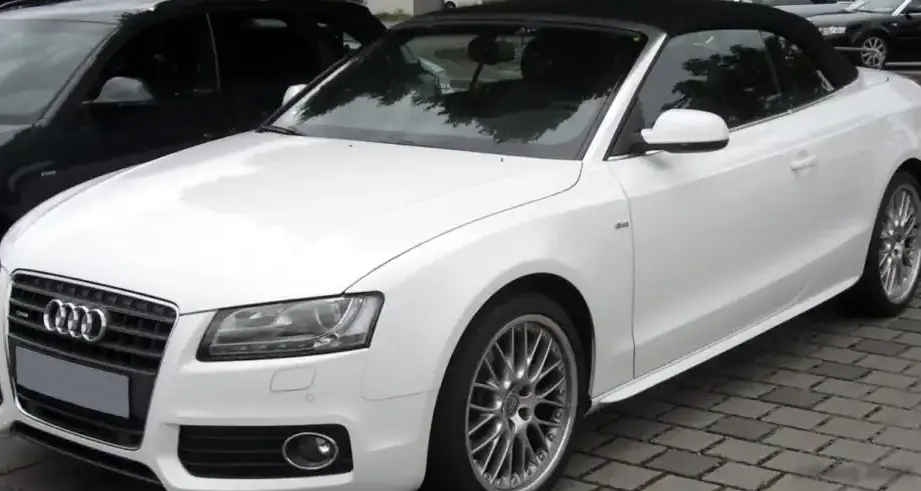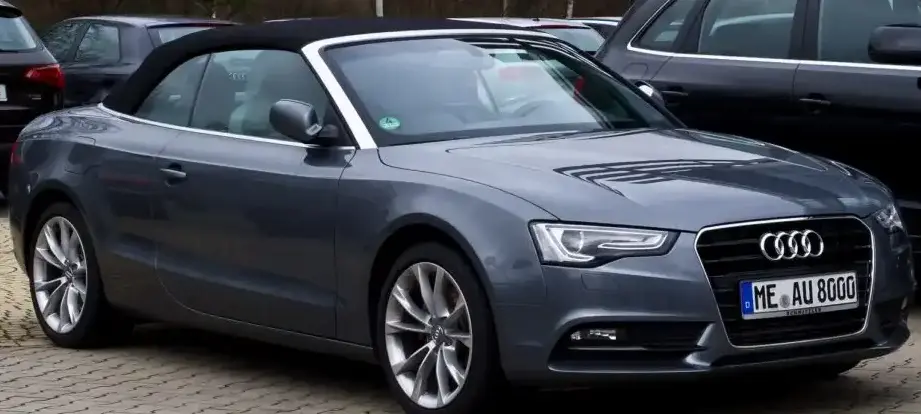
The Audi A5 Cabriolet, specifically the 8F7 facelift model produced from 2011-2015, represented Audi’s entry into the premium mid-size convertible market. The 2.0 TFSI variant with the Multitronic continuously variable transmission (CVT), introduced in June 2013 and continuing through 2015, occupied a middle ground within the A5 Cabriolet lineup, offering a balance between performance, fuel efficiency, and luxury features. This model aimed to appeal to buyers seeking a stylish open-top experience without the higher price tag or more aggressive performance of the top-tier trims.
Technical Specifications
| Brand | Audi |
| Model | A5 |
| Generation | A5 Cabriolet (8F7, facelift 2011) |
| Type (Engine) | 2.0 TFSI (220 Hp) Multitronic |
| Start of production | June, 2013 |
| End of production | 2015 |
| Powertrain Architecture | Internal Combustion engine |
| Body type | Cabriolet |
| Seats | 4 |
| Doors | 2 |
| Fuel consumption (economy) – urban (EPA) | 10.2 l/100 km (23.1 US mpg, 27.7 UK mpg, 9.8 km/l) |
| Fuel consumption (economy) – extra urban (EPA) | 7.6 l/100 km (30.9 US mpg, 37.2 UK mpg, 13.2 km/l) |
| Fuel consumption (economy) – combined (EPA) | 9 l/100 km (26.1 US mpg, 31.4 UK mpg, 11.1 km/l) |
| Fuel Type | Petrol (Gasoline) |
| Acceleration 0 – 60 mph | 7.1 sec |
| Maximum speed | 210 km/h (130.49 mph), Electronically limited |
| Emission standard | ULEV II |
| Weight-to-power ratio | 8 kg/Hp, 125 Hp/tonne |
| Weight-to-torque ratio | 5 kg/Nm, 198.9 Nm/tonne |
| Power | 220 Hp @ 4450-6000 rpm |
| Power per litre | 110.9 Hp/l |
| Torque | 350 Nm @ 1500-4300 rpm (258.15 lb.-ft. @ 1500-4300 rpm) |
| Engine layout | Front, Longitudinal |
| Engine Model/Code | EA888 / CAED, CPMB |
| Engine displacement | 1984 cm3 (121.07 cu. in.) |
| Number of cylinders | 4 |
| Engine configuration | Inline |
| Cylinder Bore | 82.5 mm (3.25 in.) |
| Piston Stroke | 92.8 mm (3.65 in.) |
| Compression ratio | 9.6:1 |
| Number of valves per cylinder | 4 |
| Fuel injection system | Direct injection |
| Engine aspiration | Turbocharger, Intercooler |
| Valvetrain | DOHC |
| Engine oil capacity | 4.6 l (4.86 US qt | 4.05 UK qt) |
| Coolant | 10 l (10.57 US qt | 8.8 UK qt) |
| Kerb Weight | 1760 kg (3880.14 lbs.) |
| Trunk (boot) space – minimum | 320 l (11.3 cu. ft.) |
| Trunk (boot) space – maximum | 750 l (26.49 cu. ft.) |
| Fuel tank capacity | 61 l (16.11 US gal | 13.42 UK gal) |
| Length | 4626 mm (182.13 in.) |
| Width | 1854 mm (72.99 in.) |
| Width including mirrors | 2020 mm (79.53 in.) |
| Height | 1383 mm (54.45 in.) |
| Wheelbase | 2751 mm (108.31 in.) |
| Front track | 1590 mm (62.6 in.) |
| Rear (Back) track | 1577 mm (62.09 in.) |
| Front overhang | 861 mm (33.9 in.) |
| Rear overhang | 1014 mm (39.92 in.) |
| Drag coefficient (Cd) | 0.34 |
| Minimum turning circle (turning diameter) | 11.4 m (37.4 ft.) |
| Drivetrain Architecture | The Internal combustion engine (ICE) drives the front wheels of the vehicle. |
| Drive wheel | Front wheel drive |
| Number of gears and type of gearbox | automatic transmission Multitronic |
| Front suspension | Coil spring, Independent multi-link suspension, Transverse stabilizer |
| Rear suspension | Independent on trapezoidal lever, Transverse stabilizer |
| Front brakes | Ventilated discs, 320 mm |
| Rear brakes | Disc, 300 mm |
| Assisting systems | ABS (Anti-lock braking system) |
| Steering type | Steering rack and pinion |
| Power steering | Electric Steering |
| Tires size | 245/40 R18; 255/35 R19 |
| Wheel rims size | 8.5J x 18; 8.5J x 19; 9J x 19 |
INTRODUCTION
The Audi A5 Cabriolet 8F7, facelifted in 2011, built upon the success of the original A5 introduced in 2007. This generation A5 Cabriolet shared its platform (PL46/B8) with the Audi Q5 and utilized a longitudinally-mounted engine layout, a hallmark of Audi’s quattro all-wheel-drive system, although the 2.0 TFSI Multitronic was typically front-wheel drive. The 2.0 TFSI Multitronic variant, launched in 2013, was positioned as a more accessible entry point into the A5 Cabriolet range, offering a compelling blend of style, comfort, and efficiency. It sat below the more powerful 3.0 TFSI V6 models and offered a different driving experience than the available manual transmission options.
Powertrain & Engine Architecture
At the heart of the A5 Cabriolet 2.0 TFSI Multitronic lies the EA888 engine, specifically the CAED or CPMB code depending on the exact production date and market. This 1984cc, turbocharged, direct-injection four-cylinder engine was a mainstay of the Volkswagen Group’s powertrain lineup. The engine features a cast iron block with an aluminum cylinder head, incorporating four valves per cylinder and a dual overhead camshaft (DOHC) configuration. Direct injection, coupled with a turbocharger and intercooler, allowed for a high compression ratio of 9.6:1, contributing to both power and efficiency. The Multitronic transmission is a continuously variable transmission (CVT) offering smooth, stepless gear changes. It utilizes a chain-driven system with a hydraulic multi-plate clutch, providing efficient power transfer and contributing to improved fuel economy. The Multitronic was programmed with specific shift maps tailored to balance performance and fuel consumption, differing from the more aggressive settings found in higher-performance A5 models.
Driving Characteristics
The 2.0 TFSI Multitronic A5 Cabriolet delivers a comfortable and refined driving experience. While not as overtly sporty as the higher-powered variants, the 220 horsepower and 350 Nm (258 lb-ft) of torque provide adequate performance for everyday driving and spirited cruising. Acceleration from 0-60 mph takes approximately 7.1 seconds, and the electronically limited top speed is 210 km/h (130 mph). The Multitronic transmission contributes to smooth acceleration, but some drivers may find it lacks the direct feel of a traditional automatic or manual gearbox. The CVT’s programming prioritizes fuel efficiency, meaning the engine may hold lower gears for longer to maximize torque, sometimes resulting in a slightly less responsive feel. The front-wheel-drive configuration, common in this trim, offers good traction in most conditions but doesn’t provide the all-weather confidence of Audi’s quattro system.
Equipment & Trim Levels
The 2.0 TFSI Multitronic A5 Cabriolet typically came standard with a generous array of features. Interior appointments included leather upholstery, power-adjustable front seats, and a multi-function steering wheel. Standard technology included Audi’s MMI infotainment system with a central display screen, automatic climate control, and a premium sound system. Optional extras included features like navigation, heated seats, a wind deflector (to reduce wind buffeting with the top down), and various driver-assistance systems. Trim levels varied by market, but generally, the 2.0 TFSI Multitronic served as a well-equipped base model, with options available to personalize the vehicle to the owner’s preferences.
Chassis & Braking
The A5 Cabriolet’s chassis was designed to provide a balance between comfort and handling. The front suspension utilizes a coil spring and independent multi-link setup with a transverse stabilizer bar, while the rear suspension employs an independent trapezoidal lever design, also with a stabilizer bar. This configuration provides a comfortable ride while minimizing body roll during cornering. Braking duties are handled by ventilated discs at the front (320mm) and solid discs at the rear (300mm). The standard ABS (Anti-lock Braking System) ensures safe and controlled stopping power. The weight distribution, influenced by the front-wheel-drive layout and the engine’s position, contributes to predictable handling characteristics.
Market Reception & Comparison
The Audi A5 Cabriolet 2.0 TFSI Multitronic was generally well-received by automotive critics. It was praised for its stylish design, comfortable interior, and refined driving experience. However, some reviewers noted that the Multitronic transmission could feel less engaging than a traditional automatic or manual gearbox. Compared to the more powerful 3.0 TFSI V6 models, the 2.0 TFSI offered a more affordable entry point into the A5 Cabriolet range, albeit with a noticeable reduction in performance. Fuel economy was a strong point, with combined figures around 9 l/100 km (26.1 US mpg), making it a more economical choice for those prioritizing efficiency. Compared to competitors like the BMW 3 Series Convertible and Mercedes-Benz C-Class Cabriolet, the A5 offered a distinctive blend of German engineering and stylish design.
Legacy
The EA888 2.0 TFSI engine, in its various iterations, has proven to be a relatively reliable powertrain. However, the Multitronic transmission has a reputation for requiring more frequent and potentially costly maintenance than traditional automatic transmissions. Regular fluid changes are crucial to ensure its longevity. Today, the A5 Cabriolet 2.0 TFSI Multitronic represents a compelling option in the used car market, offering a stylish and comfortable open-top experience at a relatively affordable price. Well-maintained examples continue to provide years of enjoyable motoring, but prospective buyers should be aware of the potential maintenance requirements of the Multitronic transmission and ensure a thorough inspection before purchase.