Technical Specifications
| Brand | Audi |
| Model | A5 |
| Generation | A5 Cabriolet (8F7, facelift 2011) |
| Type (Engine) | 2.0 TFSI (230 Hp) |
| Start of production | 2015 |
| End of production | 2016 |
| Powertrain Architecture | Internal Combustion engine |
| Body type | Cabriolet |
| Seats | 4 |
| Doors | 2 |
| Fuel consumption (urban) | 8.1-8.6 l/100 km (29 – 27.4 US mpg) |
| Fuel consumption (extra urban) | 5.2-5.9 l/100 km (45.2 – 39.9 US mpg) |
| Fuel consumption (combined) | 6.3-6.9 l/100 km (37.3 – 34.1 US mpg) |
| CO2 emissions | 144-157 g/km |
| Fuel Type | Petrol (Gasoline) |
| Acceleration 0 – 100 km/h | 7.4 sec |
| Acceleration 0 – 62 mph | 7.4 sec |
| Acceleration 0 – 60 mph | 7 sec |
| Maximum speed | 246 km/h (152.86 mph) |
| Emission standard | Euro 6 |
| Weight-to-power ratio | 7.1 kg/Hp, 141.1 Hp/tonne |
| Weight-to-torque ratio | 4.7 kg/Nm, 214.7 Nm/tonne |
| Power | 230 Hp @ 4700-6200 rpm |
| Torque | 350 Nm @ 1500-4600 rpm (258.15 lb.-ft. @ 1500-4600 rpm) |
| Engine layout | Front, Longitudinal |
| Engine Model/Code | EA888 / CNCE |
| Engine displacement | 1984 cm3 (121.07 cu. in.) |
| Number of cylinders | 4 |
| Engine configuration | Inline |
| Cylinder Bore | 82.5 mm (3.25 in.) |
| Piston Stroke | 92.8 mm (3.65 in.) |
| Compression ratio | 9.6:1 |
| Number of valves per cylinder | 4 |
| Fuel injection system | Direct injection and Multi-port manifold injection |
| Engine aspiration | Turbocharger, Intercooler |
| Valvetrain | DOHC |
| Engine oil capacity | 4.6 l (4.86 US qt | 4.05 UK qt) |
| Kerb Weight | 1630 kg (3593.53 lbs.) |
| Max. weight | 2130 kg (4695.85 lbs.) |
| Max load | 500 kg (1102.31 lbs.) |
| Trunk (boot) space – minimum | 320 l (11.3 cu. ft.) |
| Trunk (boot) space – maximum | 750 l (26.49 cu. ft.) |
| Fuel tank capacity | 63 l (16.64 US gal | 13.86 UK gal) |
| Permitted trailer load with brakes (8%) | 1700 kg (3747.86 lbs.) |
| Permitted trailer load with brakes (12%) | 1500 kg (3306.93 lbs.) |
| Permitted trailer load without brakes | 750 kg (1653.47 lbs.) |
| Permitted towbar download | 80 kg (176.37 lbs.) |
| Length | 4626 mm (182.13 in.) |
| Width | 1854 mm (72.99 in.) |
| Width including mirrors | 2020 mm (79.53 in.) |
| Height | 1383 mm (54.45 in.) |
| Wheelbase | 2751 mm (108.31 in.) |
| Front track | 1590 mm (62.6 in.) |
| Rear (Back) track | 1577 mm (62.09 in.) |
| Front overhang | 861 mm (33.9 in.) |
| Rear overhang | 1014 mm (39.92 in.) |
| Drag coefficient (Cd) | 0.31 |
| Minimum turning circle (turning diameter) | 11.4 m (37.4 ft.) |
| Drivetrain Architecture | The Internal combustion engine (ICE) drives the front wheels of the vehicle. |
| Drive wheel | Front wheel drive |
| Number of gears and type of gearbox | 6 gears, manual transmission |
| Front suspension | Independent multi-link suspension, Transverse stabilizer |
| Rear suspension | Independent on trapezoidal lever, Transverse stabilizer |
| Front brakes | Ventilated discs |
| Rear brakes | Disc |
| Assisting systems | ABS (Anti-lock braking system) |
| Steering type | Steering rack and pinion |
| Power steering | Electric Steering |
| Tires size | 225/50 R17; 245/40 R18; 255/35 R19 |
| Wheel rims size | 7.5J x 17; 8.5J x 18; 8.5J x 19; 9J x 19 |
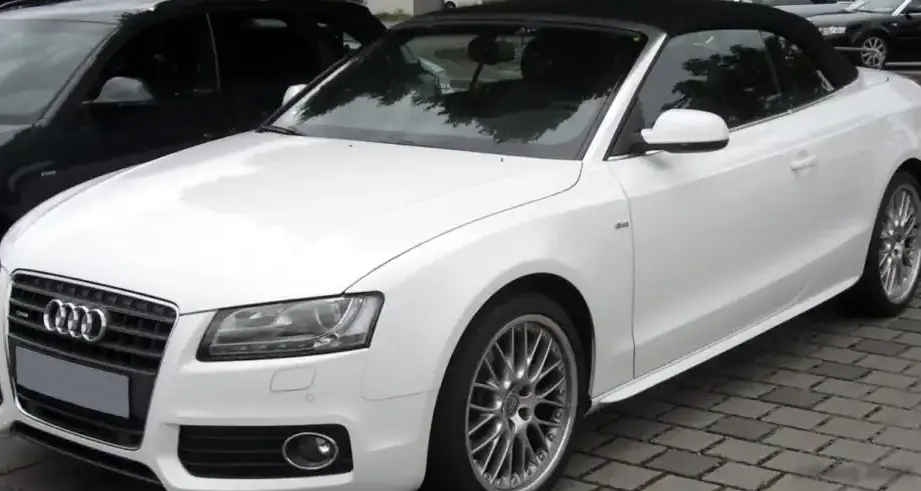
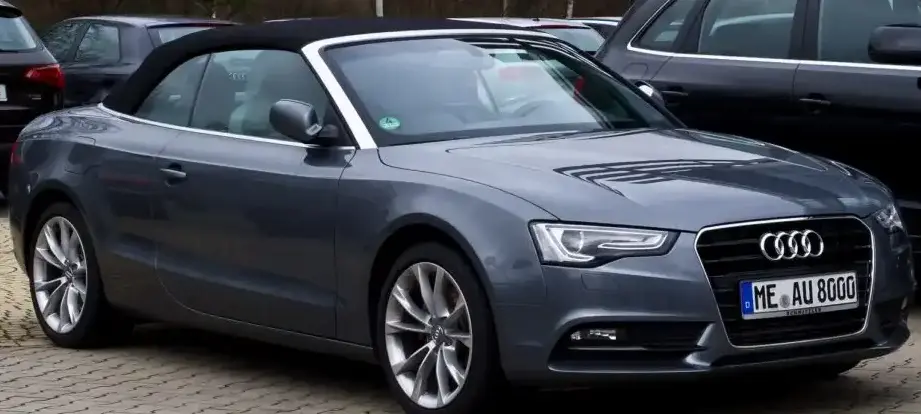
The Audi A5 Cabriolet 8F7 facelift, produced between 2015 and 2016, represents a refined iteration of Audi’s popular open-top luxury car. Positioned within the broader A5 range (which also included Coupe and Sportback models), the Cabriolet offered a more emotionally driven experience, prioritizing open-air enjoyment. The 2.0 TFSI 230 Hp variant served as a strong mid-range option, appealing to buyers seeking a balance between performance, fuel efficiency, and price. It was built on the Volkswagen Group’s PL46 platform, also known as the B8 platform, shared with models like the Audi A4, Volkswagen Passat, and Skoda Superb.
Powertrain & Engine Architecture
At the heart of the A5 Cabriolet 2.0 TFSI lies the EA888 engine, specifically the CNCE code variant. This 1984cc, inline-four cylinder engine utilizes direct fuel injection combined with multi-point manifold injection, optimizing both power delivery and fuel economy. The engine features a single turbocharger with an intercooler, boosting output to 230 horsepower at 4700-6200 rpm and 350 Nm (258.15 lb-ft) of torque between 1500-4600 rpm. The dual overhead camshafts (DOHC) and four valves per cylinder contribute to efficient cylinder filling and exhaust scavenging. The engine is longitudinally mounted, driving the front wheels. The standard transmission for this variant was a 6-speed manual, though an 8-speed automatic transmission (DL800) was also available as an option. The automatic transmission offered smoother shifts and enhanced convenience, but at a slight cost to fuel efficiency and driver engagement.
Driving Characteristics
The 2.0 TFSI 230 Hp engine in the A5 Cabriolet provided a respectable level of performance. Acceleration from 0 to 100 km/h (0-62 mph) took approximately 7.4 seconds. While not a sports car, the engine delivered sufficient power for comfortable cruising and spirited driving. The turbocharger provided a noticeable boost in mid-range acceleration, making overtaking maneuvers relatively effortless. Compared to the more powerful 3.0-liter V6 variants, the 2.0 TFSI offered a more economical driving experience. The manual transmission provided a more engaging driving experience, allowing for greater control over gear selection, while the optional automatic transmission prioritized comfort and ease of use. The Cabriolet’s weight, around 1630 kg (3593.53 lbs), did impact overall agility, but the well-tuned suspension helped to minimize body roll and maintain a composed ride.
Equipment & Trim Levels
The A5 Cabriolet 2.0 TFSI typically came standard with features such as leather upholstery, automatic climate control, a multi-function steering wheel, and an Audi Concert audio system. Optional extras included Audi’s MMI navigation system, heated seats, a wind deflector (to reduce wind buffeting with the top down), and various driver assistance systems like parking sensors and adaptive cruise control. Trim levels varied by market, but generally offered packages that bundled popular options together. The S line package, for example, added sportier styling cues, including unique bumpers, side skirts, and interior trim. The interior design was typically understated and elegant, reflecting Audi’s commitment to quality and refinement.
Chassis & Braking
The A5 Cabriolet featured an independent suspension system on all four wheels. The front suspension utilized a multi-link setup with a transverse stabilizer bar, while the rear employed a trapezoidal lever arrangement, also with a stabilizer bar. This configuration provided a good balance between ride comfort and handling precision. Braking duties were handled by ventilated discs at the front and solid discs at the rear, equipped with ABS (Anti-lock Braking System). The steering system was a rack and pinion type with electric power assistance, offering precise and responsive steering feel.
Market Reception & Comparison
The Audi A5 Cabriolet 2.0 TFSI was generally well-received by automotive critics. It was praised for its stylish design, comfortable ride, and refined interior. The 2.0 TFSI engine was considered a good compromise between performance and fuel economy. Compared to rivals like the BMW 3 Series Convertible and Mercedes-Benz C-Class Cabriolet, the A5 Cabriolet offered a slightly more understated and sophisticated character. Fuel economy figures of 6.3-6.9 l/100 km (37.3 – 34.1 US mpg) were competitive for its class. Reliability was generally good, although some owners reported minor issues with the electronic systems.
Legacy
The Audi A5 Cabriolet 2.0 TFSI (8F7) has proven to be a relatively reliable and durable vehicle. The EA888 engine is known for its robustness, and with regular maintenance, it can provide many years of trouble-free service. On the used car market, these models remain popular due to their combination of style, comfort, and practicality. However, potential buyers should be aware of the potential for carbon buildup in the intake manifold, a common issue with direct-injection engines. Overall, the A5 Cabriolet 2.0 TFSI represents a well-engineered and enjoyable open-top driving experience that continues to appeal to enthusiasts today.