Technical Specifications
| Brand | Audi |
| Model | A5 |
| Generation | A5 Cabriolet (F5) |
| Type (Engine) | 2.0 TDI (190 Hp) S tronic |
| Start of production | 2016 |
| End of production | 2018 |
| Powertrain Architecture | Internal Combustion engine |
| Body type | Cabriolet |
| Seats | 4 |
| Doors | 2 |
| Fuel consumption (urban) | 5.2-5.3 l/100 km (45.2 – 44.4 US mpg) |
| Fuel consumption (extra urban) | 4.1-4.4 l/100 km (57.4 – 53.5 US mpg) |
| Fuel consumption (combined) | 4.5-4.7 l/100 km (52.3 – 50 US mpg) |
| CO2 emissions | 118-124 g/km |
| Fuel Type | Diesel |
| Acceleration 0 – 100 km/h | 8.3 sec |
| Acceleration 0 – 62 mph | 8.3 sec |
| Acceleration 0 – 60 mph | 7.9 sec |
| Maximum speed | 232 km/h (144.16 mph) |
| Emission standard | Euro 6 |
| Weight-to-power ratio | 8.9 kg/Hp, 112.4 Hp/tonne |
| Weight-to-torque ratio | 4.2 kg/Nm, 236.7 Nm/tonne |
| Power | 190 Hp @ 3800-4200 rpm |
| Torque | 400 Nm @ 1750-3000 rpm (295.02 lb.-ft.) |
| Engine layout | Front, Longitudinal |
| Engine Model/Code | DESA, DETA, DFVA |
| Engine displacement | 1968 cm3 (120.09 cu. in.) |
| Number of cylinders | 4 |
| Engine configuration | Inline |
| Cylinder Bore | 81 mm (3.19 in.) |
| Piston Stroke | 95.5 mm (3.76 in.) |
| Compression ratio | 15.5:1 |
| Number of valves per cylinder | 4 |
| Fuel injection system | Diesel Commonrail |
| Engine aspiration | Turbocharger, Intercooler |
| Valvetrain | DOHC |
| Engine oil capacity | 4.7 l (4.97 US qt | 4.14 UK qt) |
| Kerb Weight | 1690 kg (3725.81 lbs.) |
| Max. weight | 2215 kg (4883.24 lbs.) |
| Max load | 525 kg (1157.43 lbs.) |
| Trunk (boot) space – minimum | 380 l (13.42 cu. ft.) |
| Fuel tank capacity | 40 l (10.57 US gal | 8.8 UK gal) |
| AdBlue tank | 12 l (3.17 US gal | 2.64 UK gal) |
| Permitted trailer load with brakes (8%) | 1900 kg (4188.78 lbs.) |
| Permitted trailer load with brakes (12%) | 1700 kg (3747.86 lbs.) |
| Permitted trailer load without brakes | 750 kg (1653.47 lbs.) |
| Length | 4673 mm (183.98 in.) |
| Width | 1846 mm (72.68 in.) |
| Height | 1383 mm (54.45 in.) |
| Wheelbase | 2765 mm (108.86 in.) |
| Front track | 1587 mm (62.48 in.) |
| Rear track | 1568 mm (61.73 in.) |
| Drag coefficient (Cd) | 0.29 |
| Minimum turning circle | 11.5 m (37.73 ft.) |
| Drivetrain Architecture | Front wheel drive |
| Number of gears and type of gearbox | 7 gears, automatic transmission S tronic |
| Front suspension | Independent multi-link suspension |
| Rear suspension | Independent multi-link suspension |
| Front brakes | Ventilated discs |
| Rear brakes | Ventilated discs |
| Assisting systems | ABS (Anti-lock braking system) |
| Steering type | Steering rack and pinion |
| Power steering | Electric Steering |
| Tires size | 225/50 R17; 245/40 R18; 255/35 R19 |
| Wheel rims size | 7.5J x 17; 18; 19 |
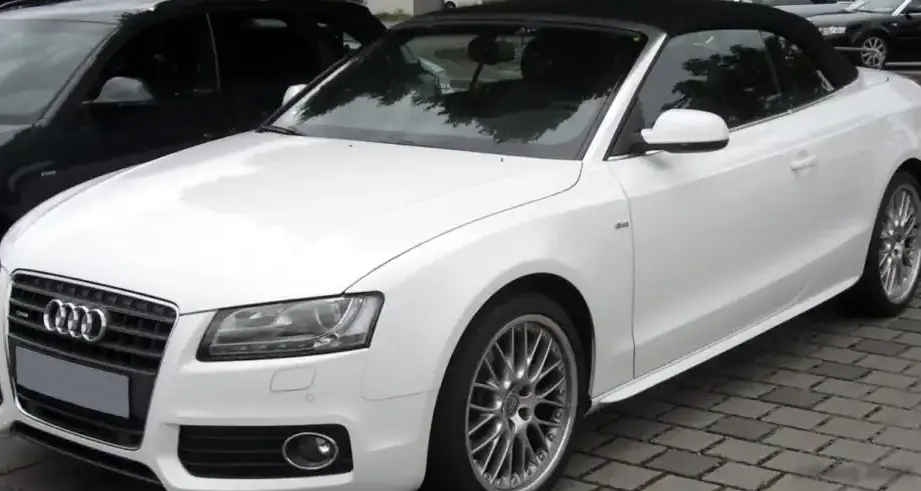
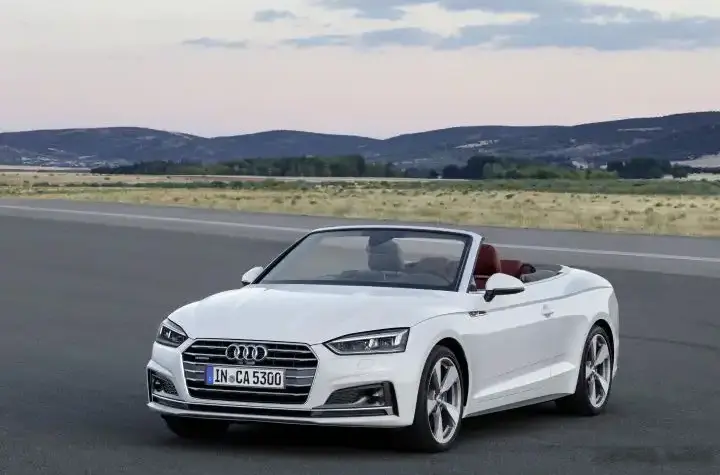
The Audi A5 Cabriolet (F5) 2.0 TDI 190 hp S tronic, launched in 2016, represented the second generation of Audi’s popular open-top A5. This variant was a key offering in markets where diesel remained prevalent, providing a more fuel-efficient alternative to the petrol options. The F5 generation A5 Cabriolet brought with it a more refined design, improved technology, and enhanced driving dynamics compared to its predecessor. The 2.0 TDI 190 hp S tronic model specifically targeted buyers who desired a comfortable and stylish convertible without sacrificing practicality or running costs. It sat in the mid-range of the A5 Cabriolet lineup, offering a good balance of performance and economy.
Powertrain & Engine Architecture
At the heart of the A5 Cabriolet 2.0 TDI 190 hp S tronic lies the Volkswagen Group’s EA288 series of 2.0-liter four-cylinder diesel engines. Specifically, this model utilized engine codes DESA, DETA, or DFVA, depending on the exact production year and market. These engines are characterized by their advanced common-rail direct injection system, which operates at extremely high pressures to optimize fuel atomization and combustion efficiency. The engine features a turbocharger with an intercooler to boost power output and improve throttle response. The valvetrain employs a dual overhead camshaft (DOHC) design with four valves per cylinder, contributing to efficient gas exchange. The S tronic transmission is a seven-speed dual-clutch transmission (DCT) known for its quick and smooth gear changes. This transmission offers both automatic and manual shift modes, allowing drivers to tailor the driving experience to their preferences. The DCT’s efficiency also contributes to the vehicle’s overall fuel economy.
Driving Characteristics
The 2.0 TDI 190 hp S tronic A5 Cabriolet delivers a refined and comfortable driving experience. While not overtly sporty, the engine provides ample torque – 400 Nm (295 lb-ft) – available from a low 1750 rpm, resulting in strong acceleration in everyday driving situations. The S tronic transmission complements the engine well, providing seamless gear changes and contributing to a smooth power delivery. Acceleration from 0 to 100 km/h (0-62 mph) takes around 8.3 seconds. Compared to the more powerful gasoline variants, the 2.0 TDI feels less eager to rev, but its superior torque makes it feel responsive in most driving scenarios. The automatic transmission’s gear ratios are tuned for efficiency and comfort, prioritizing smooth cruising over outright performance. Compared to a manual transmission equipped A5, the S tronic offers greater convenience, especially in urban traffic.
Equipment & Trim Levels
The A5 Cabriolet 2.0 TDI 190 hp S tronic typically came well-equipped as standard. Features included automatic climate control, a multi-function steering wheel, Audi’s MMI infotainment system with a central display screen, and electrically adjustable front seats. Upholstery was typically a combination of cloth and leatherette, with full leather options available as an upgrade. Optional extras included Audi’s Virtual Cockpit (a fully digital instrument cluster), a premium sound system, navigation, and various driver assistance systems such as adaptive cruise control and lane departure warning. Exterior features often included alloy wheels, LED headlights, and a power-operated soft top. Trim levels varied by market, but generally offered packages that bundled popular options together.
Chassis & Braking
The A5 Cabriolet’s chassis is based on the MLB platform, providing a solid and well-balanced foundation. The suspension utilizes an independent multi-link setup at both the front and rear, offering a comfortable ride and good handling characteristics. The front suspension geometry is optimized for steering precision, while the rear suspension is designed to minimize body roll. Braking duties are handled by ventilated disc brakes on all four wheels, providing ample stopping power. Anti-lock braking system (ABS) and electronic stability control (ESC) are standard features, enhancing safety and stability. The weight distribution is well-balanced, contributing to the car’s neutral handling characteristics.
Market Reception & Comparison
The Audi A5 Cabriolet 2.0 TDI 190 hp S tronic was generally well-received by automotive critics. It was praised for its refined driving experience, comfortable ride, and fuel efficiency. Critics noted that while it wasn’t the sportiest convertible on the market, it offered a compelling blend of practicality and luxury. Compared to the higher-output gasoline variants, the TDI model offered significantly better fuel economy, making it an attractive option for drivers who covered long distances. However, some critics noted that the diesel engine lacked the responsiveness and sound of the gasoline engines. Compared to competitors like the BMW 2 Series Convertible and Mercedes-Benz C-Class Cabriolet, the A5 Cabriolet offered a more sophisticated and technologically advanced package.
Legacy
The 2.0 TDI engine in the A5 Cabriolet has proven to be relatively reliable, although, like all diesel engines, it requires regular maintenance, including oil changes and diesel particulate filter (DPF) regeneration. The S tronic transmission is also generally reliable, but it’s important to follow the manufacturer’s recommended service intervals. On the used car market, the A5 Cabriolet 2.0 TDI 190 hp S tronic remains a popular choice, offering a good balance of style, comfort, and economy. Its fuel efficiency and relatively low running costs make it an attractive option for buyers seeking a practical and enjoyable convertible experience. The availability of parts and servicing is generally good, ensuring that these vehicles can be maintained for many years to come.