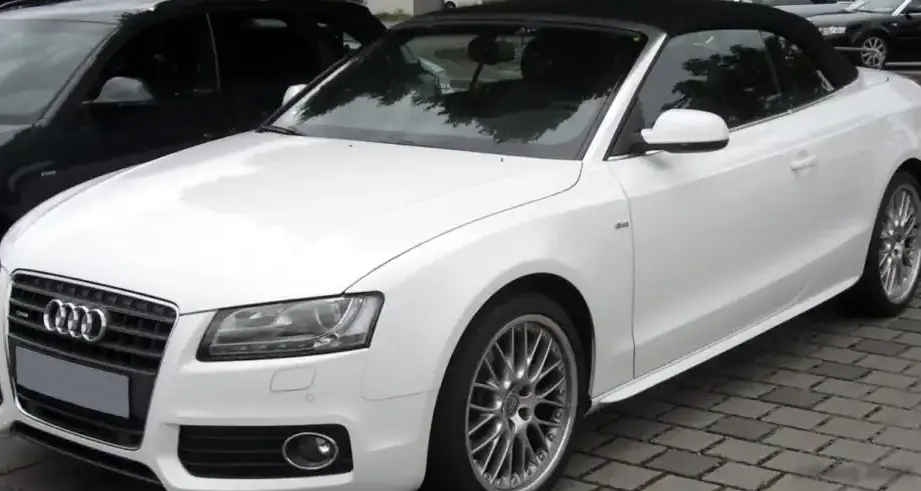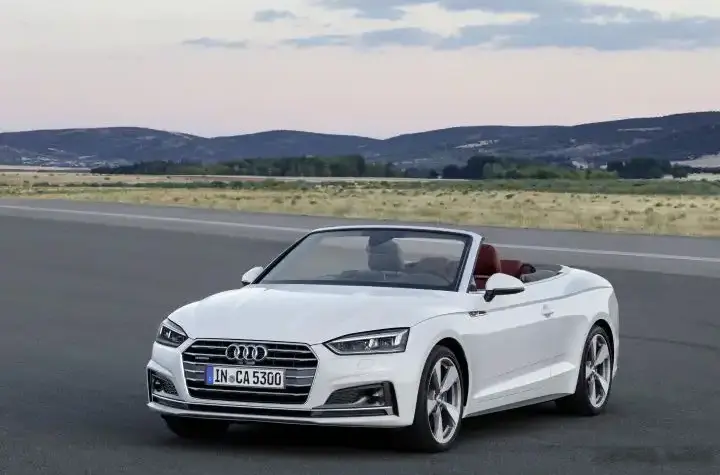
The Audi A5 Cabriolet (F5) 3.0 TDI S tronic, produced from 2017 to 2018, represents a sophisticated blend of open-air motoring and diesel efficiency within the fifth generation of Audi’s A5 line. Positioned as a mid-to-upper trim level within the Cabriolet range, it offered a compelling alternative to the petrol-powered variants and the more performance-focused S5. This model utilized Audi’s well-regarded 3.0-liter TDI engine paired with the quick-shifting S tronic dual-clutch transmission, targeting buyers seeking a refined and economical grand tourer experience. It was primarily sold in the European market, where diesel engines held a significant share of the premium car segment.
Technical Specifications
| Brand | Audi |
| Model | A5 |
| Generation | A5 Cabriolet (F5) |
| Type (Engine) | 3.0 TDI (218 Hp) S tronic |
| Start of production | 2017 |
| End of production | 2018 |
| Powertrain Architecture | Internal Combustion engine |
| Body type | Cabriolet |
| Seats | 4 |
| Doors | 2 |
| Fuel consumption (urban) | 5.1-5.2 l/100 km (46.1 – 45.2 US mpg) |
| Fuel consumption (extra urban) | 4.3-4.5 l/100 km (54.7 – 52.3 US mpg) |
| Fuel consumption (combined) | 4.6-4.8 l/100 km (51.1 – 49 US mpg) |
| CO2 emissions | 120-124 g/km |
| Fuel Type | Diesel |
| Acceleration 0 – 100 km/h | 7 sec |
| Acceleration 0 – 62 mph | 7 sec |
| Acceleration 0 – 60 mph | 6.7 sec |
| Maximum speed | 246 km/h (152.86 mph) |
| Emission standard | Euro 6 |
| Weight-to-power ratio | 8 kg/Hp, 124.6 Hp/tonne |
| Weight-to-torque ratio | 4.4 kg/Nm, 228.6 Nm/tonne |
| Power | 218 Hp @ 4000-5000 rpm |
| Torque | 400 Nm @ 1250-3750 rpm (295.02 lb.-ft. @ 1250-3750 rpm) |
| Engine layout | Front, Longitudinal |
| Engine Model/Code | CSWB |
| Engine displacement | 2967 cm3 (181.06 cu. in.) |
| Number of cylinders | 6 |
| Engine configuration | V-engine |
| Cylinder Bore | 83 mm (3.27 in.) |
| Piston Stroke | 91.4 mm (3.6 in.) |
| Compression ratio | 16:1 |
| Number of valves per cylinder | 4 |
| Fuel injection system | Diesel Commonrail |
| Engine aspiration | Turbocharger, Intercooler |
| Valvetrain | DOHC |
| Engine oil capacity | 6.1 l (6.45 US qt | 5.37 UK qt) |
| Kerb Weight | 1750 kg (3858.09 lbs.) |
| Max. weight | 2250 kg (4960.4 lbs.) |
| Max load | 500 kg (1102.31 lbs.) |
| Trunk (boot) space – minimum | 380 l (13.42 cu. ft.) |
| Fuel tank capacity | 54 l (14.27 US gal | 11.88 UK gal) |
| AdBlue tank | 12 l (3.17 US gal | 2.64 UK gal) |
| Permitted trailer load with brakes (8%) | 1900 kg (4188.78 lbs.) |
| Permitted trailer load with brakes (12%) | 1700 kg (3747.86 lbs.) |
| Permitted trailer load without brakes | 750 kg (1653.47 lbs.) |
| Length | 4673 mm (183.98 in.) |
| Width | 1846 mm (72.68 in.) |
| Height | 1383 mm (54.45 in.) |
| Wheelbase | 2765 mm (108.86 in.) |
| Front track | 1587 mm (62.48 in.) |
| Rear (Back) track | 1568 mm (61.73 in.) |
| Drag coefficient (Cd) | 0.29 |
| Minimum turning circle (turning diameter) | 11.5 m (37.73 ft.) |
| Drivetrain Architecture | The Internal combustion engine (ICE) drives the front wheels of the vehicle. |
| Drive wheel | Front wheel drive |
| Number of gears and type of gearbox | 7 gears, automatic transmission S tronic |
| Front suspension | Independent multi-link suspension |
| Rear suspension | Independent multi-link suspension |
| Front brakes | Ventilated discs |
| Rear brakes | Disc |
| Assisting systems | ABS (Anti-lock braking system) |
| Steering type | Steering rack and pinion |
| Power steering | Electric Steering |
| Tires size | 225/50 R17; 245/40 R18; 255/35 R19 |
| Wheel rims size | 7.5J x 17; 18; 19 |
INTRODUCTION
The F5 generation Audi A5 Cabriolet, launched in 2017, represented a significant evolution of the original A5, boasting a more refined design, improved technology, and enhanced driving dynamics. The 3.0 TDI S tronic variant occupied a sweet spot in the lineup, offering a compelling combination of performance, fuel economy, and luxury. Built on the Volkswagen Group’s MLB Evo platform (shared with the Audi A4, Q5, and other models), the A5 Cabriolet aimed to deliver a premium open-top experience without sacrificing practicality or comfort. This particular engine and transmission combination was a popular choice in Europe, where diesel power remained dominant in the premium segment.
Powertrain & Engine Architecture
At the heart of the A5 Cabriolet 3.0 TDI S tronic lies Audi’s CSWB engine, a 3.0-liter V6 turbodiesel. This engine is a member of the Volkswagen Group’s modular engine family, known for its robust construction and sophisticated technology. The CSWB utilizes a common-rail direct injection system, delivering fuel at extremely high pressures for optimized combustion. A single turbocharger, coupled with an intercooler, provides forced induction, boosting power and torque. The engine also features a Diesel Particulate Filter (DPF) to meet stringent Euro 6 emissions standards. The S tronic 7-speed dual-clutch transmission is a key component of this variant. It offers incredibly fast and smooth gear changes, contributing to both performance and efficiency. The transmission features a wet clutch design for enhanced durability and cooling. Gear ratios are tuned to balance acceleration with fuel economy, providing a responsive driving experience.
Driving Characteristics
The 218 horsepower and 400 Nm (295 lb-ft) of torque delivered by the 3.0 TDI engine provide ample power for comfortable and confident cruising. Acceleration from 0 to 62 mph takes approximately 7 seconds, which is respectable for a relatively heavy convertible. The S tronic transmission plays a crucial role in maximizing the engine’s output, providing quick and seamless shifts. Compared to the lower-powered 2.0 TDI variants, the 3.0 TDI offers a noticeably more relaxed driving experience, particularly during highway overtaking. While not as overtly sporty as the S5 Cabriolet, the 3.0 TDI provides a satisfying level of performance for everyday driving. The front-wheel-drive configuration offers good traction in most conditions, although it doesn’t provide the all-weather capability of Audi’s quattro all-wheel-drive system.
Equipment & Trim Levels
The A5 Cabriolet 3.0 TDI S tronic typically came well-equipped as standard. Features included leather upholstery, three-zone automatic climate control, Audi’s MMI infotainment system with a 7-inch display, and automatic headlights and wipers. Optional extras included Audi’s Virtual Cockpit (a fully digital instrument cluster), a Bang & Olufsen sound system, and advanced driver assistance systems such as adaptive cruise control and lane keep assist. Interior trim options varied, with choices in wood, aluminum, and carbon fiber accents. The Cabriolet’s soft top was available in several colors and could be raised or lowered electrically in around 15 seconds at speeds of up to 31 mph.
Chassis & Braking
The A5 Cabriolet’s chassis is designed to provide a comfortable and controlled ride. It utilizes an independent multi-link suspension setup at both the front and rear, offering excellent wheel control and minimizing body roll. The suspension is tuned to prioritize comfort, but still provides a reasonably engaging driving experience. Braking duties are handled by ventilated discs at the front and solid discs at the rear. ABS (Anti-lock Braking System) is standard, along with electronic brake-force distribution and brake assist. The steering is electrically assisted, providing a light and precise feel.
Market Reception & Comparison
The Audi A5 Cabriolet 3.0 TDI S tronic was generally well-received by automotive critics. It was praised for its refined engine, smooth transmission, and comfortable ride. Fuel economy was also a strong point, with combined figures averaging around 46-48 mpg. Compared to the 2.0 TDI variants, the 3.0 TDI offered a significant performance upgrade, while remaining relatively economical. However, it was more expensive to purchase and maintain than the lower-powered models. The BMW 4 Series Convertible and Mercedes-Benz C-Class Cabriolet were its main competitors, offering similar levels of luxury and performance.
Legacy
The 3.0 TDI engine, in various iterations, has proven to be a reliable and durable powerplant. However, like all modern diesel engines, it’s susceptible to issues with the DPF and AdBlue system if not properly maintained. The S tronic transmission is generally reliable, but requires regular servicing to ensure smooth operation. Today, the A5 Cabriolet 3.0 TDI S tronic represents a good value proposition on the used car market, offering a stylish and well-equipped convertible at a reasonable price. Its combination of performance, fuel economy, and luxury continues to appeal to buyers seeking a refined open-top experience.