Technical Specifications
| Brand | Audi |
| Model | A5 |
| Generation | A5 Coupe (8T3) |
| Type (Engine) | 2.0 TFSI (211 Hp) |
| Start of production | June, 2008 |
| End of production | 2011 |
| Powertrain Architecture | Internal Combustion engine |
| Body type | Coupe |
| Seats | 4 |
| Doors | 2 |
| Fuel consumption (urban) | 8.3 l/100 km (28.3 US mpg, 34 UK mpg, 12 km/l) |
| Fuel consumption (extra urban) | 5.3 l/100 km (44.4 US mpg, 53.3 UK mpg, 18.9 km/l) |
| Fuel consumption (combined) | 6.4 l/100 km (36.8 US mpg, 44.1 UK mpg, 15.6 km/l) |
| CO2 emissions | 149 g/km |
| Fuel Type | Petrol (Gasoline) |
| Acceleration 0 – 100 km/h | 6.9 sec |
| Acceleration 0 – 62 mph | 6.9 sec |
| Acceleration 0 – 60 mph | 6.6 sec |
| Maximum speed | 250 km/h (155.34 mph) |
| Emission standard | Euro 5 |
| Weight-to-power ratio | 6.8 kg/Hp, 147.6 Hp/tonne |
| Weight-to-torque ratio | 4.1 kg/Nm, 244.8 Nm/tonne |
| Power | 211 Hp @ 4300-6000 rpm |
| Power per litre | 106.4 Hp/l |
| Torque | 350 Nm @ 1500-4200 rpm (258.15 lb.-ft. @ 1500-4200 rpm) |
| Engine layout | Front, Longitudinal |
| Engine Model/Code | CDNC |
| Engine displacement | 1984 cm3 (121.07 cu. in.) |
| Number of cylinders | 4 |
| Engine configuration | Inline |
| Cylinder Bore | 82.5 mm (3.25 in.) |
| Piston Stroke | 92.8 mm (3.65 in.) |
| Compression ratio | 9.6:1 |
| Number of valves per cylinder | 4 |
| Fuel injection system | Direct injection |
| Engine aspiration | Turbocharger, Intercooler |
| Valvetrain | DOHC |
| Engine oil capacity | 4.6 l (4.86 US qt | 4.05 UK qt) |
| Kerb Weight | 1430 kg (3152.61 lbs.) |
| Max. weight | 1930 kg (4254.92 lbs.) |
| Max load | 500 kg (1102.31 lbs.) |
| Trunk (boot) space – minimum | 455 l (16.07 cu. ft.) |
| Trunk (boot) space – maximum | 829 l (29.28 cu. ft.) |
| Fuel tank capacity | 65 l (17.17 US gal | 14.3 UK gal) |
| Max. roof load | 75 kg (165.35 lbs.) |
| Permitted trailer load with brakes (8%) | 1700 kg (3747.86 lbs.) |
| Permitted trailer load with brakes (12%) | 1500 kg (3306.93 lbs.) |
| Permitted trailer load without brakes | 750 kg (1653.47 lbs.) |
| Permitted towbar download | 80 kg (176.37 lbs.) |
| Length | 4625 mm (182.09 in.) |
| Width | 1854 mm (72.99 in.) |
| Height | 1372 mm (54.02 in.) |
| Wheelbase | 2751 mm (108.31 in.) |
| Front track | 1590 mm (62.6 in.) |
| Rear (Back) track | 1577 mm (62.09 in.) |
| Drag coefficient (Cd) | 0.29 |
| Minimum turning circle (turning diameter) | 11.4 m (37.4 ft.) |
| Drivetrain Architecture | The Internal combustion engine (ICE) drives the front wheels of the vehicle. |
| Drive wheel | Front wheel drive |
| Number of gears and type of gearbox | 6 gears, manual transmission |
| Front suspension | Independent multi-link suspension |
| Rear suspension | Independent multi-link spring suspension with stabilizer |
| Front brakes | Ventilated discs |
| Rear brakes | Disc |
| Assisting systems | ABS (Anti-lock braking system) |
| Steering type | Steering rack and pinion |
| Power steering | Electric Steering |
| Tires size | 225/50 R17 |
| Wheel rims size | 7.5J x 17 |
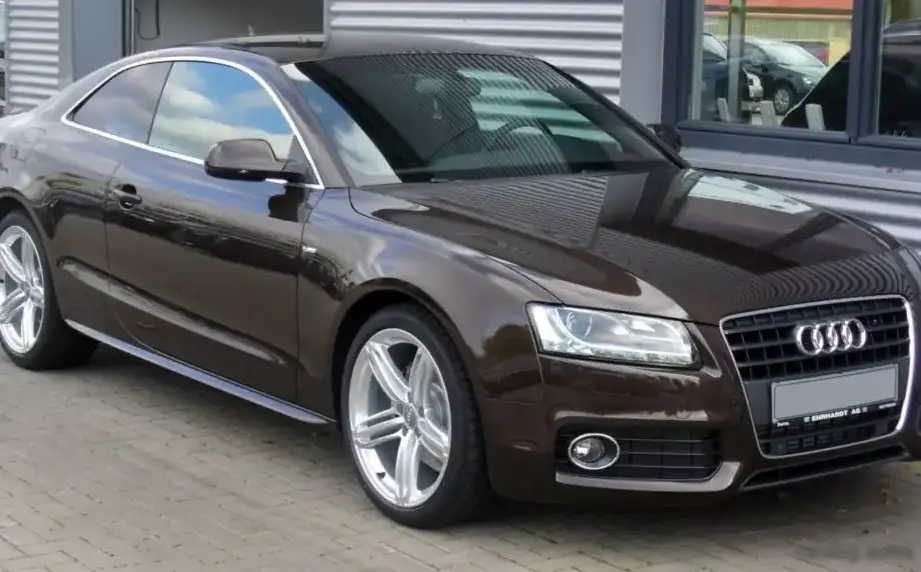
The Audi A5 Coupe (8T3) 2.0 TFSI, producing 211 horsepower, was a key variant in Audi’s second-generation A5 lineup, manufactured from June 2008 to 2011. Positioned as a mid-range offering, it bridged the gap between the entry-level 1.8 TFSI models and the performance-oriented S5. This coupe, built on the Audi’s B8 platform (shared with the A4), aimed to deliver a blend of style, performance, and everyday usability, appealing to buyers seeking a premium sports coupe experience. The 8T3 generation A5 represented a significant evolution in Audi’s design language, moving away from the more conservative aesthetics of its predecessor.
Powertrain & Engine Architecture
The heart of the A5 2.0 TFSI is the CDNC engine, a 1.984-liter inline-four cylinder powerplant. This engine belongs to Audi’s EA888 family, known for its robust design and tuning potential. The CDNC utilizes direct fuel injection (FSI) and a single turbocharger with an intercooler to deliver a healthy 211 horsepower and 258 lb-ft of torque. The direct injection system allows for precise fuel delivery, improving efficiency and reducing emissions. The engine features a dual overhead camshaft (DOHC) valvetrain with four valves per cylinder, optimizing airflow for increased power output. The 6-speed manual transmission was standard, providing drivers with direct control over the engine’s power. The engine’s longitudinal mounting, typical of Audi’s front-wheel-drive platforms, contributes to balanced weight distribution.
Driving Characteristics
The 2.0 TFSI-equipped A5 Coupe offered a compelling driving experience. While not as overtly sporty as the S5, it provided ample power for everyday driving and spirited weekend excursions. Acceleration from 0-60 mph took approximately 6.6 seconds, and the engine delivered strong torque throughout the rev range, making overtaking maneuvers effortless. The manual transmission’s gear ratios were well-matched to the engine’s power curve, providing responsive acceleration in each gear. Compared to the base 1.8 TFSI, the 2.0 TFSI offered a noticeable performance boost, while remaining more fuel-efficient than the higher-performance S5. The front-wheel-drive configuration provided good traction in most conditions, although torque steer could be felt under hard acceleration.
Equipment & Trim Levels
The A5 2.0 TFSI typically came well-equipped, reflecting Audi’s premium positioning. Standard features included leather upholstery, automatic climate control, a multi-function steering wheel, and an Audi Concert audio system. Optional extras included a sunroof, navigation system, heated front seats, and a premium Bang & Olufsen sound system. Trim levels varied slightly depending on the market, but generally offered packages that bundled popular options together. The interior design was characterized by Audi’s clean, minimalist aesthetic, with high-quality materials and a driver-focused layout.
Chassis & Braking
The A5 Coupe’s chassis was designed to provide a balance of comfort and handling. The front suspension utilized independent multi-link setup, while the rear featured an independent multi-link spring suspension with a stabilizer bar. This configuration minimized body roll and provided a comfortable ride over uneven surfaces. The braking system consisted of ventilated discs at the front and solid discs at the rear, providing ample stopping power. Anti-lock braking system (ABS) was standard, enhancing safety and control during emergency braking situations. The A5’s relatively low weight, at around 3153 lbs, contributed to its agile handling characteristics.
Market Reception & Comparison
The Audi A5 Coupe 2.0 TFSI was generally well-received by automotive critics. It was praised for its stylish design, refined interior, and engaging driving experience. Critics noted that the 2.0 TFSI engine provided a good balance of performance and fuel economy. Compared to rivals such as the BMW 3 Series Coupe and the Mercedes-Benz CLC-Class, the A5 was often lauded for its superior interior quality and more modern design. Fuel economy figures of around 36.8 US mpg combined were competitive for its class. Reliability was generally good, although some owners reported minor issues with the turbocharger and fuel injectors.
Legacy
The Audi A5 Coupe 2.0 TFSI has proven to be a relatively reliable and durable vehicle. The EA888 engine, while not without its potential issues, is generally considered robust when properly maintained. Today, these A5s are readily available on the used car market at attractive prices. They remain a popular choice for buyers seeking a stylish and well-equipped sports coupe. The 2.0 TFSI engine’s tuning potential has also made it a favorite among enthusiasts, with many owners opting for aftermarket modifications to further enhance performance. The A5 Coupe 2.0 TFSI represents a significant chapter in Audi’s history, showcasing the brand’s commitment to design, technology, and driving pleasure.