Technical Specifications
| Brand | Audi |
| Model | A5 |
| Generation | A5 Coupe (F5) |
| Type (Engine) | 2.0 TDI (190 Hp) |
| Start of production | 2016 |
| End of production | 2018 |
| Powertrain Architecture | Internal Combustion engine |
| Body type | Coupe |
| Seats | 4 |
| Doors | 2 |
| Fuel consumption (urban) | 5.1-5.4 l/100 km (46.1 – 43.6 US mpg, 55.4 – 52.3 UK mpg, 19.6 – 18.5 km/l) |
| Fuel consumption (extra urban) | 3.8-4.1 l/100 km (61.9 – 57.4 US mpg, 74.3 – 68.9 UK mpg, 26.3 – 24.4 km/l) |
| Fuel consumption (combined) | 4.3-4.5 l/100 km (54.7 – 52.3 US mpg, 65.7 – 62.8 UK mpg, 23.3 – 22.2 km/l) |
| CO2 emissions | 111-118 g/km |
| Fuel Type | Diesel |
| Acceleration 0 – 100 km/h | 7.7 sec |
| Acceleration 0 – 62 mph | 7.7 sec |
| Acceleration 0 – 60 mph | 7.3 sec |
| Maximum speed | 240 km/h (149.13 mph) |
| Emission standard | Euro 6 |
| Weight-to-power ratio | 7.7 kg/Hp, 130.1 Hp/tonne |
| Weight-to-torque ratio | 3.7 kg/Nm, 274 Nm/tonne |
| Power | 190 Hp @ 3800-4200 rpm |
| Torque | 400 Nm @ 1750-3000 rpm (295.02 lb.-ft. @ 1750-3000 rpm) |
| Engine layout | Front, Longitudinal |
| Engine Model/Code | DESA, DETA, DFVA |
| Engine displacement | 1968 cm3 (120.09 cu. in.) |
| Number of cylinders | 4 |
| Engine configuration | Inline |
| Cylinder Bore | 81 mm (3.19 in.) |
| Piston Stroke | 95.5 mm (3.76 in.) |
| Compression ratio | 15.5:1 |
| Number of valves per cylinder | 4 |
| Fuel injection system | Diesel Commonrail |
| Engine aspiration | Turbocharger, Intercooler |
| Valvetrain | DOHC |
| Engine oil capacity | 4.7 l (4.97 US qt | 4.14 UK qt) |
| Coolant | 10.9 l (11.52 US qt | 9.59 UK qt) |
| Kerb Weight | 1460 kg (3218.75 lbs.) |
| Max. weight | 1985 kg (4376.18 lbs.) |
| Max load | 525 kg (1157.43 lbs.) |
| Trunk (boot) space – minimum | 465 l (16.42 cu. ft.) |
| Fuel tank capacity | 40 l (10.57 US gal | 8.8 UK gal) |
| AdBlue tank | 12 l (3.17 US gal | 2.64 UK gal) |
| Max. roof load | 75 kg (165.35 lbs.) |
| Permitted trailer load with brakes (8%) | 1900 kg (4188.78 lbs.) |
| Permitted trailer load with brakes (12%) | 1700 kg (3747.86 lbs.) |
| Permitted trailer load without brakes | 750 kg (1653.47 lbs.) |
| Permitted towbar download | 80 kg (176.37 lbs.) |
| Length | 4673 mm (183.98 in.) |
| Width | 1846 mm (72.68 in.) |
| Width including mirrors | 2029 mm (79.88 in.) |
| Height | 1371 mm (53.98 in.) |
| Wheelbase | 2764 mm (108.82 in.) |
| Front track | 1587 mm (62.48 in.) |
| Rear (Back) track | 1568 mm (61.73 in.) |
| Front overhang | 878 mm (34.57 in.) |
| Rear overhang | 1031 mm (40.59 in.) |
| Drag coefficient (Cd) | 0.27 |
| Minimum turning circle (turning diameter) | 11.5 m (37.73 ft.) |
| Drivetrain Architecture | The Internal combustion engine (ICE) drives the front wheels of the vehicle. |
| Drive wheel | Front wheel drive |
| Number of gears and type of gearbox | 6 gears, manual transmission |
| Front suspension | Independent multi-link suspension |
| Rear suspension | Independent multi-link suspension |
| Front brakes | Ventilated discs |
| Rear brakes | Disc |
| Assisting systems | ABS (Anti-lock braking system) |
| Steering type | Steering rack and pinion |
| Power steering | Electric Steering |
| Tires size | 225/50 R17; 245/40 R18 93Y; 255/35 R19 |
| Wheel rims size | 7.5 J x 17; 18; 19 |
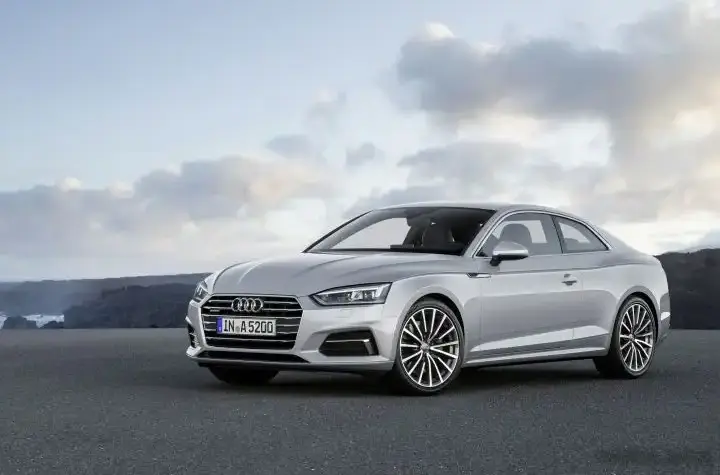
The Audi A5 Coupe (F5) 2.0 TDI, producing 190 horsepower, represents a significant iteration in Audi’s popular luxury coupe line. Introduced in 2016 and continuing through 2018, this variant occupied a key position within the F5 A5 generation, which itself was built upon the MLB Evo platform shared with other Volkswagen Group vehicles. It aimed to balance performance, fuel efficiency, and refinement, appealing to buyers seeking a sporty yet practical grand tourer. This model year marked a complete redesign of the A5, moving away from the B8 generation and introducing a more angular, modern aesthetic alongside updated technology.
Powertrain & Engine Architecture
The heart of the A5 Coupe 2.0 TDI 190 hp is the Volkswagen Group’s EA288 engine family. Specifically, the DESA, DETA, or DFVA engine codes were commonly found in this variant, depending on the exact production date and market. This 2.0-liter inline-four diesel engine utilizes a common rail direct injection system, delivering fuel at extremely high pressures for optimized combustion. The engine features a single turbocharger with an intercooler, boosting power and torque. The valvetrain employs a dual overhead camshaft (DOHC) design with four valves per cylinder, enhancing breathing and efficiency. The engine’s 15.5:1 compression ratio is typical for modern diesel engines, contributing to thermal efficiency. The 190 horsepower and 400 Nm (295 lb-ft) of torque are delivered across a broad rev range, making it a flexible powerplant. The engine is longitudinally mounted, driving the front wheels through a six-speed manual transmission.
Driving Characteristics
The 2.0 TDI 190 hp variant of the A5 Coupe offered a balanced driving experience. While not as overtly sporty as the higher-output gasoline models, it provided ample power for everyday driving and comfortable highway cruising. Acceleration from 0-60 mph took around 7.3 seconds. The manual transmission, while engaging, had relatively long gearing, prioritizing fuel economy over outright performance. The torque curve was relatively flat, providing good responsiveness in most situations. Compared to the more powerful 2.0 TFSI gasoline engine, the TDI offered significantly better fuel economy, but lacked the same level of responsiveness and engine character. The front-wheel-drive configuration, while adequate, could exhibit some torque steer under hard acceleration.
Equipment & Trim Levels
The 2.0 TDI 190 hp A5 Coupe typically came standard with features like Audi’s Multi Media Interface (MMI) infotainment system, leather upholstery, automatic climate control, and a suite of safety features including ABS, stability control, and multiple airbags. Optional extras included a panoramic sunroof, upgraded sound system (Bang & Olufsen), navigation system, and various driver-assistance systems like adaptive cruise control and lane departure warning. Trim levels varied by market, but generally offered progressively more luxurious appointments and technology features as you moved up the range. The base trim focused on essential comfort and convenience features, while higher trims added more premium materials and advanced technology.
Chassis & Braking
The A5 Coupe’s chassis featured an independent multi-link suspension at both the front and rear, providing a comfortable ride and good handling characteristics. The suspension was tuned to balance comfort and control, offering a composed ride even on uneven surfaces. Braking duties were handled by ventilated discs at the front and solid discs at the rear. ABS (Anti-lock Braking System) was standard. The steering utilized an electric power steering system, providing light and precise steering feel. The front track and rear track were 1587 mm and 1568 mm respectively, contributing to the car’s stable handling.
Market Reception & Comparison
The A5 Coupe 2.0 TDI 190 hp was generally well-received by automotive critics. It was praised for its stylish design, comfortable interior, and fuel-efficient engine. However, some critics noted that the front-wheel-drive configuration and manual transmission didn’t quite deliver the sporty driving experience expected of an Audi coupe. Compared to the gasoline-powered A5 models, the TDI offered superior fuel economy, making it a popular choice for drivers who prioritized efficiency. Against competitors like the BMW 4 Series Coupe and Mercedes-Benz C-Class Coupe, the A5 TDI stood out for its refined interior and advanced technology.
Legacy
The EA288 engine family, including the variants used in the A5 Coupe 2.0 TDI, has proven to be relatively reliable, although diesel particulate filter (DPF) issues can occur, particularly with vehicles primarily used for short trips. The F5 A5 generation as a whole has maintained a good reputation for build quality and durability. On the used car market, the 2.0 TDI 190 hp A5 Coupe represents a good value proposition, offering a blend of style, comfort, and fuel efficiency. However, potential buyers should be aware of the potential maintenance costs associated with diesel engines, including DPF maintenance and potential injector issues.