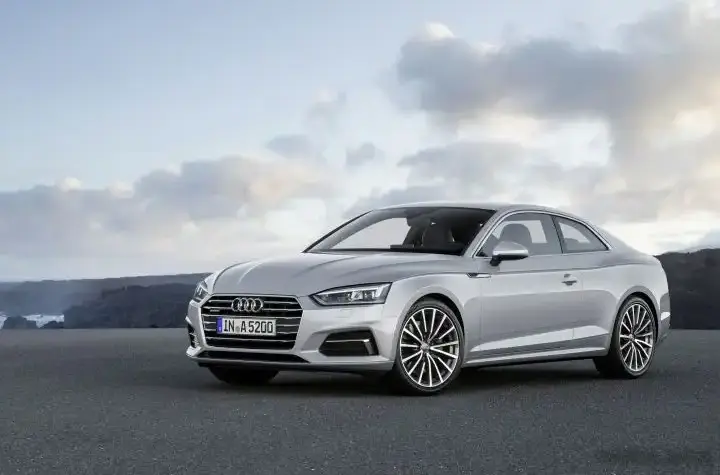
The Audi A5 Coupe (F5) 2.0 TDI 190 hp S tronic represents a compelling blend of performance and efficiency within the fifth-generation A5 lineup, produced from 2016 to 2018. Positioned as a mid-range offering, this variant catered to buyers seeking a balance between spirited driving and respectable fuel economy. Built on the MLB Evo platform (shared with other Audi and Volkswagen group vehicles), the F5 A5 aimed to refine the design and technology of its predecessor while maintaining the core characteristics of a sporty, yet practical, grand tourer. This specific configuration – the 2.0-liter turbocharged diesel paired with Audi’s seven-speed S tronic dual-clutch transmission – was a popular choice in European markets, where diesel engines remained dominant due to favorable taxation and fuel efficiency.
Technical Specifications
| Brand | Audi |
| Model | A5 |
| Generation | A5 Coupe (F5) |
| Type (Engine) | 2.0 TDI (190 Hp) S tronic |
| Start of production | 2016 |
| End of production | 2018 |
| Powertrain Architecture | Internal Combustion engine |
| Body type | Coupe |
| Seats | 4 |
| Doors | 2 |
| Fuel consumption (urban) | 4.8-5.0 l/100 km (49-47 US mpg, 58.9-56.5 UK mpg, 20.8-20 km/l) |
| Fuel consumption (extra urban) | 3.7-4.0 l/100 km (63.6-58.8 US mpg, 76.3-70.6 UK mpg, 27-25 km/l) |
| Fuel consumption (combined) | 4.1-4.3 l/100 km (57.4-54.7 US mpg, 68.9-65.7 UK mpg, 24.4-23.3 km/l) |
| CO2 emissions | 107-113 g/km |
| Fuel Type | Diesel |
| Acceleration 0 – 100 km/h | 7.7 sec |
| Acceleration 0 – 62 mph | 7.7 sec |
| Acceleration 0 – 60 mph | 7.3 sec |
| Maximum speed | 238 km/h (147.89 mph) |
| Emission standard | Euro 6 |
| Weight-to-power ratio | 7.8 kg/Hp, 127.5 Hp/tonne |
| Weight-to-torque ratio | 3.7 kg/Nm, 268.5 Nm/tonne |
| Power | 190 Hp @ 3800-4200 rpm |
| Power per litre | 96.5 Hp/l |
| Torque | 400 Nm @ 1750-3000 rpm (295.02 lb.-ft. @ 1750-3000 rpm) |
| Engine layout | Front, Longitudinal |
| Engine Model/Code | DESA, DETA, DFVA |
| Engine displacement | 1968 cm3 (120.09 cu. in.) |
| Number of cylinders | 4 |
| Engine configuration | Inline |
| Cylinder Bore | 81 mm (3.19 in.) |
| Piston Stroke | 95.5 mm (3.76 in.) |
| Compression ratio | 15.5:1 |
| Number of valves per cylinder | 4 |
| Fuel injection system | Diesel Commonrail |
| Engine aspiration | Turbocharger, Intercooler |
| Valvetrain | DOHC |
| Engine oil capacity | 4.7 l (4.97 US qt | 4.14 UK qt) |
| Coolant | 11.9 l (12.57 US qt | 10.47 UK qt) |
| Kerb Weight | 1490 kg (3284.89 lbs.) |
| Max. weight | 2015 kg (4442.31 lbs.) |
| Max load | 525 kg (1157.43 lbs.) |
| Trunk (boot) space – minimum | 465 l (16.42 cu. ft.) |
| Fuel tank capacity | 40 l (10.57 US gal | 8.8 UK gal) |
| AdBlue tank | 12 l (3.17 US gal | 2.64 UK gal) |
| Max. roof load | 75 kg (165.35 lbs.) |
| Permitted trailer load with brakes (8%) | 1900 kg (4188.78 lbs.) |
| Permitted trailer load with brakes (12%) | 1700 kg (3747.86 lbs.) |
| Permitted trailer load without brakes | 750 kg (1653.47 lbs.) |
| Permitted towbar download | 80 kg (176.37 lbs.) |
| Length | 4673 mm (183.98 in.) |
| Width | 1846 mm (72.68 in.) |
| Width including mirrors | 2029 mm (79.88 in.) |
| Height | 1371 mm (53.98 in.) |
| Wheelbase | 2764 mm (108.82 in.) |
| Front track | 1587 mm (62.48 in.) |
| Rear (Back) track | 1568 mm (61.73 in.) |
| Front overhang | 878 mm (34.57 in.) |
| Rear overhang | 1031 mm (40.59 in.) |
| Drag coefficient (Cd) | 0.27 |
| Minimum turning circle (turning diameter) | 11.5 m (37.73 ft.) |
| Drivetrain Architecture | The Internal combustion engine (ICE) drives the front wheels of the vehicle. |
| Drive wheel | Front wheel drive |
| Number of gears and type of gearbox | 7 gears, automatic transmission S tronic |
| Front suspension | Independent multi-link suspension |
| Rear suspension | Independent multi-link suspension |
| Front brakes | Ventilated discs |
| Rear brakes | Disc |
| Assisting systems | ABS (Anti-lock braking system) |
| Steering type | Steering rack and pinion |
| Power steering | Electric Steering |
| Tires size | 225/50 R17; 245/40 R18 93Y; 255/35 R19 |
| Wheel rims size | 7.5 J x 17; 18; 19 |
Powertrain & Engine Architecture
The heart of this A5 variant is the 2.0-liter inline-four cylinder diesel engine, identified by engine codes DESA, DETA, or DFVA depending on the specific production year and market. This engine utilizes a common rail direct injection system, delivering fuel at extremely high pressures for optimized combustion. A single turbocharger, often with variable geometry turbine (VGT) technology, provides forced induction, boosting power and torque. The engine also features an intercooler to reduce intake air temperature, further enhancing performance. The valvetrain employs a dual overhead camshaft (DOHC) design with four valves per cylinder, contributing to efficient gas exchange. The seven-speed S tronic dual-clutch transmission is a key component, offering rapid and smooth gear changes. This transmission features two separate clutches, one for odd gears and one for even gears, allowing for pre-selection of the next gear and minimizing interruption in power delivery.
Driving Characteristics
The 190 hp 2.0 TDI with the S tronic transmission delivers a refined and capable driving experience. While not as overtly sporty as higher-powered A5 variants, it provides ample torque (400 Nm / 295 lb-ft) from low engine speeds, resulting in strong acceleration in everyday driving situations. The S tronic transmission contributes to this responsiveness, providing quick shifts and a seamless power delivery. Compared to the six-speed manual transmission available on some A5 models, the S tronic offers greater convenience and potentially slightly quicker acceleration. However, some enthusiasts might prefer the more engaging feel of a manual gearbox. The gear ratios are tuned for a balance between acceleration and fuel efficiency, with a relatively tall seventh gear for comfortable highway cruising.
Equipment & Trim Levels
The 2.0 TDI 190 hp S tronic typically came equipped with a generous level of standard features. These included Audi’s MMI infotainment system with a central display screen, automatic climate control, power-adjustable front seats, and a leather-wrapped steering wheel. Exterior features often included alloy wheels, automatic headlights, and rain-sensing wipers. Optional extras could include a sunroof, upgraded leather upholstery, a premium sound system, and various driver-assistance systems such as adaptive cruise control and lane departure warning. Trim levels varied by market, but generally, this engine/transmission combination was positioned as a mid-range offering, bridging the gap between the entry-level models and the more performance-oriented variants like the S5.
Chassis & Braking
The A5 Coupe (F5) features a sophisticated chassis design with independent multi-link suspension at both the front and rear axles. This setup provides a comfortable ride quality while maintaining good handling characteristics. The front suspension geometry is optimized for precise steering response, while the rear suspension helps to maintain stability during cornering. Braking duties are handled by ventilated discs at the front and solid discs at the rear. Anti-lock braking system (ABS) is standard, along with electronic stability control (ESC) to help prevent skidding. The suspension tuning is generally geared towards comfort and refinement, rather than outright sportiness, although the optional sport suspension package could provide a firmer ride and more responsive handling.
Market Reception & Comparison
The Audi A5 Coupe (F5) 2.0 TDI 190 hp S tronic was generally well-received by automotive critics. It was praised for its stylish design, refined interior, and efficient powertrain. The combination of diesel power and the S tronic transmission was seen as a particularly strong point, offering a good balance between performance and fuel economy. Compared to the higher-output 2.0 TFSI gasoline engine, the TDI offered superior fuel efficiency, but slightly less outright performance. The TDI also tended to be more expensive to maintain due to the complexity of the diesel particulate filter (DPF) system. Against competitors like the BMW 4 Series Coupe and Mercedes-Benz C-Class Coupe, the A5 was often seen as offering a more technologically advanced and refined driving experience.
Legacy
The 2.0 TDI engine, in various iterations, has proven to be a reliable and durable powertrain. However, like all modern diesel engines, it is susceptible to issues related to the diesel particulate filter (DPF) and the exhaust gas recirculation (EGR) system, particularly if the vehicle is primarily used for short trips. The S tronic transmission is generally reliable, but requires regular maintenance, including fluid changes, to ensure optimal performance. In the used car market, the A5 Coupe (F5) 2.0 TDI 190 hp S tronic remains a popular choice, offering a compelling combination of style, comfort, and efficiency. Well-maintained examples continue to command reasonable prices, making it an attractive option for buyers seeking a premium coupe with a focus on practicality.