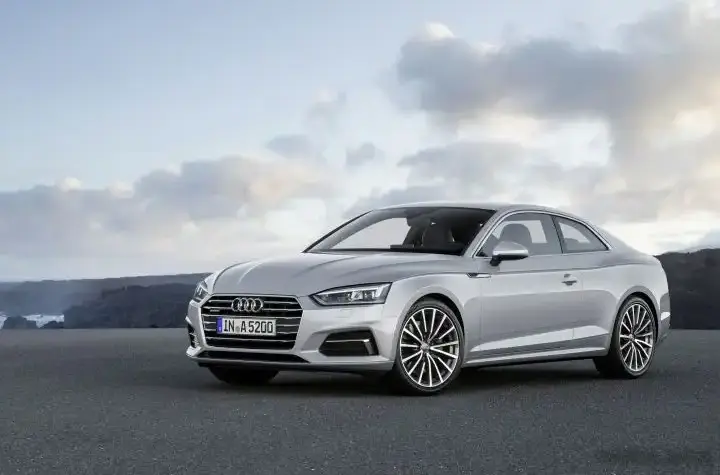
The Audi A5 Coupe (F5) 2.0 TDI ultra, produced from 2016 to 2018, represented a key variant within the second generation of Audi’s popular A5 line. Positioned as a fuel-efficient and refined option, it catered to buyers seeking a balance between performance and economy in a stylish coupe package. This model utilized a 2.0-liter turbocharged diesel engine paired with Audi’s seven-speed S tronic dual-clutch transmission, and was part of the broader A5 (F5) family built on the MLB Evo platform, shared with other Volkswagen Group vehicles like the Audi A4 and the Skoda Superb.
Technical Specifications
| Brand | Audi |
| Model | A5 |
| Generation | A5 Coupe (F5) |
| Type (Engine) | 2.0 TDI ultra (190 Hp) S tronic |
| Start of production | 2016 |
| End of production | 2018 |
| Powertrain Architecture | Internal Combustion engine |
| Body type | Coupe |
| Seats | 4 |
| Doors | 2 |
| Fuel consumption (urban) | 4.7-4.9 l/100 km (50 – 48 US mpg, 60.1 – 57.6 UK mpg, 21.3 – 20.4 km/l) |
| Fuel consumption (extra urban) | 3.6-3.8 l/100 km (65.3 – 61.9 US mpg, 78.5 – 74.3 UK mpg, 27.8 – 26.3 km/l) |
| Fuel consumption (combined) | 4.0-4.2 l/100 km (58.8 – 56 US mpg, 70.6 – 67.3 UK mpg, 25 – 23.8 km/l) |
| CO2 emissions | 105-111 g/km |
| Fuel Type | Diesel |
| Acceleration 0 – 100 km/h | 7.7 sec |
| Acceleration 0 – 62 mph | 7.7 sec |
| Acceleration 0 – 60 mph | 7.3 sec |
| Maximum speed | 210 km/h (130.49 mph) |
| Emission standard | Euro 6 |
| Weight-to-power ratio | 7.8 kg/Hp, 127.5 Hp/tonne |
| Weight-to-torque ratio | 3.7 kg/Nm, 268.5 Nm/tonne |
| Power | 190 Hp @ 3800-4200 rpm |
| Torque | 400 Nm @ 1750-3000 rpm (295.02 lb.-ft. @ 1750-3000 rpm) |
| Engine layout | Front, Longitudinal |
| Engine Model/Code | DESA, DETA, DFVA |
| Engine displacement | 1968 cm3 (120.09 cu. in.) |
| Number of cylinders | 4 |
| Engine configuration | Inline |
| Cylinder Bore | 81 mm (3.19 in.) |
| Piston Stroke | 95.5 mm (3.76 in.) |
| Compression ratio | 15.5:1 |
| Number of valves per cylinder | 4 |
| Fuel injection system | Diesel Commonrail |
| Engine aspiration | Turbocharger, Intercooler |
| Valvetrain | DOHC |
| Engine oil capacity | 4.7 l (4.97 US qt | 4.14 UK qt) |
| Coolant | 11.9 l (12.57 US qt | 10.47 UK qt) |
| Kerb Weight | 1490 kg (3284.89 lbs.) |
| Max. weight | 2015 kg (4442.31 lbs.) |
| Max load | 525 kg (1157.43 lbs.) |
| Trunk (boot) space – minimum | 465 l (16.42 cu. ft.) |
| Fuel tank capacity | 40 l (10.57 US gal | 8.8 UK gal) |
| AdBlue tank | 12 l (3.17 US gal | 2.64 UK gal) |
| Max. roof load | 75 kg (165.35 lbs.) |
| Permitted trailer load with brakes (8%) | 1900 kg (4188.78 lbs.) |
| Permitted trailer load with brakes (12%) | 1700 kg (3747.86 lbs.) |
| Permitted trailer load without brakes | 750 kg (1653.47 lbs.) |
| Permitted towbar download | 80 kg (176.37 lbs.) |
| Length | 4673 mm (183.98 in.) |
| Width | 1846 mm (72.68 in.) |
| Width including mirrors | 2029 mm (79.88 in.) |
| Height | 1371 mm (53.98 in.) |
| Wheelbase | 2764 mm (108.82 in.) |
| Front track | 1587 mm (62.48 in.) |
| Rear (Back) track | 1568 mm (61.73 in.) |
| Front overhang | 878 mm (34.57 in.) |
| Rear overhang | 1031 mm (40.59 in.) |
| Drag coefficient (Cd) | 0.25 |
| Minimum turning circle (turning diameter) | 11.5 m (37.73 ft.) |
| Drivetrain Architecture | The Internal combustion engine (ICE) drives the front wheels of the vehicle. |
| Drive wheel | Front wheel drive |
| Number of gears and type of gearbox | 7 gears, automatic transmission S tronic |
| Front suspension | Independent multi-link suspension |
| Rear suspension | Independent multi-link suspension |
| Front brakes | Ventilated discs |
| Rear brakes | Disc |
| Assisting systems | ABS (Anti-lock braking system) |
| Steering type | Steering rack and pinion |
| Power steering | Electric Steering |
| Tires size | 225/50 R17; 245/40 R18 93Y |
| Wheel rims size | 7.5 J x 17; 18 |
INTRODUCTION
The Audi A5 Coupe (F5) 2.0 TDI ultra, launched in 2016, was a significant iteration of Audi’s popular coupe. It represented a focus on efficiency within the A5 range, appealing to drivers who prioritized fuel economy without sacrificing the Audi brand’s reputation for quality and refinement. This variant sat within the broader F5 A5 lineup, which included the standard A5 Coupe, the more performance-oriented S5, and the convertible A5 Cabriolet. The “ultra” designation signified Audi’s efforts to optimize fuel consumption through weight reduction and aerodynamic enhancements. It was a key model in the European market, where diesel engines and fuel efficiency were highly valued.
Powertrain & Engine Architecture
At the heart of the A5 Coupe 2.0 TDI ultra lay the Volkswagen Group’s 2.0-liter four-cylinder diesel engine, specifically the DESA, DETA, or DFVA engine code depending on the specific production year and market. This engine featured common-rail direct injection, a turbocharger with an intercooler, and a double overhead camshaft (DOHC) valvetrain with four valves per cylinder. The engine produced 190 horsepower at 3800-4200 rpm and a substantial 400 Nm (295 lb-ft) of torque between 1750 and 3000 rpm. This broad torque curve provided strong pulling power across a wide range of engine speeds. The engine also incorporated a particulate filter to reduce emissions, meeting stringent Euro 6 standards. Paired with this engine was Audi’s seven-speed S tronic dual-clutch transmission. This transmission offered quick and smooth gear changes, contributing to both performance and efficiency. The S tronic’s programming was tuned to prioritize fuel economy in normal driving conditions, while still providing responsive shifts when needed.
Driving Characteristics
The 2.0 TDI ultra with the S tronic transmission delivered a refined and comfortable driving experience. While not as overtly sporty as the higher-powered variants like the S5, it offered ample performance for everyday driving and highway cruising. Acceleration from 0 to 62 mph (0-100 km/h) took approximately 7.7 seconds. The S tronic transmission’s quick shifts helped to maximize the available power, and the broad torque band meant that overtaking maneuvers could be executed with ease. Compared to the six-speed manual transmission offered on other A5 models, the S tronic provided smoother gear changes and slightly improved fuel economy. However, some drivers preferred the more engaging feel of a manual gearbox. The gear ratios were optimized for both fuel efficiency and responsiveness, with a relatively tall seventh gear for relaxed highway cruising.
Equipment & Trim Levels
The A5 Coupe 2.0 TDI ultra typically came well-equipped as standard. Features included Audi’s MMI infotainment system with a 7-inch display, three-zone automatic climate control, and a leather-wrapped multifunction steering wheel. Upholstery was typically cloth or a combination of cloth and leatherette, with full leather available as an option. Standard exterior features included alloy wheels (typically 17 or 18 inches), LED headlights, and automatic headlights and wipers. Optional extras included Audi’s Virtual Cockpit digital instrument cluster, a Bang & Olufsen sound system, and a suite of driver assistance systems such as adaptive cruise control, lane departure warning, and blind spot monitoring.
Chassis & Braking
The A5 Coupe 2.0 TDI ultra featured a sophisticated chassis designed to provide a balance between comfort and handling. The front suspension utilized independent multi-link suspension, while the rear also employed an independent multi-link setup. This configuration provided excellent ride quality and precise handling. The steering was a rack-and-pinion system with electric power assistance. Braking duties were handled by ventilated discs at the front and solid discs at the rear, with ABS (Anti-lock Braking System) as standard. The suspension tuning was generally softer than that of the S5, prioritizing comfort over outright sportiness.
Market Reception & Comparison
The A5 Coupe 2.0 TDI ultra was generally well-received by automotive critics. It was praised for its fuel efficiency, refined driving experience, and stylish design. Compared to the more powerful A5 variants, it offered a more affordable entry point into the A5 range. However, some critics noted that the engine lacked the outright punch of the larger engines. In terms of fuel economy, the 2.0 TDI ultra significantly outperformed the gasoline-powered A5 models, achieving combined fuel consumption figures of around 4.0-4.2 l/100 km (58.8-56 US mpg). Reliability was generally good, although, as with any diesel engine, the particulate filter could require maintenance over time.
Legacy
The Audi A5 Coupe 2.0 TDI ultra remains a popular choice in the used car market. Its combination of fuel efficiency, refinement, and stylish design continues to appeal to buyers. The 2.0 TDI engine, while not without its complexities, has proven to be relatively durable when properly maintained. The S tronic transmission is also generally reliable, although regular servicing is essential. The A5 Coupe (F5) as a whole established itself as a strong competitor in the premium coupe segment, and the 2.0 TDI ultra variant played a key role in its success, particularly in markets where diesel engines were favored.