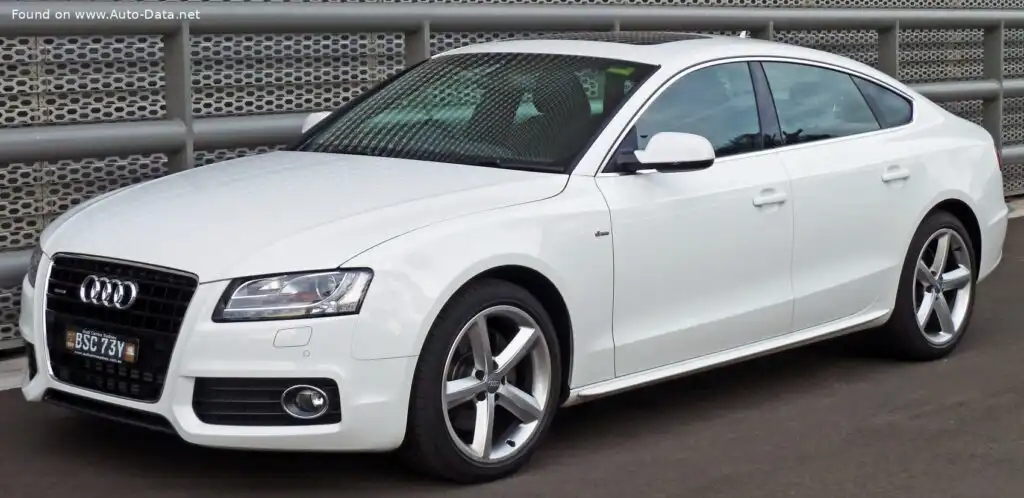
The Audi A5 Sportback (8TA) 3.0 TDI V6 quattro, produced between 2009 and 2011, represents a compelling blend of performance, practicality, and luxury within the Audi A5 range. Positioned as a premium offering, this variant combined Audi’s renowned quattro all-wheel-drive system with a powerful 3.0-liter turbocharged diesel engine. The Sportback body style, a five-door fastback, distinguished itself from the coupe and cabriolet versions by offering enhanced accessibility and cargo space, making it a more versatile option for buyers. This model played a significant role in Audi’s strategy to broaden the A5’s appeal, attracting customers seeking a sophisticated and capable grand tourer.
Technical Specifications
| Brand | Audi |
| Model | A5 |
| Generation | A5 Sportback (8TA) |
| Type (Engine) | 3.0 TDI V6 (240 Hp) quattro |
| Start of production | 2009 |
| End of production | 2011 |
| Powertrain Architecture | Internal Combustion engine |
| Body type | Fastback |
| Seats | 4 |
| Doors | 5 |
| Fuel consumption (urban) | 8.9 l/100 km (26.4 US mpg, 31.7 UK mpg, 11.2 km/l) |
| Fuel consumption (extra urban) | 5.4 l/100 km (43.6 US mpg, 52.3 UK mpg, 18.5 km/l) |
| Fuel consumption (combined) | 6.7 l/100 km (35.1 US mpg, 42.2 UK mpg, 14.9 km/l) |
| CO2 emissions | 176 g/km |
| Fuel Type | Diesel |
| Acceleration 0 – 100 km/h | 6.3 sec |
| Acceleration 0 – 62 mph | 6.3 sec |
| Acceleration 0 – 60 mph | 6 sec |
| Maximum speed | 250 km/h (155.34 mph) |
| Emission standard | Euro 5 |
| Weight-to-power ratio | 7 kg/Hp, 142.4 Hp/tonne |
| Weight-to-torque ratio | 3.4 kg/Nm, 296.7 Nm/tonne |
| Power | 240 Hp @ 4000-4400 rpm |
| Power per litre | 80.9 Hp/l |
| Torque | 500 Nm @ 1500-3000 rpm (368.78 lb.-ft. @ 1500-3000 rpm) |
| Engine layout | Front, Longitudinal |
| Engine Model/Code | CAPA, CCWA |
| Engine displacement | 2967 cm3 (181.06 cu. in.) |
| Number of cylinders | 6 |
| Engine configuration | V-engine |
| Cylinder Bore | 83 mm (3.27 in.) |
| Piston Stroke | 91.4 mm (3.6 in.) |
| Compression ratio | 16.8:1 |
| Number of valves per cylinder | 4 |
| Fuel injection system | Diesel Commonrail |
| Engine aspiration | Turbocharger, Intercooler |
| Valvetrain | DOHC |
| Engine oil capacity | 6.9 l (7.29 US qt | 6.07 UK qt) |
| Kerb Weight | 1685 kg (3714.79 lbs.) |
| Max. weight | 2215 kg (4883.24 lbs.) |
| Max load | 530 kg (1168.45 lbs.) |
| Trunk (boot) space – minimum | 480 l (16.95 cu. ft.) |
| Trunk (boot) space – maximum | 980 l (34.61 cu. ft.) |
| Fuel tank capacity | 64 l (16.91 US gal | 14.08 UK gal) |
| Max. roof load | 90 kg (198.42 lbs.) |
| Permitted trailer load with brakes (8%) | 2100 kg (4629.71 lbs.) |
| Permitted trailer load with brakes (12%) | 1900 kg (4188.78 lbs.) |
| Permitted trailer load without brakes | 750 kg (1653.47 lbs.) |
| Permitted towbar download | 80 kg (176.37 lbs.) |
| Length | 4711 mm (185.47 in.) |
| Width | 1854 mm (72.99 in.) |
| Height | 1391 mm (54.76 in.) |
| Wheelbase | 2810 mm (110.63 in.) |
| Front track | 1590 mm (62.6 in.) |
| Rear (Back) track | 1575 mm (62.01 in.) |
| Drag coefficient (Cd) | 0.30 |
| Minimum turning circle (turning diameter) | 11.5 m (37.73 ft.) |
| Drivetrain Architecture | The Internal combustion engine (ICE) drives permanently the four wheels of the vehicle. |
| Drive wheel | All wheel drive (4×4) |
| Number of gears and type of gearbox | 6 gears, manual transmission |
| Front suspension | Independent multi-link suspension |
| Rear suspension | Independent multi-link spring suspension with stabilizer |
| Front brakes | Ventilated discs |
| Rear brakes | Disc |
| Assisting systems | ABS (Anti-lock braking system) |
| Steering type | Steering rack and pinion |
| Power steering | Electric Steering |
| Tires size | 225/50 R17 |
| Wheel rims size | 7.5J x 17 |
Powertrain & Engine Architecture
At the heart of the A5 Sportback 3.0 TDI quattro lies the CAPA or CCWA engine code, a 3.0-liter V6 diesel engine. This engine utilized a common rail direct injection system, delivering fuel at extremely high pressures for optimized combustion. The engine featured a single turbocharger with an intercooler, boosting power and torque while managing exhaust gas temperatures. The valvetrain employed a double overhead camshaft (DOHC) design with four valves per cylinder, enhancing volumetric efficiency. The engine’s robust construction and advanced technologies allowed it to produce 240 horsepower and a substantial 500 Nm (368 lb-ft) of torque. This power was delivered to all four wheels through a six-speed manual transmission, providing a balance between performance and fuel efficiency. The longitudinal engine layout contributed to the car’s balanced handling characteristics.
Driving Characteristics
The 3.0 TDI quattro Sportback offered a refined and capable driving experience. The engine’s ample torque, available from as low as 1500 rpm, provided strong acceleration in everyday driving situations. While not as overtly sporty as some of its gasoline-powered siblings, the diesel engine delivered a smooth and linear power delivery, making it ideal for long-distance cruising. The quattro all-wheel-drive system ensured excellent traction in various weather conditions, enhancing stability and confidence. The six-speed manual transmission, while engaging, had relatively long throws compared to some competitors. Compared to the 2.0 TDI variants, the 3.0 TDI offered significantly more power and refinement, while the manual transmission provided a more direct connection to the engine than the available automatic options.
Equipment & Trim Levels
The A5 Sportback 3.0 TDI quattro typically came well-equipped, reflecting its premium positioning. Standard features often included leather upholstery, three-zone automatic climate control, a multi-function steering wheel, and an Audi Concert audio system. Optional extras included navigation, advanced parking systems, and a panoramic sunroof. Trim levels varied depending on the market, but generally offered upgrades in interior materials, exterior styling, and technology features. The Sportback’s interior was characterized by Audi’s typically high build quality and attention to detail, creating a comfortable and sophisticated cabin environment.
Chassis & Braking
The A5 Sportback featured an independent multi-link suspension system at both the front and rear axles, providing a comfortable ride and precise handling. A stabilizer bar was included on the rear axle to reduce body roll during cornering. The braking system consisted of ventilated discs at the front and solid discs at the rear, providing ample stopping power. Anti-lock braking system (ABS) was standard, enhancing safety and control. The chassis was tuned to balance comfort and handling, offering a composed and predictable driving experience.
Market Reception & Comparison
The Audi A5 Sportback 3.0 TDI quattro was generally well-received by automotive critics. It was praised for its stylish design, refined engine, and all-weather capability. Fuel economy was considered excellent for a vehicle of its size and performance. Compared to competitors like the BMW 3 Series Gran Turismo and the Mercedes-Benz CLS, the A5 Sportback offered a compelling combination of practicality, luxury, and driving dynamics. The 3.0 TDI variant was often seen as a sweet spot in the A5 lineup, offering a significant performance upgrade over the lower-powered diesel options without the higher cost of the gasoline-powered S5.
Legacy
The 3.0 TDI engine, in various iterations, proved to be a reliable and durable powertrain. While diesel engines, in general, have faced increased scrutiny in recent years, the Audi 3.0 TDI has a reputation for longevity when properly maintained. The A5 Sportback 3.0 TDI quattro remains a desirable used car, appealing to buyers seeking a stylish, practical, and capable grand tourer. Common maintenance items include regular oil changes, filter replacements, and inspection of the turbocharger and fuel injection system. The quattro all-wheel-drive system continues to be a significant selling point, particularly in regions with inclement weather. The model’s blend of performance, luxury, and practicality ensures its continued relevance in the used car market.