Technical Specifications
| Brand | Audi |
| Model | A5 |
| Generation | A5 Sportback (8TA, facelift 2011) |
| Type (Engine) | 2.0 TFSI (211 Hp) Multitronic |
| Start of production | 2011 |
| End of production | 2013 |
| Powertrain Architecture | Internal Combustion engine |
| Body type | Fastback |
| Seats | 5 |
| Doors | 5 |
| Fuel consumption (urban) | 7.7 l/100 km (30.5 US mpg, 36.7 UK mpg, 13 km/l) |
| Fuel consumption (extra urban) | 5.3 l/100 km (44.4 US mpg, 53.3 UK mpg, 18.9 km/l) |
| Fuel consumption (combined) | 6.2 l/100 km (37.9 US mpg, 45.6 UK mpg, 16.1 km/l) |
| CO2 emissions | 144 g/km |
| Fuel Type | Petrol (Gasoline) |
| Acceleration 0 – 100 km/h | 7.2 sec |
| Acceleration 0 – 62 mph | 7.2 sec |
| Acceleration 0 – 60 mph | 6.8 sec |
| Maximum speed | 234 km/h (145.4 mph) |
| Emission standard | Euro 6 |
| Weight-to-power ratio | 7.3 kg/Hp, 137.9 Hp/tonne |
| Weight-to-torque ratio | 4.4 kg/Nm, 228.8 Nm/tonne |
| Power | 211 Hp @ 4300-6000 rpm |
| Power per litre | 106.4 Hp/l |
| Torque | 350 Nm @ 1500-4200 rpm (258.15 lb.-ft. @ 1500-4200 rpm) |
| Engine layout | Front, Longitudinal |
| Engine Model/Code | CDNC |
| Engine displacement | 1984 cm3 (121.07 cu. in.) |
| Number of cylinders | 4 |
| Engine configuration | Inline |
| Cylinder Bore | 82.5 mm (3.25 in.) |
| Piston Stroke | 92.8 mm (3.65 in.) |
| Compression ratio | 9.6:1 |
| Number of valves per cylinder | 4 |
| Fuel injection system | Direct injection |
| Engine aspiration | Turbocharger, Intercooler |
| Valvetrain | DOHC |
| Engine oil capacity | 4.6 l (4.86 US qt | 4.05 UK qt) |
| Kerb Weight | 1530 kg (3373.07 lbs.) |
| Max. weight | 2080 kg (4585.62 lbs.) |
| Max load | 550 kg (1212.54 lbs.) |
| Trunk (boot) space – minimum | 480 l (16.95 cu. ft.) |
| Trunk (boot) space – maximum | 980 l (34.61 cu. ft.) |
| Fuel tank capacity | 63 l (16.64 US gal | 13.86 UK gal) |
| Max. roof load | 90 kg (198.42 lbs.) |
| Permitted trailer load with brakes (8%) | 1700 kg (3747.86 lbs.) |
| Permitted trailer load with brakes (12%) | 1500 kg (3306.93 lbs.) |
| Permitted trailer load without brakes | 750 kg (1653.47 lbs.) |
| Permitted towbar download | 80 kg (176.37 lbs.) |
| Length | 4712 mm (185.51 in.) |
| Width | 1854 mm (72.99 in.) |
| Width including mirrors | 2020 mm (79.53 in.) |
| Height | 1391 mm (54.76 in.) |
| Wheelbase | 2810 mm (110.63 in.) |
| Front track | 1590 mm (62.6 in.) |
| Rear (Back) track | 1575 mm (62.01 in.) |
| Front overhang | 861 mm (33.9 in.) |
| Rear overhang | 1041 mm (40.98 in.) |
| Drag coefficient (Cd) | 0.29 |
| Minimum turning circle (turning diameter) | 11.5 m (37.73 ft.) |
| Drivetrain Architecture | The Internal combustion engine (ICE) drives the front wheels of the vehicle. |
| Drive wheel | Front wheel drive |
| Number of gears and type of gearbox | automatic transmission Multitronic |
| Front suspension | Independent multi-link suspension |
| Rear suspension | Independent on trapezoidal lever |
| Front brakes | Ventilated discs |
| Rear brakes | Disc |
| Assisting systems | ABS (Anti-lock braking system) |
| Steering type | Steering rack and pinion |
| Power steering | Electric Steering |
| Tires size | 225/50 R17 |
| Wheel rims size | 7.5J x 17 |
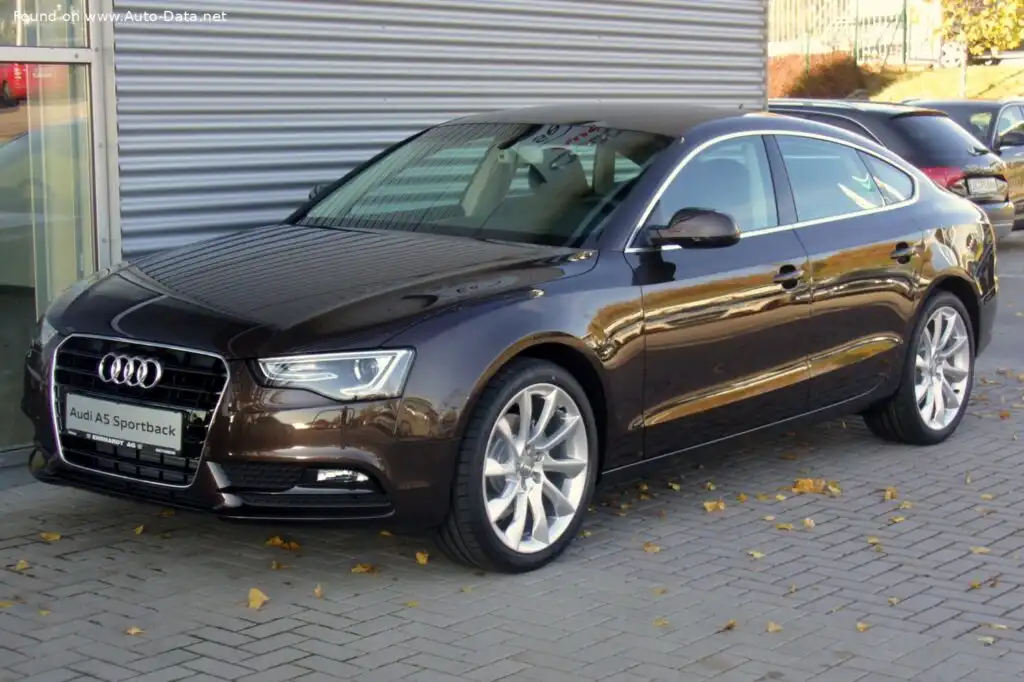
The 2011-2013 Audi A5 Sportback 2.0 TFSI Multitronic represented a compelling offering in the premium compact segment. Built on the Audi A5 (8TA) platform, which was itself derived from the Volkswagen Golf Mk5 and Audi A3 (1HX0/A3) architecture, the Sportback distinguished itself with its five-door layout, offering increased practicality without sacrificing the A5’s sleek, coupe-like aesthetics. The 2.0 TFSI engine, paired with Audi’s Multitronic continuously variable transmission (CVT), was a popular choice, providing a balance between performance and fuel economy. This configuration aimed to appeal to buyers who desired a refined and versatile vehicle for both daily commuting and longer journeys.
Powertrain & Engine Architecture
At the heart of the A5 Sportback 2.0 TFSI Multitronic lies the CDNC engine, a 1.984-liter inline-four cylinder gasoline engine. This engine utilizes direct fuel injection (FSI) and a single turbocharger with an intercooler to deliver 211 horsepower at 4300-6000 rpm and 350 Nm (258.15 lb.-ft.) of torque between 1500-4200 rpm. The engine features a double overhead camshaft (DOHC) valvetrain with four valves per cylinder. The Multitronic transmission is a continuously variable transmission that uses a chain drive between two pulleys to provide a seamless and stepless gear ratio. This design allows the engine to operate at its most efficient point, contributing to improved fuel economy. The Multitronic transmission featured a manual mode allowing drivers some control over the gear ratios, though it primarily focused on optimizing efficiency.
Driving Characteristics
The 2.0 TFSI Multitronic powertrain delivered a smooth and refined driving experience. While not as overtly sporty as the higher-output variants like the 3.2 FSI or the S5, it provided ample power for everyday driving situations. Acceleration from 0-60 mph took approximately 6.8 seconds, and the car felt responsive in most scenarios. The Multitronic transmission, while efficient, lacked the immediate responsiveness of a traditional automatic or dual-clutch transmission. Gear ratios were continuously adjusted to maintain optimal engine speed, resulting in a sometimes detached feeling. Compared to the six-speed manual transmission available on other A5 models, the Multitronic prioritized smoothness and fuel economy over driver engagement.
Equipment & Trim Levels
The A5 Sportback 2.0 TFSI Multitronic typically came well-equipped as standard. Features included automatic climate control, a multi-function steering wheel, power windows and mirrors, and an Audi Concert audio system. Upholstery was typically cloth, with leather options available as upgrades. Optional extras included a navigation system, sunroof, parking sensors, and upgraded sound systems like Bang & Olufsen. Trim levels varied slightly depending on the market, but generally offered packages that bundled popular options together. The Sportback’s interior design was characterized by Audi’s typically high build quality and attention to detail, creating a comfortable and premium cabin environment.
Chassis & Braking
The A5 Sportback featured an independent multi-link suspension at the front and an independent trapezoidal lever suspension at the rear, providing a comfortable and controlled ride. The front brakes were ventilated discs, while the rear brakes were solid discs. Anti-lock braking system (ABS) was standard. The chassis was tuned to balance comfort and handling, offering a stable and predictable driving experience. Stabilizer bars were fitted to both the front and rear axles to reduce body roll during cornering. The weight distribution was generally well-balanced, contributing to the car’s overall handling characteristics.
Market Reception & Comparison
The Audi A5 Sportback 2.0 TFSI Multitronic was generally well-received by automotive critics. It was praised for its stylish design, spacious interior, and refined driving experience. The Multitronic transmission, while not universally loved, was acknowledged for its contribution to fuel efficiency. Compared to the manual transmission versions, the Multitronic offered greater convenience, particularly in urban driving. Against competitors like the BMW 3 Series Gran Turismo and the Mercedes-Benz CLS, the A5 Sportback offered a compelling combination of style, practicality, and technology. Fuel economy figures of around 37.9 US mpg combined were competitive for its class.
Legacy
The Audi A5 Sportback 2.0 TFSI Multitronic has proven to be a relatively reliable vehicle in the used car market. The 2.0 TFSI engine, while occasionally susceptible to carbon buildup on the intake valves, is generally robust when properly maintained. The Multitronic transmission requires regular servicing, including fluid changes, to ensure longevity. Today, these vehicles represent a good value proposition for buyers seeking a stylish and well-equipped premium compact car. Their blend of practicality, refinement, and relatively good fuel economy continues to make them an attractive option in the used car market.