Technical Specifications
| Brand | Audi |
| Model | A5 |
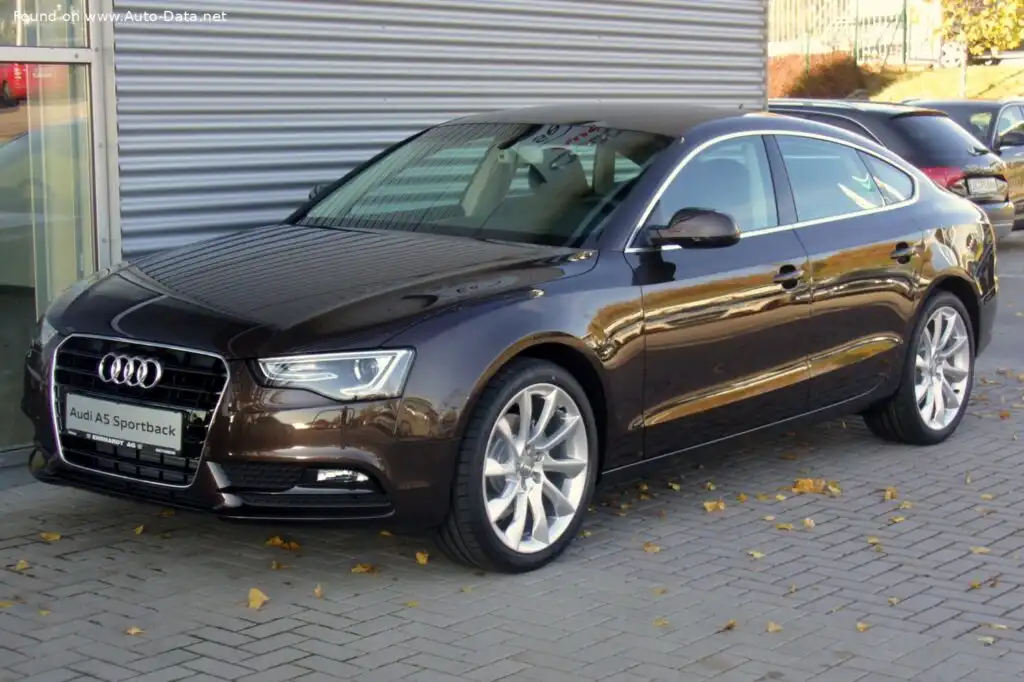
| Generation | A5 Sportback (8TA, facelift 2011) |
| Type (Engine) | 2.0 TFSI (225 Hp) |
| Start of production | April, 2013 |
| End of production | 2016 |
| Powertrain Architecture | Internal Combustion engine |
| Body type | Fastback |
| Seats | 5 |
| Doors | 5 |
| Fuel consumption (urban) | 7.8 l/100 km (30.2 US mpg, 36.2 UK mpg, 12.8 km/l) |
| Fuel consumption (extra urban) | 4.8 l/100 km (49 US mpg, 58.9 UK mpg, 20.8 km/l) |
| Fuel consumption (combined) | 5.9 l/100 km (39.9 US mpg, 47.9 UK mpg, 16.9 km/l) |
| CO2 emissions | 138 g/km |
| Fuel Type | Petrol (Gasoline) |
| Acceleration 0 – 100 km/h | 7 sec |
| Acceleration 0 – 62 mph | 7 sec |
| Acceleration 0 – 60 mph | 6.7 sec |
| Maximum speed | 250 km/h (155.34 mph), Electronically limited |
| Emission standard | Euro 6 |
| Weight-to-power ratio | 6.7 kg/Hp, 150 Hp/tonne |
| Weight-to-torque ratio | 4.3 kg/Nm, 233.3 Nm/tonne |
| Power | 225 Hp @ 4500-6250 rpm |
| Power per litre | 113.4 Hp/l |
| Torque | 350 Nm @ 1500-4500 rpm (258.15 lb.-ft. @ 1500-4500 rpm) |
| Engine layout | Front, Longitudinal |
| Engine Model/Code | EA888 / CNCD |
| Engine displacement | 1984 cm3 (121.07 cu. in.) |
| Number of cylinders | 4 |
| Engine configuration | Inline |
| Cylinder Bore | 82.5 mm (3.25 in.) |
| Piston Stroke | 92.8 mm (3.65 in.) |
| Compression ratio | 9.6:1 |
| Number of valves per cylinder | 4 |
| Fuel injection system | Direct injection and Multi-port manifold injection |
| Engine aspiration | Turbocharger, Intercooler |
| Valvetrain | DOHC |
| Engine oil capacity | 4.6 l (4.86 US qt | 4.05 UK qt) |
| Kerb Weight | 1500 kg (3306.93 lbs.) |
| Max. weight | 2050 kg (4519.48 lbs.) |
| Max load | 550 kg (1212.54 lbs.) |
| Trunk (boot) space – minimum | 480 l (16.95 cu. ft.) |
| Trunk (boot) space – maximum | 1283 l (45.31 cu. ft.) |
| Fuel tank capacity | 63 l (16.64 US gal | 13.86 UK gal) |
| Max. roof load | 90 kg (198.42 lbs.) |
| Permitted trailer load with brakes (8%) | 1700 kg (3747.86 lbs.) |
| Permitted trailer load with brakes (12%) | 1500 kg (3306.93 lbs.) |
| Permitted trailer load without brakes | 750 kg (1653.47 lbs.) |
| Permitted towbar download | 80 kg (176.37 lbs.) |
| Length | 4712 mm (185.51 in.) |
| Width | 1854 mm (72.99 in.) |
| Width including mirrors | 2020 mm (79.53 in.) |
| Height | 1391 mm (54.76 in.) |
| Wheelbase | 2810 mm (110.63 in.) |
| Front track | 1590 mm (62.6 in.) |
| Rear (Back) track | 1575 mm (62.01 in.) |
| Front overhang | 861 mm (33.9 in.) |
| Rear overhang | 1041 mm (40.98 in.) |
| Minimum turning circle (turning diameter) | 11.5 m (37.73 ft.) |
| Drivetrain Architecture | The Internal combustion engine (ICE) drives the front wheels of the vehicle. |
| Drive wheel | Front wheel drive |
| Number of gears and type of gearbox | 6 gears, manual transmission |
| Front suspension | Independent multi-link suspension, Transverse stabilizer |
| Rear suspension | Independent on trapezoidal lever, Transverse stabilizer |
| Front brakes | Ventilated discs |
| Rear brakes | Disc |
| Assisting systems | ABS (Anti-lock braking system) |
| Steering type | Steering rack and pinion |
| Power steering | Electric Steering |
| Tires size | 225/50 R17; 245/40 R18; 255/35 R19 |
| Wheel rims size | 7.5J x 17; 8.5J x 18; 8.5J x 19; 9J x 19 |
The Audi A5 Sportback (8TA, facelift 2011) 2.0 TFSI 225 Hp variant represents a compelling blend of performance, practicality, and Audi’s signature refinement. Introduced in April 2013 and continuing through 2016, this model occupied a significant position within the A5 Sportback range, offering a step up in power and driving experience from the base 1.8 TFSI models while remaining more accessible than the high-performance S5 variants. Built on the Audi A4 (B8) platform – internally designated 8K – the Sportback body style combined the sleek lines of a coupe with the added versatility of a five-door hatchback, appealing to buyers seeking a stylish and functional vehicle.
Powertrain & Engine Architecture
At the heart of the A5 Sportback 2.0 TFSI 225 Hp lies the EA888 engine, specifically the CNCD variant. This 1.984-liter inline-four cylinder engine utilizes direct fuel injection (FSI) combined with multi-point injection, optimizing combustion efficiency and power delivery. A single turbocharger with an intercooler provides forced induction, boosting power output to 225 horsepower at 4500-6250 rpm and 350 Nm (258 lb-ft) of torque between 1500-4500 rpm. The engine features a double overhead camshaft (DOHC) valvetrain with four valves per cylinder. The engine’s control unit manages the fuel injection, ignition timing, and turbocharger boost pressure for optimal performance. The standard transmission for this variant was a six-speed manual, although a S tronic dual-clutch transmission was also available as an option. The S tronic offered quicker shifts and improved fuel economy, but at an additional cost.
Driving Characteristics
The 2.0 TFSI 225 Hp Sportback delivered a responsive and engaging driving experience. Acceleration from 0 to 60 mph took approximately 6.7 seconds, and the car felt adequately powered for both city driving and highway cruising. The broad torque curve ensured strong pull throughout the rev range, making overtaking maneuvers effortless. Compared to the 1.8 TFSI, the 2.0 TFSI offered a noticeable increase in performance, while the S tronic transmission further enhanced responsiveness. While not as exhilarating as the S5, the 2.0 TFSI provided a satisfying balance of power and efficiency. The Sportback’s front-wheel-drive configuration offered good traction in most conditions, although torque steer could be felt under hard acceleration.
Equipment & Trim Levels
The A5 Sportback 2.0 TFSI 225 Hp typically came well-equipped as standard. Features included automatic climate control, a multi-function steering wheel, power windows and mirrors, and an Audi Concert audio system. Upholstery was typically cloth, with leather options available as upgrades. Common optional extras included a panoramic sunroof, navigation system, parking sensors, and upgraded alloy wheels. Trim levels varied slightly depending on the market, but generally offered packages that bundled popular options together. The interior design was typically understated and elegant, reflecting Audi’s commitment to quality and refinement.
Chassis & Braking
The A5 Sportback featured a sophisticated chassis designed to deliver a comfortable yet engaging ride. The front suspension utilized independent multi-link setup with a transverse stabilizer, while the rear employed an independent trapezoidal link suspension, also with a stabilizer bar. This configuration minimized body roll and provided precise handling. Braking duties were handled by ventilated discs at the front and solid discs at the rear, equipped with ABS (Anti-lock Braking System). The steering was a rack-and-pinion system with electric power assistance, offering precise and responsive control.
Market Reception & Comparison
The Audi A5 Sportback 2.0 TFSI 225 Hp was generally well-received by automotive critics. It was praised for its stylish design, practical hatchback configuration, and refined driving experience. Compared to the 1.8 TFSI, the 2.0 TFSI offered a significant performance upgrade, justifying the higher price tag for many buyers. Fuel economy was respectable, averaging around 39.9 US mpg in combined driving. Reliability was generally good, although some owners reported issues with the turbocharger and fuel injectors. The Sportback’s main competitors included the BMW 3 Series Gran Turismo and the Volkswagen Passat CC.
Legacy
The Audi A5 Sportback 2.0 TFSI 225 Hp remains a popular choice in the used car market today. Its combination of style, practicality, and performance continues to appeal to buyers seeking a premium compact vehicle. The EA888 engine is known for its durability and tunability, making it a relatively reliable powertrain. However, potential buyers should be aware of potential issues with the turbocharger and fuel injectors, and ensure that the car has been properly maintained. The A5 Sportback helped establish Audi as a leader in the premium compact segment, and its innovative design continues to influence automotive styling today.