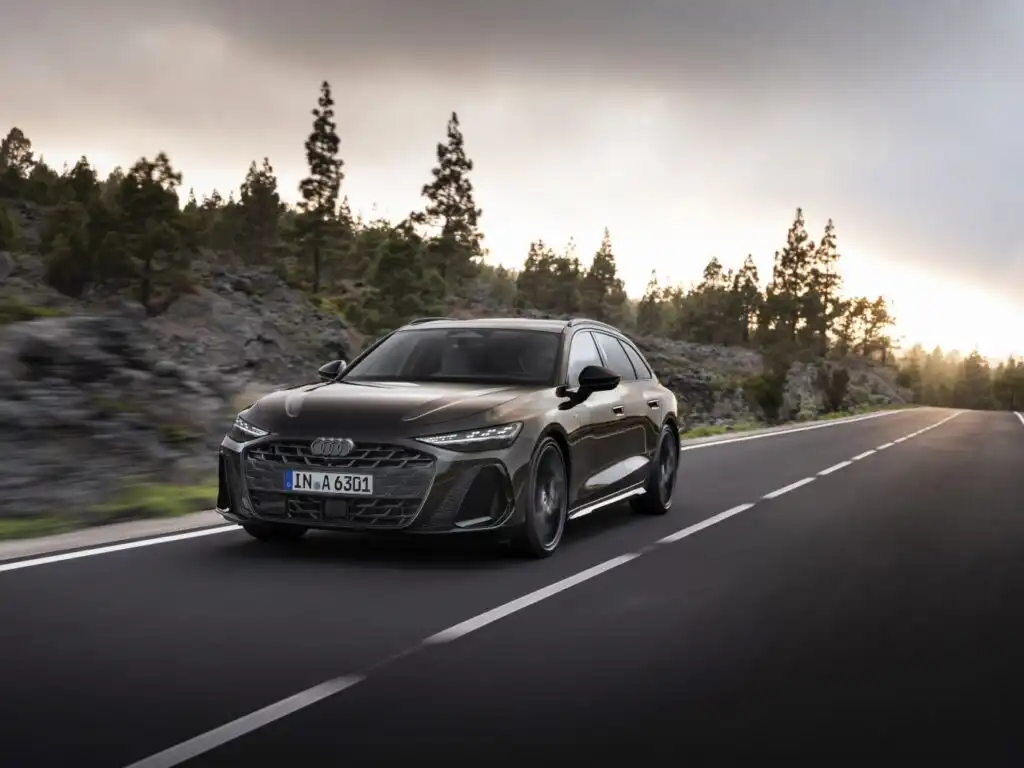
The Audi A6 Avant (C9) 2.0 TFSI S tronic, launched in March 2025, represents the latest iteration of Audi’s popular executive wagon. Positioned as a mid-range offering within the C9 A6 Avant lineup, this variant combines a turbocharged four-cylinder engine with Audi’s renowned S tronic dual-clutch transmission. It builds upon the foundation of the A6 family, known for its blend of luxury, technology, and driving dynamics, while offering a balance between performance and efficiency. The C9 generation A6 Avant continues Audi’s tradition of providing a practical and sophisticated vehicle for discerning buyers, particularly in European markets where wagons remain highly sought after.
Technical Specifications
| Brand | Audi |
| Model | A6 |
| Generation | A6 Avant (C9) |
| Type (Engine) | 2.0 TFSI (204 Hp) S tronic |
| Start of production | March, 2025 |
| Powertrain Architecture | Internal Combustion engine |
| Body type | Station wagon (estate) |
| Seats | 5 |
| Doors | 5 |
| Fuel consumption at Low speed (WLTP) | 10.6 l/100 km (22.2 US mpg, 26.6 UK mpg, 9.4 km/l) |
| Fuel consumption at Medium speed (WLTP) | 7.5 l/100 km (31.4 US mpg, 37.7 UK mpg, 13.3 km/l) |
| Fuel consumption at high speed (WLTP) | 6.1 l/100 km (38.6 US mpg, 46.3 UK mpg, 16.4 km/l) |
| Fuel consumption at very high speed (WLTP) | 6.7 l/100 km (35.1 US mpg, 42.2 UK mpg, 14.9 km/l) |
| Combined fuel consumption (WLTP) | 7.1-8 l/100 km (33.1 – 29.4 US mpg, 39.8 – 35.3 UK mpg, 14.1 – 12.5 km/l) |
| CO2 emissions (WLTP) | 161-181 g/km |
| Fuel Type | Petrol (Gasoline) |
| Acceleration 0 – 100 km/h | 8.3 sec |
| Acceleration 0 – 62 mph | 8.3 sec |
| Acceleration 0 – 60 mph | 7.9 sec |
| Maximum speed | 240 km/h (149.13 mph) |
| Emission standard | Euro 6e |
| Weight-to-power ratio | 8.8 kg/Hp, 114 Hp/tonne |
| Weight-to-torque ratio | 5.3 kg/Nm, 189.9 Nm/tonne |
| Power | 204 Hp @ 4300-6000 rpm |
| Power per litre | 102.8 Hp/l |
| Torque | 340 Nm @ 2000-4000 rpm (250.77 lb.-ft. @ 2000-4000 rpm) |
| Engine layout | Front, Longitudinal |
| Engine displacement | 1984 cm3 (121.07 cu. in.) |
| Number of cylinders | 4 |
| Engine configuration | Inline |
| Cylinder Bore | 82.5 mm (3.25 in.) |
| Piston Stroke | 92.8 mm (3.65 in.) |
| Compression ratio | 12.5:1 |
| Number of valves per cylinder | 4 |
| Fuel injection system | Direct injection |
| Engine aspiration | Turbocharger, Intercooler |
| Valvetrain | DOHC |
| Engine oil capacity | 6 l (6.34 US qt | 5.28 UK qt) |
| Coolant | 12.5 l (13.21 US qt | 11 UK qt) |
| Engine systems | Start & Stop System, Particulate filter |
| Kerb Weight | 1790 kg (3946.27 lbs.) |
| Max. weight | 2415 kg (5324.16 lbs.) |
| Max load | 625 kg (1377.89 lbs.) |
| Trunk (boot) space – minimum | 503 l (17.76 cu. ft.) |
| Trunk (boot) space – maximum | 1534 l (54.17 cu. ft.) |
| Fuel tank capacity | 61 l (16.11 US gal | 13.42 UK gal) |
| Max. roof load | 100 kg (220.46 lbs.) |
| Permitted trailer load with brakes (8%) | 1800 kg (3968.32 lbs.) |
| Permitted trailer load with brakes (12%) | 1800 kg (3968.32 lbs.) |
| Permitted trailer load without brakes | 750 kg (1653.47 lbs.) |
| Permitted towbar download | 95 kg (209.44 lbs.) |
| Length | 4999 mm (196.81 in.) |
| Width | 1875 mm (73.82 in.) |
| Width including mirrors | 2099 mm (82.64 in.) |
| Height | 1472 mm (57.95 in.) |
| Wheelbase | 2923 mm (115.08 in.) |
| Front track | 1626-1631 mm (64.02 – 64.21 in.) |
| Rear (Back) track | 1610-1616 mm (63.39 – 63.62 in.) |
| Front overhang | 938 mm (36.93 in.) |
| Rear overhang | 1138 mm (44.8 in.) |
| Drag coefficient (Cd) | 0.26 |
| Minimum turning circle (turning diameter) | 12.3 m (40.35 ft.) |
| Approach angle | 14.1° |
| Departure angle | 16.9° |
| Drivetrain Architecture | The Internal combustion engine (ICE) drives the front wheels of the vehicle. |
| Drive wheel | Front wheel drive |
| Number of gears and type of gearbox | 7 gears, automatic transmission S tronic |
| Front suspension | Coil spring, Independent multi-link suspension, Transverse stabilizer, Air Suspension – Optional |
| Rear suspension | Independent multi-link spring suspension with stabilizer, Air Suspension – Optional |
| Front brakes | Ventilated discs, 338 mm |
| Rear brakes | Ventilated discs, 330 mm |
| Assisting systems | ABS (Anti-lock braking system) |
| Steering type | Steering rack and pinion |
| Power steering | Electric Steering |
| Tires size | 225/60 R17; 225/55 R18; 245/45 R19; 255/40 R20; 255/35 R21 |
| Wheel rims size | 7.5J x 17; 8J x 18; 8.5J x 19; 8.5J x 20; 8.5J x 21 |
Powertrain & Engine Architecture
At the heart of the A6 Avant (C9) 2.0 TFSI S tronic lies the EA888 2.0-liter turbocharged four-cylinder engine. This engine, often identified by internal codes such as DZG or similar depending on specific market calibration, is a staple in the Volkswagen Group’s powertrain lineup. It features direct fuel injection, a single turbocharger with an intercooler, and a dual overhead camshaft (DOHC) valvetrain. The engine produces 204 horsepower between 4300 and 6000 rpm, and 340 Nm (250.77 lb.-ft.) of torque from 2000 to 4000 rpm. The S tronic 7-speed dual-clutch transmission provides rapid and smooth gear changes, contributing to both performance and efficiency. This transmission allows for both fully automatic operation and manual gear selection via steering wheel-mounted paddles.
Driving Characteristics
The 2.0 TFSI S tronic powertrain delivers a refined and capable driving experience. While not as overtly sporty as higher-output A6 Avant variants, the 204 hp engine provides ample power for everyday driving and highway cruising. Acceleration from 0 to 60 mph takes approximately 7.9 seconds. The S tronic transmission’s quick shifts and well-chosen gear ratios ensure responsive acceleration. The engine’s torque curve provides good mid-range punch, making overtaking maneuvers relatively effortless. Compared to a manual transmission equipped A6 Avant, the S tronic offers greater convenience and ease of use, particularly in urban environments. However, some driving enthusiasts may prefer the more engaging feel of a manual gearbox.
Equipment & Trim Levels
The A6 Avant 2.0 TFSI S tronic typically comes well-equipped as standard. Features commonly include Audi’s MMI touch response infotainment system with a dual-screen setup, Audi virtual cockpit, leather upholstery, three-zone automatic climate control, and a suite of driver-assistance systems such as lane departure warning and automatic emergency braking. Optional extras often include a premium sound system, adaptive cruise control, a head-up display, and matrix LED headlights. Trim levels may vary by market, but generally, this variant sits in the middle of the A6 Avant range, offering a good balance of features and price.
Chassis & Braking
The A6 Avant (C9) utilizes a sophisticated chassis design featuring independent suspension all around. The front suspension employs a multi-link setup with coil springs, while the rear also uses a multi-link configuration. Optional air suspension is available, providing adjustable ride height and enhanced comfort. Braking duties are handled by ventilated disc brakes on all four wheels, measuring 338mm at the front and 330mm at the rear. The standard fitment of ABS (Anti-lock Braking System) and electronic stability control ensures confident braking performance in various conditions.
Market Reception & Comparison
The Audi A6 Avant 2.0 TFSI S tronic has been generally well-received by automotive critics. It’s praised for its comfortable ride, refined interior, and efficient powertrain. Fuel economy figures, averaging between 33.1 and 29.4 US mpg combined, are competitive within its segment. Compared to the more powerful A6 Avant 45 TFSI quattro, the 2.0 TFSI offers a more affordable entry point, albeit with slightly less performance. Against rivals like the BMW 5 Series Touring and Mercedes-Benz E-Class Estate, the A6 Avant 2.0 TFSI S tronic holds its own with its blend of luxury, technology, and practicality.
Legacy
The EA888 2.0 TFSI engine, in various iterations, has proven to be a reliable and durable powertrain. While early versions of this engine experienced some issues with carbon buildup, later revisions have addressed these concerns. The S tronic transmission is also generally considered to be a robust unit, provided it receives regular maintenance. In the used car market, the A6 Avant 2.0 TFSI S tronic is expected to hold its value reasonably well, appealing to buyers seeking a premium wagon with a good balance of performance, efficiency, and features. Its continued popularity demonstrates Audi’s success in creating a versatile and desirable vehicle for a wide range of drivers.